The Developer Equalizer: AI Closes Web3's Skill Gap
AI-powered development tools are compressing the Web3 learning curve from years to months, giving junior developers access to leverage that once belonged exclusively to senior engineers.
Subscribe to our newsletter to get the latest updates and offers
* Will send you weekly updates on new features, tips, and developer resources.
The Skill Gap That Defined a Generation of Web3 Development
TL;DR:
- The global AI skills gap represents a $5.5 trillion economic problem, with Web3 engineering sitting at the sharpest edge of that shortage
- AI-augmented development tools are compressing the learning curve for Solidity, EVM architecture, and DeFi protocol patterns from years to months
- Junior developers using AI-assisted IDEs are shipping production-quality smart contracts at rates that previously required 3 to 5 years of on-chain experience
- The convergence of AI and Web3 is creating a new class of hybrid engineer, one who can navigate cryptographic primitives, tokenomics design, and machine learning pipelines simultaneously
- Boris Cherny, an AI-native engineer, ships 20 to 30 pull requests per day compared to the traditional 3 per week, a productivity differential that compounds across entire teams
- AI tools are not replacing senior Web3 engineers, they are redistributing the leverage that senior engineers once held exclusively, making that leverage accessible to developers at every experience level
- The equalization effect carries real risks: comprehension gaps widen when developers ship code they do not fully understand, and in smart contract environments, those gaps become permanent financial liabilities
The result: AI tools are not just accelerating Web3 development, they are restructuring who gets to participate in it.
The Talent Bottleneck Nobody Quantified
For most of Web3's short history, the supply of qualified engineers has been the binding constraint on the industry's growth. Not capital, not user demand, not regulatory clarity. Engineers. Specifically, engineers who understood the full stack of concerns that production-grade blockchain development requires: EVM internals, Solidity's quirks around storage layout and gas optimization, the security patterns that separate auditable code from exploitable code, and the protocol-level mechanics of how transactions actually get finalized on a live network. That combination of knowledge took years to accumulate, and the pipeline producing developers with that profile was narrow by any measure.
The numbers behind this shortage are not abstract. The broader AI skills gap, which overlaps significantly with the Web3 talent shortage given how intertwined these domains have become, represents an estimated $5.5 trillion in unrealized economic value. That figure comes from analysis of workforce productivity losses attributable to the mismatch between the skills organizations need and the skills available in the labor market. In Web3 specifically, the gap manifested as a small cohort of senior engineers commanding compensation packages that reflected their scarcity, while teams at early-stage protocols struggled to find anyone capable of writing a reentrancy-safe contract without months of onboarding. The result was a two-tier industry: well-funded teams with experienced engineers who could ship safely, and everyone else.
What made this gap particularly stubborn was the nature of the knowledge required. Web3 engineering is not a single discipline. It sits at the intersection of distributed systems, cryptography, game theory, financial engineering, and software security. A developer coming from a traditional web background could learn JavaScript in weeks and be productive in months. Learning to write production Solidity, understand the attack surface of a DeFi protocol, and reason about the economic incentives that might motivate an exploit was a fundamentally different kind of education. It required exposure to real codebases, real audits, and often real incidents. That kind of knowledge does not transfer easily through documentation or tutorials.
What the Gap Actually Looks Like in Practice
The practical consequence of this talent shortage showed up in predictable ways. Protocols launched with codebases that had never been reviewed by anyone with deep security expertise. Teams shipped features under competitive pressure without fully understanding the invariants their contracts were supposed to maintain. Junior developers, eager to contribute, wrote code that passed tests but contained subtle vulnerabilities that only became visible under adversarial conditions. The industry's incident history is, in large part, a record of what happens when the demand for shipping outpaces the supply of people who know what they are doing.
This is not a criticism of the developers involved. The knowledge required to avoid these mistakes was genuinely hard to acquire, and the tooling available to help developers catch their own errors was limited. Static analysis tools like Slither could flag certain vulnerability classes, but they required configuration expertise and produced enough false positives to be noisy in practice. Formal verification was available but demanded a level of mathematical sophistication that most development teams did not have. The gap between what a developer needed to know to ship safely and what they actually knew was real, and the tools available to bridge it were insufficient.
The hiring market reflected this reality. Senior Solidity engineers with audit experience were, and in many contexts still are, among the most sought-after technical profiles in the industry. Protocols competed aggressively for a small pool of people who had accumulated the right combination of experience. That competition drove compensation to levels that made Web3 development inaccessible to smaller teams and independent builders, concentrating the best engineering talent at well-capitalized projects and leaving the long tail of the ecosystem underserved.
How AI Tools Are Compressing the Learning Curve
The shift that AI-assisted development tools have introduced is not primarily about writing code faster. It is about making the knowledge embedded in that code accessible to developers who have not yet accumulated years of domain-specific experience. When a developer working in an AI-native IDE writes a function that handles token transfers, the tool can surface relevant context: the ERC-20 standard's edge cases, the reentrancy patterns that have caused losses in similar contracts, the gas optimization approaches that experienced engineers would apply instinctively. That context, delivered at the moment of writing, compresses what would otherwise be a multi-year learning process into something that happens in the flow of actual work.
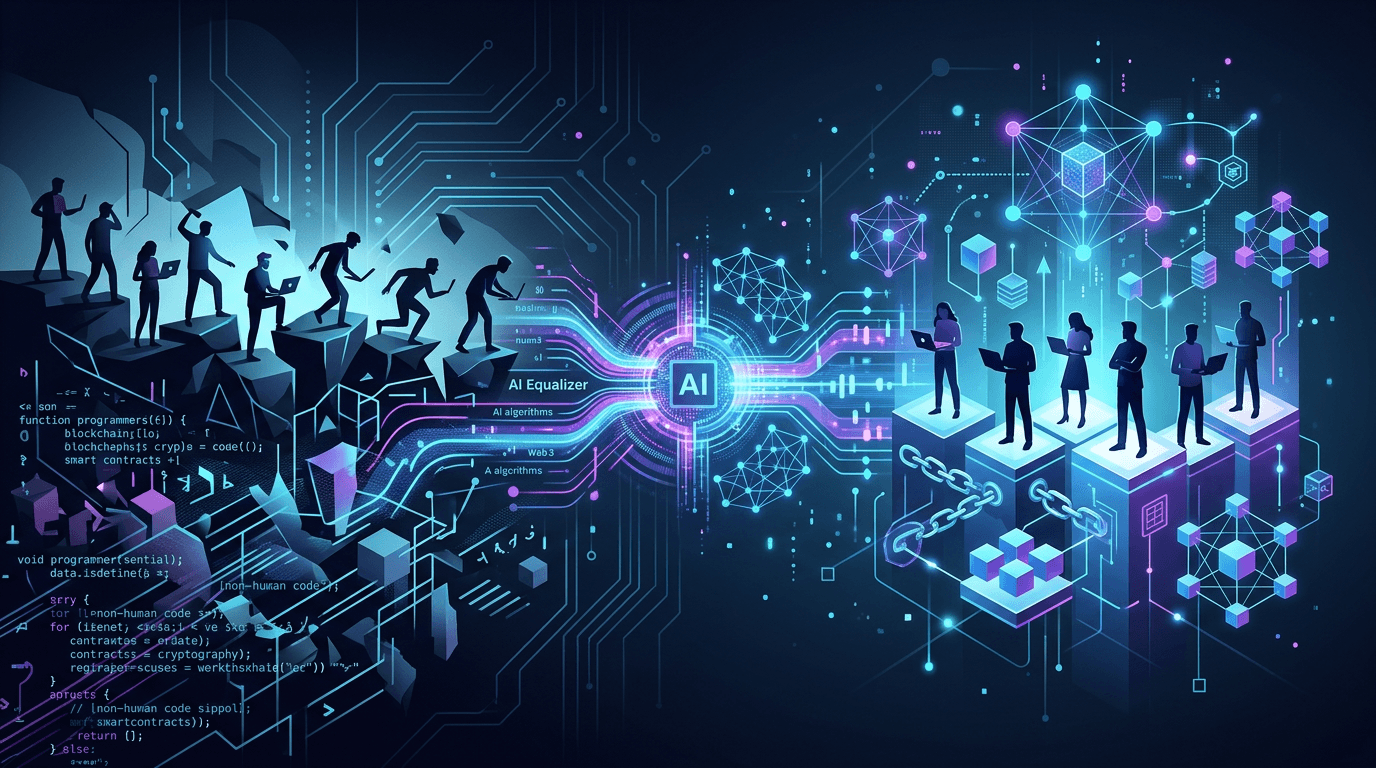
This is the mechanism behind what Nvidia's Jensen Huang described when he called AI the greatest technology equalizer. The claim is not that AI makes everyone equally skilled. It is that AI redistributes access to the leverage that skill provides. A developer with two years of experience, working with a well-designed AI assistant, can now operate with a level of contextual awareness that previously required five or more years of accumulated exposure. The gap does not disappear, but it narrows in ways that have real consequences for who can contribute meaningfully to production systems.
The productivity numbers that have emerged from AI-native development workflows support this framing. Boris Cherny, an engineer working in an AI-augmented environment, ships 20 to 30 pull requests per day. A traditional engineer working without AI assistance ships roughly 3 per week. That is not a marginal improvement. It is a structural change in what a single developer can accomplish, and it has downstream effects on team composition, hiring strategy, and the economics of building in Web3. When one developer can do the work of ten, the scarcity of senior engineers becomes a less binding constraint on what a team can ship.
The Junior Developer Who Ships Like a Senior
The most concrete expression of the equalizer effect is what happens to junior developers when they work inside AI-native tooling. The traditional model of junior developer productivity assumed a long ramp-up period during which the developer was net-negative in terms of output, requiring more review time from senior engineers than they contributed in working code. That ramp-up existed because the junior developer needed to internalize a large body of implicit knowledge before their contributions could be trusted. In Web3, that ramp-up was longer than in most domains, for the reasons already described.
AI-assisted development changes the economics of that ramp-up in a specific way. The implicit knowledge that senior engineers carry, the patterns they recognize, the mistakes they avoid instinctively, the security considerations they apply without thinking, can now be surfaced explicitly at the point of code generation. A junior developer writing a staking contract does not need to have personally reviewed a dozen staking contract audits to benefit from the patterns those audits revealed. The AI assistant can surface those patterns in context, flag the specific lines where the risk is concentrated, and suggest the implementation approach that experienced engineers would choose. The junior developer still needs to understand what they are building, but the knowledge required to build it safely is no longer locked behind years of personal experience.
This shift is not hypothetical. Teams that have adopted AI-native development workflows report meaningful changes in how quickly new developers become productive contributors. The onboarding process that once took six months to produce a developer capable of writing reviewable Solidity is compressing toward weeks in environments where the tooling is well-configured and the developer is engaged with the feedback the tools provide. That compression has direct implications for the talent bottleneck that has constrained Web3 development for years.
Smart Contract Development: Where the Gap Was Widest
If there is one area of Web3 engineering where the skill gap was most consequential, it is smart contract development. The combination of irreversibility, financial stakes, and adversarial conditions that characterizes production smart contract environments created a context where the cost of inexperience was uniquely high. A bug in a web application can be patched. A bug in a deployed smart contract is permanent, and if it is exploitable, the losses are immediate and unrecoverable. That asymmetry meant that the knowledge required to write safe contracts was not just professionally valuable, it was a prerequisite for participating in the ecosystem without causing harm.
AI tools are changing the accessibility of that knowledge in ways that matter for the industry's overall security posture. When a developer writes a function that modifies contract state before making an external call, an AI assistant with appropriate context can flag the reentrancy risk immediately, explain why the check-effects-interactions pattern exists, and suggest the corrected implementation. That intervention does not require the developer to have previously encountered a reentrancy exploit. It requires only that they are working in an environment where the tool has been trained on the relevant security literature and is configured to surface that knowledge at the right moment.
The same dynamic applies to gas optimization, access control patterns, upgrade proxy architectures, and the dozens of other areas where experienced Solidity engineers carry knowledge that junior developers lack. AI tools do not make all of these concerns trivially easy to handle, but they make the knowledge required to handle them correctly far more accessible than it was when that knowledge lived exclusively in the heads of a small number of experienced engineers and in the pages of audit reports that most developers never read.
Security Knowledge as a Leveled Playing Field
Security has historically been the most unequal dimension of Web3 engineering. The knowledge required to reason about the attack surface of a DeFi protocol was concentrated in a small community of auditors and security researchers who had spent years studying exploits, reading vulnerability disclosures, and developing intuitions about where protocols were likely to fail. That community was valuable precisely because of its scarcity, and the audit process was the primary mechanism through which their knowledge was applied to production code. For teams that could afford audits, this worked reasonably well. For teams that could not, it left significant gaps.
AI tools are beginning to democratize access to security knowledge in ways that complement rather than replace the audit process. Static analysis tools augmented with AI can surface vulnerability patterns that previously required expert review to identify. AI assistants trained on audit reports and vulnerability databases can flag risky patterns in real time, before code reaches the audit stage. This does not eliminate the need for professional security review, but it raises the baseline quality of code that reaches that review, which makes the audit process more efficient and reduces the surface area that auditors need to cover.
The Nethermind security team has documented how AI is reshaping the audit workflow itself, with AI-assisted analysis accelerating the identification of known vulnerability classes and freeing human auditors to focus on the novel, protocol-specific risks that require genuine expertise to evaluate. That division of labor, AI handling the pattern-matching work and humans handling the reasoning work, is a reasonable model for how security knowledge gets distributed more broadly across the ecosystem without sacrificing the depth that production-grade security requires.
The Hybrid Engineer Emerging at the Intersection
The convergence of AI and Web3 is not just changing how existing developers work. It is creating a new kind of developer who did not exist five years ago. The AI-Web3 hybrid engineer is someone who can reason about smart contract security, design tokenomics systems, integrate on-chain data with machine learning pipelines, and build the infrastructure that connects decentralized protocols to AI-powered applications. This profile is emerging as one of the most sought-after in the technology industry, and it is a profile that AI tools are making more accessible to developers who might previously have had to choose between the two domains.
The career paths available to developers who can navigate both AI and Web3 are expanding rapidly. Roles like on-chain AI agent developer, decentralized data pipeline engineer, and AI-augmented protocol designer are appearing in job postings at protocols that are building at the intersection of these two technology waves. These roles require a combination of skills that no single educational program currently produces systematically, which means the developers who fill them are largely self-taught, and the AI tools they use to learn are a significant part of how they acquire the necessary knowledge.
This hybrid profile also reflects a broader shift in how the industry thinks about developer specialization. The traditional model of Web3 development assumed relatively clean boundaries between smart contract engineers, frontend developers, and infrastructure engineers. Those boundaries are dissolving as AI tools make it easier for developers to operate across multiple layers of the stack. A developer who can write Solidity, understand the security implications of their design choices, and integrate their contracts with AI-powered monitoring systems is more valuable than one who can only do any single one of those things, and AI tools are making that combination of capabilities achievable for a wider range of developers.
The $5.5 Trillion Argument for Closing the Gap
The economic case for closing the Web3 skill gap is not just about the industry's internal dynamics. It connects to a much larger argument about what AI-augmented workforce development means for the global economy. The $5.5 trillion figure associated with the AI skills gap represents the economic value that is currently locked up in unfilled roles, underutilized talent, and productivity losses attributable to the mismatch between available skills and organizational needs. AI tools that close that gap, even partially, unlock a significant portion of that value.
For Web3 specifically, the economic argument is even more direct. The protocols, applications, and infrastructure that the industry is trying to build require a volume of engineering talent that the current pipeline cannot supply. Every month that a protocol cannot hire the engineers it needs is a month of delayed development, delayed user acquisition, and delayed value creation. AI tools that allow smaller teams to ship more, and less experienced developers to contribute more effectively, directly address that constraint. The productivity differential between AI-native and traditional development workflows, which the data from engineers like Boris Cherny suggests is roughly an order of magnitude, means that a team of five AI-native developers can potentially match the output of a team of fifty working in traditional ways.
That arithmetic has implications for how Web3 organizations think about hiring, team structure, and the economics of building. It also has implications for the geographic and demographic distribution of who gets to participate in building the next generation of financial infrastructure. AI tools that lower the barrier to effective Web3 development make it possible for developers in markets that have historically been underrepresented in the industry to contribute meaningfully, which expands the talent pool in ways that benefit the entire ecosystem.
The Limits of Equalization
The equalizer effect is real, but it is not unlimited, and understanding its limits is as important as understanding its potential. AI tools compress the learning curve for knowledge that can be encoded in patterns, examples, and rules. They are less effective at developing the kind of judgment that comes from having personally navigated ambiguous situations, made difficult tradeoffs under pressure, and lived with the consequences of those decisions. Senior engineers carry that kind of judgment, and it is not something that AI tools currently transfer.
In smart contract development, this distinction matters in specific ways. AI tools can help a developer avoid known vulnerability patterns. They are less reliable at helping a developer reason about novel attack vectors that have not yet appeared in the training data, or about the economic incentives that might motivate a sophisticated attacker to probe a specific protocol design. That kind of reasoning requires a depth of understanding that AI tools can support but cannot substitute for. The developers who will be most effective in AI-augmented environments are those who use the tools to handle the pattern-matching work while continuing to develop their own capacity for deeper reasoning.
There is also a risk that the equalizer effect creates a false sense of competence. A junior developer who ships code that passes AI-assisted review may develop confidence in their abilities that is not fully warranted, particularly in the areas where AI tools are least reliable. Managing that risk requires teams to maintain rigorous review processes even as they adopt AI-assisted workflows, and to invest in the kind of mentorship and knowledge transfer that helps developers understand not just what the AI is suggesting but why. The goal is not to replace the learning process with AI assistance, but to accelerate it.
What Equalization Means for Web3 Teams
The practical implications of the equalizer effect for Web3 teams are significant and worth thinking through carefully. Teams that adopt AI-native development workflows gain access to a larger pool of potentially productive contributors, because the threshold of experience required to contribute meaningfully is lower. That changes the economics of hiring, the structure of onboarding programs, and the way senior engineers spend their time. Instead of spending the majority of their review bandwidth on catching basic mistakes, senior engineers can focus on the architectural decisions, security reasoning, and protocol design work that genuinely requires their depth of experience.
This shift also changes what it means to build a high-performing Web3 engineering team. The traditional model optimized for hiring the most experienced engineers available, because experience was the primary determinant of output quality. The AI-augmented model optimizes for a different combination of qualities: the ability to work effectively with AI tools, the judgment to evaluate AI-generated suggestions critically, and the intellectual curiosity to continue developing deeper understanding even when the tools make it possible to ship without it. Those qualities are distributed differently across the developer population than raw experience, which means the talent pool for high-performing Web3 teams is genuinely larger than it was.
For teams that are currently constrained by the talent shortage, the message is practical: investing in AI-native tooling and the workflows that support it is not just a productivity play, it is a talent strategy. It allows teams to extract more value from the developers they have, to onboard new developers more quickly, and to compete for talent on dimensions other than the ability to pay senior engineer compensation packages. That is a meaningful advantage in an industry where the competition for experienced engineers has historically been intense.
Building With Cheetah AI at the Frontier
The equalizer effect described throughout this piece is not a future possibility. It is happening now, in the workflows of teams that have adopted AI-native development environments designed specifically for the demands of Web3 engineering. Cheetah AI was built with this context in mind, as a crypto-native IDE that understands the specific knowledge requirements of smart contract development and is designed to surface that knowledge at the moment developers need it.
For developers who are earlier in their Web3 journey, Cheetah AI provides the kind of contextual assistance that compresses the learning curve in meaningful ways, flagging security patterns, surfacing relevant protocol context, and helping developers understand not just what to write but why the correct implementation looks the way it does. For senior engineers, it handles the pattern-matching work that consumes review bandwidth, freeing them to focus on the reasoning and judgment that their experience uniquely equips them to provide. The result is a development environment where the gap between what a developer knows and what they need to know to ship safely is smaller, and where the knowledge required to build production-grade Web3 applications is more accessible than it has ever been. If you are building in Web3 and have not yet explored what an AI-native IDE designed for this domain can do for your workflow, Cheetah AI is worth a serious look.
Related Posts

Cheetah Architecture: Building Intelligent Code Search
Building Intelligent Code Search: A Hybrid Approach to Speed and Relevance TL;DR: We built a hybrid code search system that:Runs initial text search locally for instant response

Reasoning Agents: Rewriting Smart Contract Development
TL;DR:Codex CLI operates as a multi-surface coding agent with OS-level sandboxing, 1M context windows via GPT-5.4, and the ability to read, patch, and execute against live codebases, making

The New Bottleneck: AI Shifts Code Review
TL;DR:AI coding assistants now account for roughly 42% of all committed code, a figure projected to reach 65% by 2027, yet teams using these tools are delivering software slower and less rel