DevOps Maturity Gap: Secure Pipelines for Web3 Teams
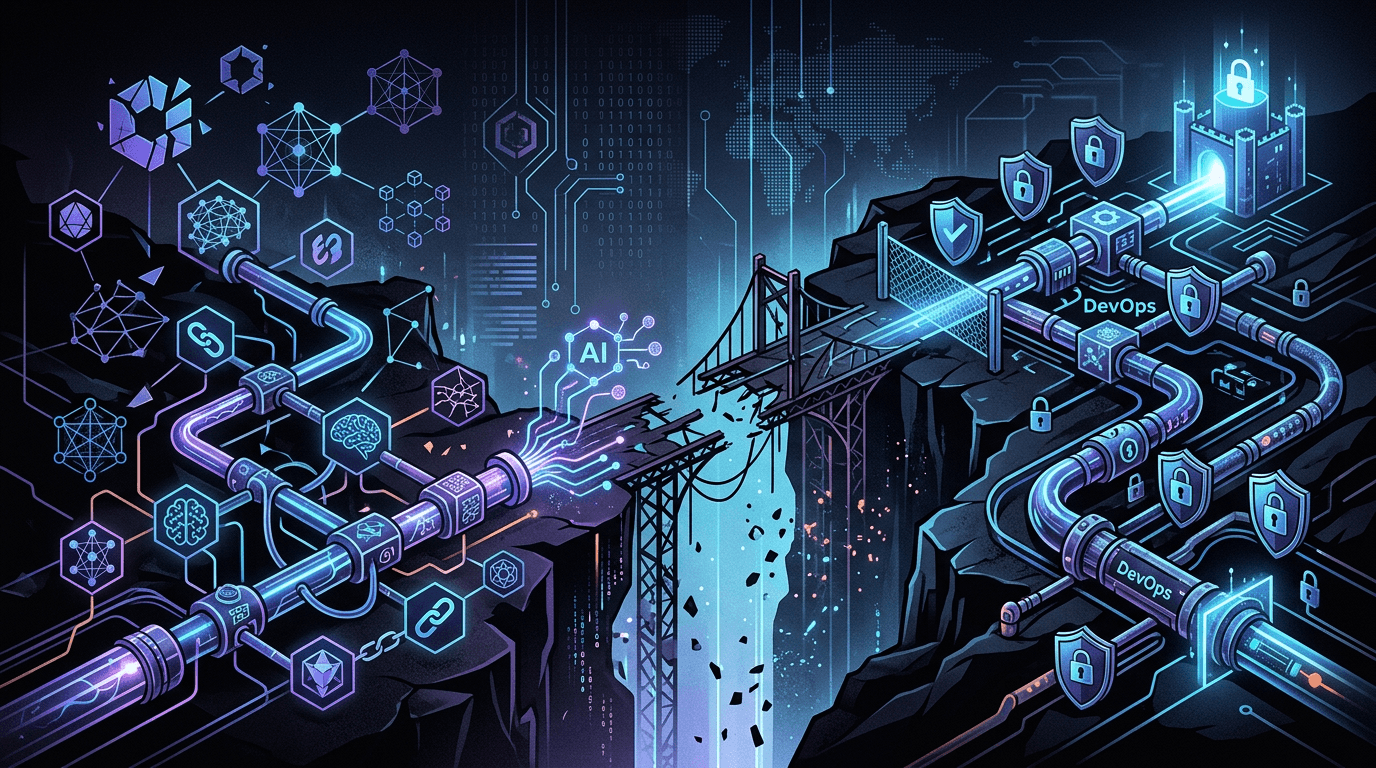
Most Web3 teams are shipping AI-generated code through pipelines that were never designed to handle it. Here is what a mature, secure deployment pipeline actually looks like.
Subscribe to our newsletter to get the latest updates and offers
* Will send you weekly updates on new features, tips, and developer resources.
The Maturity Gap That AI-Heavy Web3 Teams Cannot Afford
TL;DR:
- Most Web3 teams operate at DevOps maturity level 1 or 2, meaning manual deployments, inconsistent environments, and no automated security gates, while simultaneously shipping AI-generated Solidity code at accelerating velocity
- Veracode's 2025 GenAI Code Security Report found that AI models chose insecure coding patterns in 45% of cases across more than 100 LLMs tested, a number that compounds when those models are integrated into pipelines without static analysis gates
- Smart contract deployments are irreversible, meaning a vulnerability that slips through a weak pipeline is not a bug to patch in the next sprint, it is a permanent liability on a public ledger
- Tools like Foundry, Hardhat, Slither, and Echidna exist specifically to address the testing and analysis gaps in Web3 pipelines, but fewer than 30% of teams use them in automated CI/CD workflows
- Supply chain attacks on Web3 projects increased by over 200% between 2023 and 2025, with compromised npm packages and malicious dependencies accounting for a growing share of protocol exploits
- DevSecOps in Web3 means embedding security at every stage of the pipeline, from environment standardization through static analysis, fuzz testing, and on-chain monitoring, not treating it as a final audit before mainnet
- AI-native IDEs and tooling can close the comprehension gap between code generation velocity and developer understanding, but only if the pipeline is mature enough to surface what the AI produced
The result: the DevOps maturity gap in Web3 is not a process problem, it is a security problem, and closing it requires treating the deployment pipeline as a first-class engineering concern.
Why Web3 DevOps Is Structurally Different
The deployment model for Web3 applications breaks several assumptions that traditional DevOps practices were built around. In a conventional software stack, a bad deployment can be rolled back. A misconfigured service can be patched. A vulnerable dependency can be updated and redeployed within hours. None of those escape hatches exist when the artifact being deployed is a smart contract on a public blockchain. Once a contract is deployed to Ethereum mainnet, Arbitrum, or any other production chain, the bytecode is immutable. The only remediation path is a migration to a new contract address, which requires coordinating user migrations, updating integrations, and in many cases, accepting that some portion of locked funds may be permanently at risk during the transition window.
This irreversibility changes the calculus of every decision in the pipeline. A test suite that achieves 60% coverage might be acceptable for a web application where bugs can be hotfixed. For a DeFi protocol managing $50 million in liquidity, 60% coverage means 40% of the contract's behavior has never been formally verified. The Ronin Network bridge exploit in 2022, which resulted in $625 million in losses, was not caused by a novel cryptographic attack. It was caused by a validator key management failure that a mature DevOps process, specifically one with proper secret management and access control auditing, would have surfaced before deployment. The technical sophistication of the exploit was low. The process maturity required to prevent it was not.
Web3 teams also operate across a more complex dependency graph than most traditional software teams. A typical DeFi protocol depends on oracle contracts, external price feeds, bridge contracts, and third-party libraries, all of which are themselves deployed on-chain and outside the team's direct control. This means the supply chain attack surface is not just the team's own code and npm dependencies. It extends to every external contract the protocol interacts with. A 2024 analysis of Web3 supply chain incidents found that compromised upstream dependencies, including malicious npm packages targeting Hardhat and Truffle environments, accounted for a growing share of protocol-level exploits. Managing that surface requires a pipeline that treats dependency verification as a first-class concern, not an afterthought.
The AI Multiplier: More Code, More Risk
The adoption of AI coding assistants across Web3 development teams has accelerated significantly over the past two years. Tools like GitHub Copilot, Cursor, and purpose-built Web3 IDEs are now part of the daily workflow for a large share of Solidity developers. The productivity gains are real. Developers using AI assistance report completing boilerplate contract code, writing test scaffolding, and generating deployment scripts in a fraction of the time it would take manually. But velocity without comprehension is a liability in any software context, and in Web3, where the output is irreversible, it is a particularly dangerous combination.
Veracode's 2025 GenAI Code Security Report tested more than 100 large language models on 80 curated coding tasks and found that AI models chose insecure coding patterns in 45% of cases. That number is not a criticism of the models themselves. It reflects a structural reality: language models are trained to produce code that looks correct and compiles cleanly, not code that is secure against adversarial conditions. Reentrancy vulnerabilities, unchecked return values, and improper access control patterns are all syntactically valid Solidity. A model optimizing for functional correctness will produce them without hesitation.
The compounding effect happens at the pipeline level. When AI-generated code flows into a deployment pipeline that lacks automated static analysis, the insecure patterns the model introduced are never surfaced. They pass through code review, which is increasingly cursory when reviewers assume the AI handled the hard parts, and they pass through manual testing, which tends to focus on happy-path behavior rather than adversarial edge cases. By the time the contract reaches a pre-deployment audit, the vulnerability has been in the codebase long enough that developers have built assumptions around it. Fixing it requires rearchitecting logic that other components depend on, which creates pressure to accept the risk and ship anyway. This is how comprehension debt becomes a deployment liability.
The teams most exposed to this dynamic are not the ones using AI carelessly. They are the ones using AI effectively for velocity while running pipelines that were designed for a pre-AI development pace. The pipeline was built when a developer wrote every line and understood most of what they wrote. It was not built for a workflow where a single prompt can generate 200 lines of contract logic in under a minute. Closing that gap requires rethinking the pipeline from the ground up, not bolting a linter onto an existing workflow and calling it DevSecOps.
Environment Standardization as a Security Primitive
One of the most underappreciated sources of production incidents in Web3 is environment drift. A developer runs a local Hardhat node with one version of a dependency. The CI environment runs a slightly different version. The staging deployment uses a different compiler optimization setting. None of these differences are intentional, and none of them are visible until something breaks in a way that cannot be reproduced locally. In traditional software, environment drift is an annoyance. In Web3, where the compiled bytecode is what gets deployed and the compiler version affects the output in non-trivial ways, it is a security concern.
The Solidity compiler itself is a meaningful variable. The difference between solc 0.8.17 and 0.8.20 includes changes to how certain overflow conditions are handled and how the optimizer processes specific patterns. A contract that behaves correctly under one compiler version may exhibit different behavior under another, and those differences are not always obvious from reading the source. Teams that do not pin their compiler version in a shared, enforced configuration file are effectively running a different experiment in every environment. The fix is straightforward: use a tool like Nix, Docker, or a devcontainer specification to define the exact toolchain, including the solc version, the Foundry release, and the Node.js version, and enforce that specification across every environment from local development through production deployment.
Standardized environments also matter for the AI tooling layer. When developers use AI assistants that generate code based on the current file context, the quality of that generation depends on the consistency of the surrounding codebase. An AI assistant operating in a fragmented environment, where import paths are inconsistent, where library versions differ between files, and where the project structure does not follow a clear convention, will produce lower-quality suggestions and is more likely to generate code that references APIs or patterns that do not match the actual dependency versions in use. Environment standardization is not just a DevOps hygiene concern. It is a prerequisite for getting reliable output from AI-assisted development workflows.
Building the CI/CD Pipeline for Solidity
A mature CI/CD pipeline for a Web3 project looks meaningfully different from a pipeline for a Node.js API or a React application. The artifact being produced is not a Docker image or a static bundle. It is compiled bytecode and an ABI, and the deployment of that artifact to a blockchain is a one-way operation with financial consequences. The pipeline needs to reflect that asymmetry at every stage.
The first stage is compilation and linting. Every push to a feature branch should trigger a clean compilation using the pinned toolchain, followed by a linting pass with solhint configured to enforce the team's style and safety rules. Solhint rules like no-unused-vars, avoid-call-value, and check-send-result catch a class of common mistakes that are easy to miss in code review and trivial to catch automatically. This stage should fail fast and fail loudly. A compilation error or a linting violation should block the branch from merging, not generate a warning that gets ignored.
The second stage is static analysis. Slither, developed by Trail of Bits, is the most widely used static analyzer for Solidity and can detect over 90 distinct vulnerability classes including reentrancy, integer overflow, and dangerous delegatecall patterns. Running Slither in CI takes under two minutes for most contract codebases and produces structured output that can be parsed and reported as pipeline annotations. Mythril provides complementary analysis using symbolic execution, which catches a different class of vulnerabilities than pattern-based static analysis. Running both tools in parallel and requiring clean output before a branch can merge is not a significant overhead. It is the minimum viable security gate for a team shipping AI-generated Solidity.
The third stage is unit and integration testing. Foundry's forge test runner is the current standard for Solidity testing, offering fast execution, built-in fuzzing, and a clean assertion syntax that makes test intent readable. A mature pipeline requires a minimum coverage threshold, typically 85% or higher for core protocol logic, enforced by forge coverage with a failure condition on the coverage report. Integration tests should run against a forked mainnet state using Foundry's fork testing capabilities, which allows the test suite to interact with real deployed contracts and real on-chain state rather than mocked approximations. This catches a class of integration failures that unit tests cannot surface, particularly around oracle behavior and external contract interactions.
Fuzz Testing as a First-Class Pipeline Stage
Fuzz testing occupies a specific and important role in the Web3 security pipeline that most teams underutilize. The core idea is straightforward: instead of writing test cases with specific inputs, you define invariants, properties that should always hold regardless of input, and let the fuzzer generate thousands of random inputs to try to violate them. For a lending protocol, an invariant might be that the total collateral value always exceeds the total borrowed value. For a token contract, it might be that the sum of all balances always equals the total supply. These invariants are the mathematical expression of the protocol's security guarantees, and a fuzzer that can violate them has found a real vulnerability.
Foundry includes a built-in fuzzer that runs automatically when test functions accept parameters rather than using fixed values. Echidna, developed by Trail of Bits, provides a more sophisticated property-based fuzzing framework with configurable corpus management and coverage-guided exploration. Running Echidna in CI against a defined set of protocol invariants is one of the highest-value security investments a Web3 team can make. The Euler Finance exploit in March 2023, which resulted in $197 million in losses, involved a vulnerability in the donation mechanism that a well-specified invariant test would have caught. The invariant, that a user's health factor cannot be reduced below 1 through a sequence of legitimate operations, was violated by a specific sequence of flash loan and donation calls that no human reviewer thought to test manually.
The challenge with fuzz testing in CI is execution time. A thorough Echidna campaign can run for hours, which is incompatible with a fast feedback loop on every commit. The practical solution is to run a short fuzzing campaign, typically 10,000 to 50,000 runs, on every pull request, and run a longer campaign, 1 million or more runs, on a nightly schedule against the main branch. This gives developers fast feedback on obvious invariant violations while ensuring that the longer-running campaign catches subtler issues before they accumulate. AI-assisted tooling can help here by generating initial invariant specifications from contract logic, reducing the time it takes to get meaningful fuzz coverage from days to hours.
Supply Chain Security in the Web3 Context
The software supply chain for a Web3 project has two distinct layers that require different security approaches. The first is the traditional dependency layer: npm packages, Foundry libraries, and any off-chain tooling used in the build and deployment process. The second is the on-chain dependency layer: external contracts that the protocol interacts with, including oracles, bridges, and shared libraries deployed by other teams.
For the traditional dependency layer, the standard practices apply with heightened urgency. Pinning dependency versions in package-lock.json and foundry.toml, running npm audit and similar tools in CI, and using a software bill of materials to track what is in the build are all necessary. The 2024 compromise of the Ledger Connect Kit, which injected a wallet drainer into a widely used frontend library, demonstrated that a single compromised npm package can affect dozens of protocols simultaneously. Teams that were pinning their dependency versions and verifying checksums in CI were able to detect and respond to the compromise faster than teams relying on floating version ranges.
For the on-chain dependency layer, the security model is fundamentally different. You cannot patch an external contract. You can only decide whether to continue interacting with it. This means the pipeline needs to include checks that verify the on-chain state of dependencies before deployment. Tools like Tenderly and Forta can monitor external contracts for unexpected upgrades or ownership changes, and those checks should be integrated into the pre-deployment stage of the pipeline. If an oracle contract that the protocol depends on has been upgraded since the last deployment, that change should surface as a pipeline warning that requires explicit acknowledgment before proceeding. This is not a common practice today, but it is the logical extension of supply chain security principles to the on-chain context.
Quality Gates and the Merge Criteria Problem
A quality gate is a defined set of conditions that must be satisfied before code can progress to the next stage of the pipeline. In a mature DevOps organization, quality gates are non-negotiable. They are not suggestions that developers can override when they are in a hurry. They are enforced by the pipeline infrastructure, and bypassing them requires an explicit exception process with documented justification. Most Web3 teams do not operate this way. They have CI pipelines that run tests and report results, but the merge decision is ultimately left to human judgment, which means it is subject to deadline pressure, social dynamics, and the cognitive load of reviewing AI-generated code that looks correct but may not be.
Defining effective quality gates for a Web3 project requires being specific about what each gate is measuring and what failure means. A coverage gate that requires 85% line coverage is measuring something, but line coverage does not capture whether the tests are actually asserting meaningful behavior. A gate that requires all Slither detectors at the high and medium severity level to pass is more meaningful, because it is tied to a specific class of known vulnerabilities. A gate that requires the fuzz campaign to run for at least 50,000 iterations without violating any defined invariants is more meaningful still, because it is testing the protocol's security properties directly.
The practical challenge is that quality gates create friction, and friction creates pressure to lower the bar. The solution is not to make the gates easier to pass. It is to make passing them faster. Parallelizing the static analysis and test stages, caching compilation artifacts, and using incremental analysis tools that only re-analyze changed files can reduce a full pipeline run from 20 minutes to under 5 minutes for most projects. When the pipeline is fast, developers stop looking for ways around it and start treating it as a useful feedback mechanism. That shift in attitude is what DevOps maturity actually looks like in practice.
On-Chain Monitoring and Incident Response
Deployment is not the end of the pipeline. For Web3 protocols, the post-deployment monitoring layer is as important as the pre-deployment security gates, because the threat model does not end when the contract goes live. Attackers actively monitor deployed contracts for exploitable conditions, and the window between a vulnerability being discovered and it being exploited is often measured in hours, not days. A team that deploys a contract and then relies on user reports to detect anomalous behavior is not operating a mature pipeline. It is operating a reactive incident response process that will always be slower than the attacker.
Forta is the most widely used on-chain monitoring platform for Web3 protocols, providing a network of detection bots that can be configured to alert on specific transaction patterns, unusual gas consumption, large unexpected transfers, and other indicators of exploit activity. Tenderly's alerting system provides similar capabilities with a more developer-friendly interface and tighter integration with the deployment workflow. A mature monitoring setup for a DeFi protocol should include alerts for large single-transaction value movements, unexpected calls to privileged functions, oracle price deviations beyond a defined threshold, and any interaction with known exploit contracts or mixer addresses.
The incident response process needs to be defined before deployment, not after an exploit is detected. This means having a documented runbook that specifies who gets paged when an alert fires, what the first response actions are, whether the protocol has a pause mechanism and who has the authority to invoke it, and how the team communicates with users during an active incident. Protocols that have survived exploits with minimal losses, like Compound's response to the COMP distribution bug in 2021, did so because they had a clear incident response process and the infrastructure to execute it quickly. The pipeline does not end at deployment. It extends through the entire operational lifecycle of the contract.
The Role of Standardized Development Environments
Beyond the CI/CD pipeline itself, the local development environment is where most of the decisions that affect pipeline outcomes are made. A developer writing a contract in an environment that lacks real-time feedback on security issues will produce code that requires more pipeline intervention to catch problems. A developer working in an environment that surfaces Slither warnings inline, suggests safer patterns when it detects risky ones, and provides immediate feedback on test coverage as code is written will produce code that arrives at the pipeline in better shape.
This is where the tooling layer intersects with the DevOps maturity question in a concrete way. Standardizing the local development environment means more than sharing a .devcontainer.json file. It means agreeing on which analysis tools run on save, which linting rules are enforced in the editor, and how AI-generated code suggestions are reviewed before being accepted. Teams that treat the local environment as a personal preference zone and only enforce standards at the CI layer are creating a situation where developers get their first meaningful security feedback after they have already committed and pushed. That feedback loop is too slow for a team shipping AI-generated code at velocity.
The most effective approach is to treat the local environment as the first stage of the pipeline. Every tool that runs in CI should also be available locally, configured identically, and easy to run with a single command. When a developer can run forge test, slither ., and echidna-test in under three minutes locally, they will run them before pushing. When running those tools requires navigating a complex setup process or waiting for a slow remote environment, they will not. The investment in local environment standardization pays dividends at every subsequent stage of the pipeline.
Measuring DevOps Maturity in Web3 Teams
DevOps maturity models provide a useful framework for assessing where a team is and what the next improvement looks like. The DORA metrics, deployment frequency, lead time for changes, change failure rate, and mean time to recovery, are the most widely used quantitative measures of DevOps performance. High-performing organizations, as defined by the 2024 DORA State of DevOps Report, deploy multiple times per day, have lead times under one hour, change failure rates below 5%, and mean time to recovery under one hour. Most Web3 teams are nowhere near these benchmarks, and the gap is not primarily a tooling problem. It is a process maturity problem.
For Web3 specifically, the DORA metrics need to be supplemented with security-specific measures. The percentage of deployments that pass all quality gates without manual override is a meaningful signal of pipeline discipline. The time from a vulnerability being reported to a patched contract being deployed is a measure of incident response maturity. The percentage of contract functions covered by invariant tests is a measure of security testing depth. Tracking these metrics over time gives teams a concrete picture of where they are improving and where they are stagnating, which is more useful than a qualitative assessment of whether the pipeline feels mature.
The teams that close the DevOps maturity gap fastest are not the ones that implement the most sophisticated tooling. They are the ones that establish clear baselines, define specific improvement targets, and treat the pipeline as a product that requires ongoing investment. A team that goes from zero automated security gates to running Slither and Foundry in CI has made a meaningful improvement, even if they are still far from a fully mature pipeline. The goal is not perfection on day one. It is consistent, measurable progress toward a pipeline that can be trusted to catch what AI-generated code introduces.
Cheetah AI and the Pipeline-Aware Development Workflow
The DevOps maturity gap in Web3 is ultimately a tooling and workflow problem, and it is one that purpose-built AI development environments are well positioned to address. The challenge with most current AI coding tools is that they optimize for generation velocity without integrating the feedback signals that a mature pipeline produces. They suggest code, the developer accepts it, and the pipeline catches the problems later. That feedback loop is too slow and too disconnected from the moment of decision.
Cheetah AI is built around the idea that the pipeline and the development environment should not be separate concerns. Security analysis, test coverage feedback, and invariant checking should be part of the development workflow, not a separate stage that runs after the code is written. When a developer is working on a lending protocol and the AI assistant suggests a withdrawal function, the environment should surface the relevant Slither detectors, show the current invariant coverage for the affected code paths, and flag any patterns that match known vulnerability classes, all before the code is committed. That is what it means to close the comprehension gap between AI generation velocity and developer understanding.
If your team is shipping AI-generated Solidity through a pipeline that was designed for a slower, more manual development pace, Cheetah AI is worth a close look. The goal is not to slow down the AI-assisted workflow. It is to make the pipeline mature enough to keep up with it.
The broader point is that DevOps maturity in Web3 is not a destination. It is a practice. The threat landscape evolves, the tooling improves, and the volume of AI-generated code in production codebases will only increase. Teams that treat the pipeline as a living system, one that gets reviewed, improved, and adapted as the codebase and the threat model change, will consistently outperform teams that set up a pipeline once and consider the problem solved. Cheetah AI is designed to be part of that ongoing practice, not a one-time setup. If you are building on-chain and taking security seriously, it is worth seeing what a pipeline-aware development environment actually feels like in practice.
Related Posts
Reasoning Agents: Rewriting Smart Contract Development
TL;DR:Codex CLI operates as a multi-surface coding agent with OS-level sandboxing, 1M context windows via GPT-5.4, and the ability to read, patch, and execute against live codebases, making

Web3 Game Economies: AI Dev Tools That Scale
TL;DR:On-chain gaming attracted significant capital throughout 2025, with the Blockchain Game Alliance's State of the Industry Report confirming a decisive shift from speculative token launc
Token Unlock Engineering: Build Safer Vesting Contracts
TL;DR:Vesting contracts control token release schedules for teams, investors, and ecosystems, often managing hundreds of millions in locked supply across multi-year unlock windows Time-lo