Full-Stack Web3: AI Dissolves the Specialization Wall
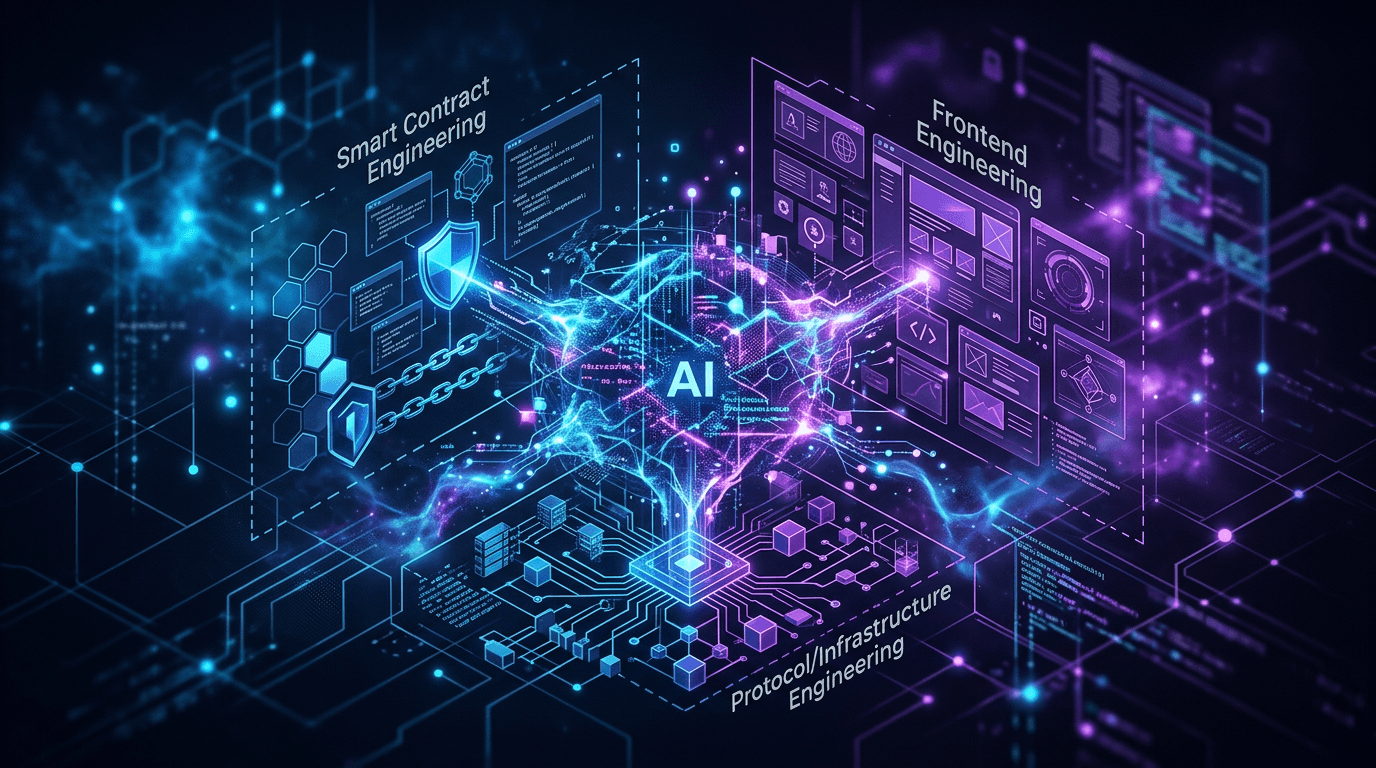
AI is collapsing the hard lines between smart contract, frontend, and protocol engineers on Web3 teams. Here is what that shift looks like in practice and why it changes everything about how decentralized applications get built.
Subscribe to our newsletter to get the latest updates and offers
* Will send you weekly updates on new features, tips, and developer resources.
The Walls Between Web3 Disciplines Are Coming Down
TL;DR:
- Web3 teams have historically organized around hard specialization lines, with smart contract engineers, frontend developers, and protocol architects rarely crossing into each other's domains
- AI-assisted development is collapsing those boundaries by giving each discipline enough context and capability to contribute meaningfully across the full stack
- Agentic development frameworks, where multiple specialized AI agents collaborate on a shared codebase, are accelerating this convergence by handling cross-domain coordination that previously required dedicated human specialists
- Ethereum smart contract deployments hit 8.7 million in Q4 2025, a volume that has outpaced traditional siloed team structures and made cross-functional fluency a practical necessity rather than a nice-to-have
- The shift is not eliminating specialization but redistributing it, with deep expertise remaining valuable while the cost of operating outside your primary domain drops significantly
- AI-powered IDEs purpose-built for Web3 are the infrastructure layer making this convergence practical rather than theoretical
The result: AI is not making Web3 engineers interchangeable, it is making the gaps between them navigable.
How Specialization Became a Structural Feature of Web3 Teams
The division of labor on Web3 teams did not happen by accident. It emerged from genuine technical complexity that made deep specialization the only rational response to the demands of production-grade development. Writing production Solidity requires a working mental model of the EVM's execution environment, gas accounting, storage layout, and the specific failure modes that come with immutable, value-bearing code. Protocol engineering, which involves designing the economic and cryptographic primitives that govern how a system behaves at scale, draws on a different set of skills entirely, closer to distributed systems research and mechanism design than to application development. Frontend work in Web3 adds another layer of complexity on top of standard React or Next.js development, requiring fluency with wallet connection libraries like wagmi and viem, an understanding of how to handle asynchronous transaction states, and the ability to surface on-chain data in ways that are both accurate and comprehensible to users who may not understand what a block confirmation means.
These are not superficial differences. A frontend engineer who has spent years building performant, accessible interfaces has developed intuitions that do not transfer cleanly to Solidity. The mental model required to reason about reentrancy, storage collisions, or the behavior of delegatecall is genuinely foreign to someone whose primary concern has been component re-renders and API latency. The reverse is equally true. A smart contract engineer who can write a gas-optimized ERC-4626 vault implementation from scratch may have no intuition for how to structure a React context that handles wallet disconnection gracefully, or how to design a UI that communicates pending transaction states without confusing users who have never seen a mempool.
The result was a team structure that mirrored these divisions. Small Web3 startups often had one or two Solidity engineers who owned the contracts, a separate frontend team that consumed ABIs and events, and, if the protocol was complex enough, a small group of researchers or protocol engineers who worked at a layer of abstraction above both. Communication between these groups was mediated by documentation, ABI files, and periodic syncs, not by shared context or overlapping capability. That structure worked well enough when teams were small and protocols were relatively simple. It started to break down as the ecosystem matured and the pace of deployment accelerated beyond what any siloed team structure could comfortably absorb.
The Friction That Specialization Creates in Practice
The practical cost of hard specialization shows up in specific, recurring ways that any developer who has worked on a Web3 team will recognize immediately. When a frontend engineer needs to understand why a particular contract call is reverting, they typically have two options: dig into the Solidity themselves, which is slow and error-prone without the right mental model, or wait for a smart contract engineer to investigate and explain. In a fast-moving team, that wait introduces latency that compounds across dozens of similar interactions over the course of a sprint. The same dynamic plays out in reverse when a smart contract engineer needs to understand how their contract's events are being consumed by the frontend, or when a protocol engineer needs to validate that their economic model is being correctly represented in the user interface.
This friction is not just a productivity problem. It is a security problem. Some of the most consequential vulnerabilities in deployed Web3 protocols have emerged from gaps in understanding between layers of the stack. A frontend that incorrectly handles slippage parameters before passing them to a contract call can expose users to sandwich attacks even if the contract itself is perfectly written. A protocol design that makes assumptions about how users will interact with it can be undermined by a frontend that presents options the protocol designer never anticipated. These are not hypothetical risks. They are the kinds of issues that appear in post-mortems after real exploits, and they are almost always rooted in a failure of cross-domain communication rather than a failure within any single domain.
The traditional response to this problem was more documentation, more review cycles, and more coordination overhead. Teams would write detailed integration specs, hold cross-functional design reviews, and invest in shared testing environments. All of that helps, but it does not address the underlying issue, which is that the cognitive distance between disciplines is large enough that even well-intentioned coordination often fails to catch the gaps. What changes when AI enters the picture is not the need for coordination, but the cost of crossing the cognitive distance in the first place.
AI as a Context Bridge Across the Stack
The most immediate way AI is dissolving specialization boundaries is by acting as a context bridge. A frontend engineer working in a crypto-native IDE can ask, in plain language, what a particular contract function does, what its failure conditions are, and what events it emits. The AI can read the Solidity, explain the storage layout, surface the relevant EIP standards the contract implements, and flag any patterns that are known to be risky. That is not the same as having deep Solidity expertise, but it is enough to make the frontend engineer a more informed consumer of the contract interface, capable of asking better questions and catching more integration issues before they become production bugs.
The same dynamic works in the other direction. A smart contract engineer who needs to understand how their contract is being used in the frontend can ask the AI to walk through the relevant React components, explain the wagmi hooks being used, and identify any places where the frontend is making assumptions about contract behavior that might not hold. Protocol engineers can use AI to translate their mechanism design into concrete implementation questions, asking how a particular invariant should be enforced at the contract level or how a specific economic parameter should be surfaced in the UI. The AI does not replace the expertise of the specialist, but it dramatically reduces the time and effort required to operate outside your primary domain.
This is a qualitative shift in how knowledge flows through a team, not just a speed improvement. Before AI-assisted tooling became capable enough to handle cross-domain explanation at this level of fidelity, the only way to get that context was to ask a colleague, read documentation that was often incomplete or out of date, or spend hours tracing through unfamiliar code. Each of those paths has a real cost in time and cognitive load. AI reduces that cost to something closer to a natural language query, which means the threshold for reaching across a specialization boundary drops from "is this worth interrupting someone for" to "let me just ask."
Agentic Development and the Multi-Agent Collaboration Model
The context bridge model, where a single AI assistant helps an individual developer understand adjacent domains, is only the first layer of how AI is reshaping Web3 team structure. The more structurally significant shift is happening at the level of agentic development, where multiple specialized AI agents collaborate on a shared codebase, each operating within a defined scope but coordinating toward a shared outcome. This is not a theoretical future state. Teams are already experimenting with agent pipelines where one agent handles Solidity generation and review, another handles frontend integration, and a third handles test coverage across both layers, with a coordinating agent responsible for surfacing conflicts and inconsistencies between them.
The reason this matters for specialization boundaries is that it mirrors, at the AI layer, the same cross-functional coordination problem that human teams have always struggled with. A multi-agent system that can identify when a frontend component is making an assumption about contract behavior that the contract does not actually guarantee is doing something that previously required a human with enough context to hold both layers in their head simultaneously. That kind of person is rare and expensive. An agent pipeline that approximates the same capability is available to any team willing to configure it, regardless of whether they have a single engineer who spans both domains.
The MetaInside analysis of agentic Web3 development makes the structural argument clearly: conventional workflows rely on linear processes and siloed tools, and even single-agent AI assistants operate with limited perspective because they do not collaborate, cross-verify, or challenge assumptions. The multi-agent model addresses this directly by building redundancy and cross-domain reasoning into the development process itself. For Web3 specifically, where a single mistake in the interaction between contract logic and frontend behavior can result in permanent financial loss, that redundancy is not a luxury. It is a structural requirement for shipping safely at the pace the ecosystem now demands.
The Protocol Engineer's Expanding Surface Area
Protocol engineers occupy a particular position in this shift because their work has always been the most abstracted from implementation. A protocol engineer designing a lending market or an automated market maker is typically working at the level of invariants, economic assumptions, and game-theoretic properties, not at the level of Solidity syntax or React components. The translation from that level of abstraction to working code has historically required close collaboration with smart contract engineers who could take a whitepaper-level specification and turn it into something deployable. That translation process was slow, lossy, and a frequent source of bugs when the implementation diverged from the design intent in subtle ways.
AI is compressing that translation layer significantly. A protocol engineer who can articulate the invariants of their system in precise natural language can now use AI to generate initial contract implementations, run formal property checks against those implementations, and identify places where the code does not enforce the properties the design requires. This does not eliminate the need for a skilled smart contract engineer to review and refine the output, but it changes the starting point of that collaboration from a blank file to a working draft that already captures the core logic. The protocol engineer can stay closer to the implementation without becoming a Solidity expert, and the smart contract engineer spends less time on initial translation and more time on the high-value work of security review and optimization.
The same dynamic extends to the frontend layer. Protocol engineers have historically had limited visibility into how their designs are experienced by end users, because the frontend was several layers of abstraction away from their primary domain. AI tools that can generate UI mockups and component scaffolding from a protocol specification, or that can explain how a particular mechanism will appear to a user who does not understand the underlying math, give protocol engineers a feedback loop they previously lacked. That feedback loop matters because some of the most significant usability failures in DeFi have come from protocols that were technically correct but presented their mechanics in ways that led users to make decisions the protocol designer never intended.
What Cross-Functional Fluency Looks Like in Practice
The practical expression of this shift is not that every Web3 engineer is now expected to be equally proficient across all three domains. That would be an unrealistic and counterproductive expectation. What is changing is the baseline level of cross-domain literacy that teams expect from their engineers, and the tools available to support that literacy. A smart contract engineer in 2026 who has never touched a wagmi hook is not disqualified from contributing to a frontend integration discussion, because they can use AI to get up to speed on the relevant patterns quickly enough to participate meaningfully. A frontend engineer who has never written a line of Solidity can read and reason about a contract ABI with AI assistance in a way that was not practical two years ago.
The LinkedIn hiring analysis from Talent3 Recruiters captures this shift in concrete terms: the most valued Web3 builders in 2026 are those who combine mainnet experience with cross-chain fluency, a security-first mindset, and AI-augmented workflows. The emphasis on cross-chain fluency is telling, because operating across EVM, Solana, and Cosmos ecosystems requires exactly the kind of rapid context-switching that AI tools are best positioned to support. An engineer who can use AI to quickly understand the differences between Solana's account model and the EVM's contract model, and reason about how those differences affect a cross-chain integration, is more valuable than one who has deep expertise in a single ecosystem but cannot navigate outside it.
This is also changing how senior engineers spend their time. When AI handles the routine work of explaining patterns, generating boilerplate, and surfacing relevant documentation, senior engineers can focus on the judgment calls that AI cannot reliably make: architectural decisions with long-term consequences, security reviews that require understanding attacker incentives, and protocol design choices that depend on nuanced economic reasoning. The result is not that senior engineers become less important, but that their leverage increases because they are spending more of their time on the work that actually requires their level of expertise.
The Security Implications of Dissolving Boundaries
The security dimension of this shift deserves careful attention, because it cuts in both directions. On one hand, AI-assisted cross-domain fluency means that more engineers can catch more classes of bugs earlier in the development process. A frontend engineer who understands enough about reentrancy to recognize when a UI interaction pattern might trigger it is a meaningful addition to a team's security posture, even if they could not write a formal proof of the vulnerability. On the other hand, the same AI tools that are lowering the barrier to cross-domain contribution are also lowering the barrier to writing code that looks correct but contains subtle flaws that only become visible under adversarial conditions.
The volume numbers make this tension concrete. Ethereum smart contract deployments reached 8.7 million in Q4 2025, with over 65 percent of new contracts deploying directly to Layer 2 networks like Base, Arbitrum, and Optimism. That volume is being driven in part by AI-assisted development that makes it faster and easier to ship code. The auditing pipeline has not scaled to match that volume, which means more code is reaching production with less human review than the ecosystem's historical norms would have required. AI-assisted auditing tools are emerging as a partial response to this gap, but they are not a complete solution, and the security community is still developing the practices and tooling needed to maintain meaningful review coverage at this scale.
The implication for teams dissolving their specialization boundaries is that cross-functional fluency needs to be paired with cross-functional security awareness. It is not enough for a frontend engineer to be able to read Solidity with AI assistance if they do not also understand the specific failure modes that matter in a contract context. The same AI tools that are enabling cross-domain contribution can also be used to build that security awareness, by explaining attack vectors, walking through historical exploits, and flagging patterns in generated code that match known vulnerability classes. Teams that use AI to expand their engineers' surface area without also using it to expand their security awareness are taking on risk that may not be immediately visible.
How Team Structure and Hiring Are Responding
The organizational response to this shift is still taking shape, but some patterns are becoming visible. Teams that have leaned into AI-assisted cross-functional development are reporting that they can ship more with smaller headcounts, not because they are cutting corners but because the coordination overhead between specializations has dropped enough to make smaller, more generalist teams viable for a wider range of projects. A three-person team that previously would have needed to hire a dedicated smart contract engineer, a frontend engineer, and a protocol researcher can now operate with two engineers who each cover more ground, supported by AI tooling that handles the cross-domain translation work.
This is changing hiring criteria in ways that are already showing up in job postings and recruiter conversations. The emphasis on proof of work over credentials, which the Web3 hiring community has been discussing for several years, is intensifying as AI makes it easier to demonstrate cross-domain capability through shipped projects rather than through a resume that lists separate specializations. A candidate who can show a deployed protocol with a working frontend, a test suite that covers both layers, and evidence of security-conscious development across the full stack is more compelling than one who has deep expertise in a single domain but has never shipped anything that crosses the boundary.
The longer-term structural question is whether the traditional three-way division between smart contract, frontend, and protocol engineering will persist as a meaningful organizational category, or whether it will be replaced by something more like a spectrum of specialization depth, where every engineer has a primary domain but is expected to operate competently across the full stack with AI support. That transition is not going to happen uniformly or quickly, and there will continue to be projects complex enough to require deep specialists who spend most of their time within a single domain. But the direction of travel is clear, and teams that are still organizing around hard specialization boundaries without investing in the AI tooling that makes cross-domain work practical are going to find themselves at a structural disadvantage.
The Limits of AI-Assisted Cross-Domain Work
It would be a mistake to treat this shift as a story of frictionless convergence. AI is genuinely lowering the cost of operating outside your primary domain, but it is not eliminating the value of deep expertise, and it is introducing new failure modes that teams need to understand. The most significant of these is the comprehension gap that opens up when engineers rely on AI-generated code or AI-provided explanations without developing enough underlying understanding to evaluate the output critically. A frontend engineer who uses AI to generate a contract interaction without understanding what the contract is actually doing is not operating cross-functionally in any meaningful sense. They are outsourcing comprehension to a system that can be confidently wrong in ways that are difficult to detect without the domain knowledge they are trying to avoid acquiring.
This is particularly acute in Web3 because the consequences of comprehension gaps are asymmetric. In traditional software development, a bug that makes it to production can usually be patched. In a deployed smart contract, the same bug may be permanent and financially catastrophic. The irreversibility of on-chain state means that the bar for "good enough" understanding is higher than in most other development contexts, and AI tools that make it easy to ship code without fully understanding it are a genuine risk when used without appropriate discipline. The answer is not to avoid using AI for cross-domain work, but to use it in ways that build understanding rather than substitute for it, asking the AI to explain what the code does and why, not just to generate code that appears to work.
There is also a meaningful difference between the kind of cross-domain fluency that AI enables and the kind that comes from years of experience in a domain. An experienced smart contract engineer has internalized failure modes, developed intuitions about where bugs tend to hide, and built a mental model of the EVM that allows them to reason about edge cases that no documentation explicitly covers. AI can help a frontend engineer approximate some of that knowledge, but it cannot fully replicate the pattern recognition that comes from having personally debugged a storage collision or traced a reentrancy attack through a transaction trace. Teams that understand this distinction will use AI to expand their engineers' effective surface area while continuing to invest in deep expertise where the stakes are highest.
Cheetah AI and the Infrastructure for Full-Stack Web3 Development
The convergence described throughout this piece does not happen automatically. It requires tooling that is purpose-built for the specific demands of Web3 development, not general-purpose AI assistants that happen to know some Solidity. The difference matters because Web3 development has context requirements that generic tools handle poorly: understanding the relationship between a contract's ABI and its frontend integration, reasoning about gas costs in the context of a user interaction, flagging security patterns that are specific to on-chain environments, and maintaining coherent context across a codebase that spans Solidity, TypeScript, and protocol specification documents simultaneously.
Cheetah AI is built around exactly this problem. As the first crypto-native AI IDE, it is designed to hold the full context of a Web3 project, from contract logic to frontend integration to protocol design, and to make that context available to every engineer on the team regardless of their primary specialization. The goal is not to turn every engineer into a generalist, but to make the gaps between specializations navigable enough that teams can move faster, catch more issues earlier, and ship with more confidence than the traditional siloed model allows. If your team is navigating the shift toward cross-functional Web3 development and looking for tooling that was built for that environment rather than adapted to it, Cheetah AI is worth a close look.
The broader point is that the tooling layer is not a peripheral concern in this transition. The shift toward cross-functional Web3 development is happening whether teams invest in purpose-built tooling or not, driven by the pace of deployment, the complexity of modern protocols, and the hiring market's increasing preference for engineers who can operate across the full stack. The question is whether that shift happens in a controlled way, with tooling that maintains security awareness and comprehension depth as engineers expand their surface area, or in an ad hoc way that introduces the comprehension gaps and coordination failures that have historically preceded the most costly production incidents in the ecosystem. Cheetah AI is built on the premise that the former is possible, and that the right IDE is the most direct lever a team has for making it happen.
The practical starting point is straightforward: bring your existing project into the IDE, let it index your contracts, your frontend, and your test suite together, and start asking questions that cross the boundaries your team has historically treated as fixed. The answers will tell you quickly where your cross-domain coverage is thin and where AI assistance can close the gap most effectively.
The broader point is that the tooling layer is not a peripheral concern in this transition. The shift toward cross-functional Web3 development is happening whether teams invest in purpose-built tooling or not, driven by the pace of deployment, the complexity of modern protocols, and the hiring market's increasing preference for engineers who can operate across the full stack. The question is whether that shift happens in a controlled way, with tooling that maintains security awareness and comprehension depth as engineers expand their surface area, or in an ad hoc way that introduces the comprehension gaps and coordination failures that have historically preceded the most costly production incidents in the ecosystem. Cheetah AI is built on the premise that the former is possible, and that the right IDE is the most direct lever a team has for making it happen.
The broader point is that the tooling layer is not a peripheral concern in this transition. The shift toward cross-functional Web3 development is happening whether teams invest in purpose-built tooling or not, driven by the pace of deployment, the complexity of modern protocols, and the hiring market's increasing preference for engineers who can operate across the full stack. The question is whether that shift happens in a controlled way, with tooling that maintains security awareness and comprehension depth as engineers expand their surface area, or in an ad hoc way that introduces the coordination failures and comprehension gaps that have historically preceded the most costly production incidents in the ecosystem.

Cheetah AI is built on the premise that the former is possible, and that the right IDE is the most direct lever a team has for making it happen. The specialization walls in Web3 are coming down regardless. The teams that will navigate that transition well are the ones that treat it as an infrastructure problem worth solving deliberately, not a cultural shift that will sort itself out over time.
Related Posts

Cheetah Architecture: Building Intelligent Code Search
Building Intelligent Code Search: A Hybrid Approach to Speed and Relevance TL;DR: We built a hybrid code search system that:Runs initial text search locally for instant response

Reasoning Agents: Rewriting Smart Contract Development
TL;DR:Codex CLI operates as a multi-surface coding agent with OS-level sandboxing, 1M context windows via GPT-5.4, and the ability to read, patch, and execute against live codebases, making

The New Bottleneck: AI Shifts Code Review
TL;DR:AI coding assistants now account for roughly 42% of all committed code, a figure projected to reach 65% by 2027, yet teams using these tools are delivering software slower and less rel