Fuzz Testing: AI Finds What Auditors Miss
How AI-powered fuzz testing is reshaping smart contract security, from reinforcement learning fuzzers to LLM-driven exploit generation in production Web3 development workflows.
Subscribe to our newsletter to get the latest updates and offers
* Will send you weekly updates on new features, tips, and developer resources.
Why Fuzz Testing Has Become the Frontline of Smart Contract Security
TL;DR:
- AI-driven fuzz testing combines reinforcement learning and large language models to generate semantically meaningful inputs that expose vulnerabilities traditional static analysis cannot reach
- Anthropic's SCONE benchmark tested 405 real-world exploited contracts and found AI agents could autonomously exploit 51.1% of them, simulating $550.1M in stolen value across historical prices
- PromFuzz, an LLM-powered composite analysis framework, demonstrates how multi-perspective reasoning can surface functional bugs that rule-based tools consistently miss
- Tools like Echidna, MythX, and Foundry's invariant testing form the practical foundation of modern smart contract fuzzing, but AI is rapidly extending their effective coverage
- Custom, protocol-aware fuzzing consistently outperforms black-box approaches because it encodes domain knowledge about how a specific contract is supposed to behave under adversarial conditions
- Integrating AI fuzz testing into CI/CD pipelines transforms security from a pre-deployment gate into a continuous property of the development workflow itself
- The same AI capabilities that can find vulnerabilities can also generate working exploits autonomously, making developer-side tooling that surfaces these issues early a structural necessity rather than a nice-to-have
The result: AI-driven fuzz testing is not a supplement to smart contract security audits, it is becoming the primary mechanism through which production-grade vulnerabilities are discovered before they reach mainnet.
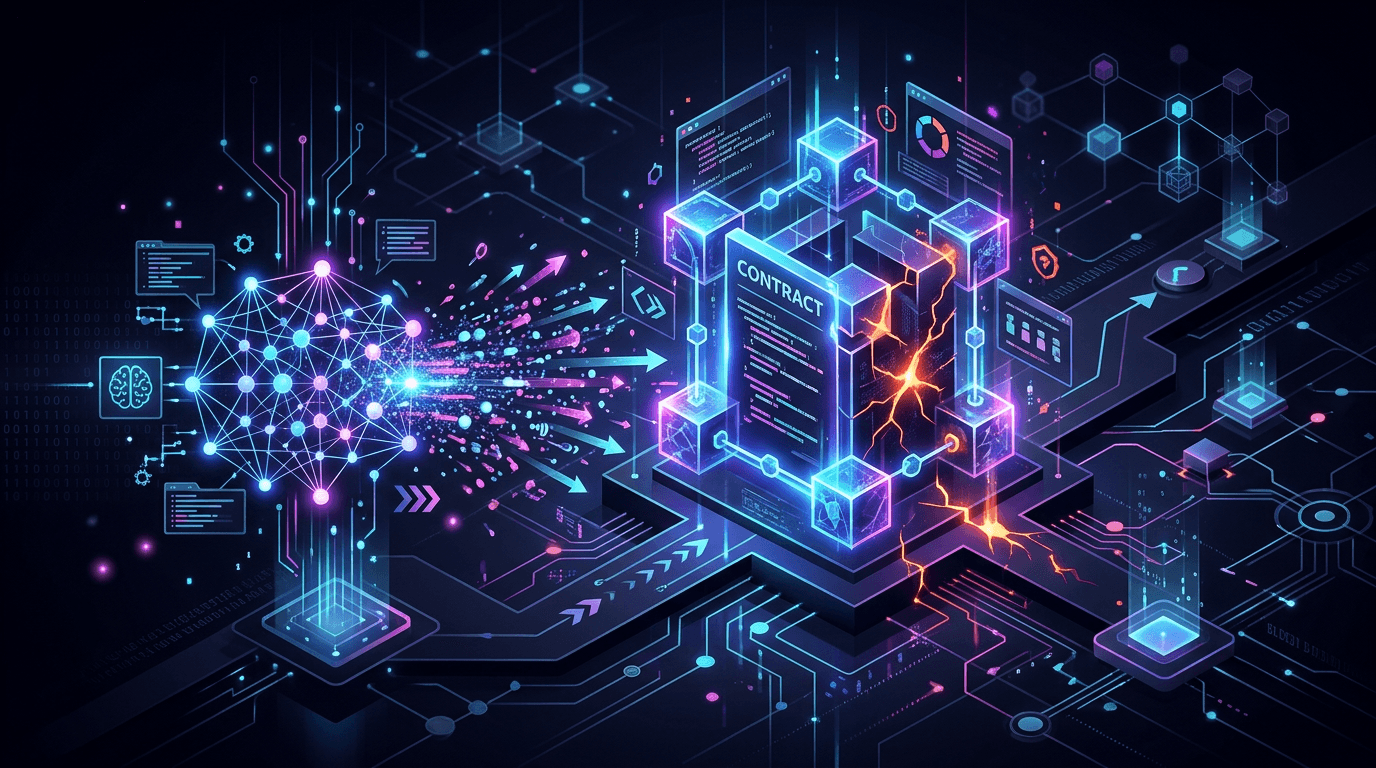
The conversation around smart contract security has historically been dominated by two activities: manual audits and static analysis. Both have genuine value, and neither is going away. But there is a class of vulnerability that neither approach handles well, the kind that only manifests when a contract receives a specific sequence of inputs in a specific order under specific state conditions. These are the bugs that live in the interaction space between functions, not in any single line of code. They are the bugs that have drained hundreds of millions of dollars from DeFi protocols, and they are precisely the bugs that fuzz testing is designed to find.
Fuzz testing, at its core, is the practice of feeding a program large volumes of semi-random or structured inputs and observing whether it behaves correctly. In traditional software engineering, fuzzing has been a standard part of the security toolkit for decades. Tools like AFL and libFuzzer have found critical vulnerabilities in everything from browser engines to operating system kernels. The challenge in applying this approach to smart contracts is that the input space is not just large, it is semantically complex. A Solidity contract does not just accept bytes. It accepts structured function calls with typed arguments, and the interesting vulnerabilities often require a precise sequence of those calls to trigger. Naive random fuzzing will spend most of its time generating inputs that revert immediately, never reaching the deep state transitions where real bugs hide.
That is the problem AI is now solving. By using reinforcement learning to guide input generation toward unexplored execution paths, and by using large language models to reason about what sequences of function calls are semantically plausible given a contract's logic, modern AI-driven fuzzers are reaching vulnerability classes that were previously only discoverable through months of manual review. The shift is not incremental. It represents a fundamental change in what automated security tooling can accomplish.
The Limits of Static Analysis and Why Fuzzing Fills the Gap
Static analysis tools like Slither, developed by Trail of Bits, and Securify, developed at ETH Zurich, have become standard fixtures in the smart contract security workflow. They parse Solidity source code, build control flow graphs, and apply pattern-matching rules to flag known vulnerability classes: reentrancy, unchecked external calls, integer overflow, access control gaps. For a developer doing a quick pre-commit scan, these tools are genuinely useful. Slither in particular is fast enough to run in a CI pipeline without meaningfully slowing down the build cycle, and its human-readable output makes it accessible to developers who are not security specialists.
The limitation of static analysis is that it reasons about code structure, not about runtime behavior. It can tell you that a function makes an external call before updating state, which is the structural pattern associated with reentrancy. It cannot tell you whether that reentrancy is actually exploitable given the specific state machine of your protocol, or whether the conditions required to trigger it can actually be reached through the contract's public interface. This distinction matters enormously in practice. A static analyzer that flags every potential reentrancy pattern will generate false positives on contracts where the pattern exists but is not exploitable, training developers to dismiss warnings. A fuzzer that actually tries to exploit the reentrancy by constructing a sequence of calls that reaches the vulnerable state gives you a concrete proof of exploitability, not a theoretical concern.
Symbolic execution tools like MythX, developed by ConsenSys, attempt to bridge this gap by reasoning about all possible execution paths through a contract simultaneously. Symbolic execution is more powerful than pattern matching because it can reason about conditions, not just structure. But it suffers from path explosion: as a contract grows in complexity, the number of possible execution paths grows exponentially, and symbolic execution tools either time out or resort to approximations that miss deep paths. Fuzzing, especially AI-guided fuzzing, handles this differently. Rather than trying to enumerate all paths, it uses feedback from actual execution to steer toward unexplored regions of the state space, making it far more practical for the complex, multi-contract systems that characterize production DeFi protocols.
How Traditional Fuzzing Works and Where It Breaks Down
The foundational fuzzing tool in the Ethereum ecosystem is Echidna, also developed by Trail of Bits. Echidna is a property-based fuzzer: you write invariants in Solidity, assertions about what should always be true regardless of what sequence of function calls is made, and Echidna tries to find a sequence of calls that violates those invariants. This is a powerful model because it forces developers to articulate their security assumptions explicitly. If you believe that the total supply of a token should never exceed a certain value, you write that as an invariant, and Echidna will spend its compute budget trying to break it.
The practical challenge with Echidna and similar property-based fuzzers is that writing good invariants requires deep protocol knowledge and significant time investment. A developer who is not a security specialist may write invariants that are technically correct but do not capture the most dangerous properties of their contract. More fundamentally, the fuzzer's effectiveness is bounded by the quality of its input generation strategy. Traditional coverage-guided fuzzers use branch coverage as their feedback signal: they prefer inputs that reach new branches in the code. This works well for finding shallow bugs but struggles with vulnerabilities that require a specific sequence of many function calls to trigger, because the probability of randomly generating that sequence is vanishingly small.
Foundry, which has become the dominant development framework for Solidity in 2025, includes its own invariant testing system that operates on similar principles to Echidna but integrates more tightly with the development workflow. Foundry's fuzzer is fast and ergonomic, and the fact that it lives inside the same tool developers use for compilation and unit testing means it gets used more consistently than standalone fuzz testing tools. But it shares the same fundamental limitation: the quality of the fuzzing is bounded by the quality of the input generation, and random or coverage-guided generation leaves large regions of the vulnerability space unexplored. This is the gap that AI-driven approaches are now beginning to close.
Reinforcement Learning Fuzzers and the Shift to Intelligent Input Generation
Research published in Applied Sciences through MDPI in 2025 demonstrates a concrete approach to applying reinforcement learning to smart contract vulnerability detection. The core insight is that fuzzing can be framed as a sequential decision problem: at each step, the fuzzer chooses which function to call and with what arguments, and the goal is to maximize the discovery of new vulnerability-triggering states. Reinforcement learning is well-suited to this framing because it can learn, over many episodes of fuzzing, which sequences of actions tend to lead to interesting states and which tend to lead to dead ends.
The practical advantage of RL-guided fuzzing over coverage-guided fuzzing is that coverage is a proxy metric for vulnerability discovery, not the thing itself. A fuzzer that maximizes branch coverage will explore a lot of code, but it will not necessarily explore the code in the order or with the state conditions that trigger vulnerabilities. An RL-guided fuzzer that receives a reward signal when it finds a property violation or reaches a previously unseen state transition learns to generate inputs that are semantically meaningful for vulnerability discovery, not just structurally novel. Over time, the fuzzer develops something like an intuition for the kinds of call sequences that tend to expose bugs in contracts with similar architectural patterns.
This matters for production DeFi development because the contracts being deployed are not simple token contracts. They are complex systems with multiple interacting components: lending pools, oracle integrations, governance mechanisms, liquidity management logic. The vulnerability surface of a protocol like a money market or a perpetuals exchange is not a single function with a bad input check. It is a set of emergent behaviors that arise from the interaction of many functions across many contracts. RL-guided fuzzers, by learning to navigate this interaction space, are far better equipped to find these emergent vulnerabilities than any approach based on random input generation or static pattern matching.
LLM-Powered Analysis: How PromFuzz Changes the Detection Model
The PromFuzz framework, described in research published on arXiv in early 2025, takes a different approach to the problem of intelligent fuzzing. Rather than using reinforcement learning to guide input generation, PromFuzz uses large language models to perform what the researchers call multi-perspective analysis: reasoning about a contract's intended behavior from multiple angles simultaneously, including its specification, its implementation, and the known patterns of functional bugs in similar contracts.
The key insight behind PromFuzz is that functional bugs, the class of vulnerabilities where a contract does not behave according to its intended specification even though it does not obviously violate any security rule, are particularly hard for traditional tools to find. A reentrancy vulnerability has a structural signature that a static analyzer can detect. A bug where a liquidation function incorrectly calculates a user's collateral ratio under specific market conditions does not have a structural signature. It requires understanding what the function is supposed to do and then reasoning about whether the implementation actually achieves that under all possible inputs. LLMs, trained on vast amounts of code and documentation, are well-positioned to perform this kind of semantic reasoning.
PromFuzz uses the LLM's analysis to generate targeted test cases: inputs that are specifically designed to probe the conditions under which the identified potential bugs might manifest. This is fundamentally different from coverage-guided fuzzing, which generates inputs based on what code has been executed, and from RL-guided fuzzing, which generates inputs based on what has historically led to interesting states. LLM-guided fuzzing generates inputs based on a semantic understanding of what the contract is trying to do and where that understanding suggests the implementation might diverge from the intent. In practice, this means PromFuzz can find functional bugs that have no structural signature and that would require an improbably lucky random input sequence to trigger through conventional fuzzing.
The Anthropic SCONE Benchmark and What It Means for Defenders
In late 2025, Anthropic published results from a red-team study using a benchmark called SCONE, which stands for Smart CONtract Exploitation. The benchmark consisted of 405 real-world exploited smart contracts drawn from incidents between 2020 and 2025 across Ethereum, Binance Smart Chain, and Base. AI agents using models including Opus 4.5 and Sonnet 4.5 were tasked with reading each contract, identifying the vulnerability, writing a runnable exploit, executing it in a sandboxed fork of the chain, and producing a net financial gain. The results were striking: the agents successfully exploited 207 of the 405 contracts, a success rate of approximately 51.1%, with simulated stolen value of $550.1 million at historical prices.
More significant for the security community was the post-training result. Anthropic also tested the agents against 2,849 newly deployed contracts from October 2025, contracts with no known vulnerabilities and no training data contamination. The agents exploited 19 of 34 contracts that were subsequently confirmed to be vulnerable, a success rate of approximately 55.8%, extracting approximately $4.6 million in simulated value. This is not a theoretical capability. It is a demonstrated ability to autonomously perform end-to-end offensive operations against real contracts deployed on live networks.
The defensive implication is direct. If AI agents can autonomously identify and exploit vulnerabilities in newly deployed contracts at a 55.8% success rate, then the window between deployment and exploitation for a vulnerable contract is now measured in hours or less, not days or weeks. The traditional model of deploying a contract, running a bug bounty program, and waiting for researchers to find issues is no longer viable as a primary security strategy. The only viable response is to use the same class of AI-driven analysis on the defensive side, before deployment, to find and fix vulnerabilities before an adversarial agent finds them first. This is precisely what AI-driven fuzz testing, combined with LLM-powered analysis, is designed to do.
Custom Fuzzing vs. Black Box Fuzzing: The Protocol Context Problem
Security researchers at Cantina and Spearbit have articulated a distinction that is worth understanding clearly: the difference between black-box fuzzing and custom, protocol-aware fuzzing. Black-box fuzzing treats a contract as an opaque system and generates inputs without any knowledge of the contract's intended behavior or internal structure. It is fast to set up and requires no domain knowledge, but it is fundamentally limited by the fact that it cannot distinguish between inputs that are semantically meaningful for the protocol and inputs that will simply revert immediately.
Custom fuzzing, by contrast, encodes domain knowledge about the protocol into the fuzzing setup. This means writing handlers that simulate realistic user behavior, setting up initial state that reflects actual deployment conditions, and writing invariants that capture the specific security properties of the protocol rather than generic properties that apply to all contracts. A custom fuzzer for a lending protocol will know that a realistic sequence of actions involves depositing collateral, borrowing against it, and then attempting various operations that might affect the collateral ratio. A black-box fuzzer will generate random function calls in random order, most of which will revert because the preconditions for those functions are not met.
The practical implication is that custom fuzzing requires significant upfront investment but produces dramatically better results. Spearbit's approach, as documented in their public research, involves security researchers spending substantial time understanding a protocol's architecture before writing a single line of fuzzing code. The fuzz suite they produce is essentially a formalization of their understanding of how the protocol is supposed to work, expressed as executable invariants and realistic action sequences. AI is beginning to change the economics of this approach by automating parts of the protocol understanding phase: an LLM that can read a contract's documentation and source code and generate a reasonable initial set of invariants and action handlers reduces the time to a useful custom fuzz suite from days to hours.
Integrating Fuzz Testing into Continuous Development Workflows
The security value of fuzz testing is maximized when it runs continuously throughout the development process, not just as a final check before deployment. This is a straightforward principle, but implementing it requires solving some practical problems. Fuzz testing is computationally expensive. A meaningful fuzz campaign against a complex DeFi contract might require hours of compute time to achieve useful coverage. Running that in a standard CI pipeline on every pull request is not practical with naive approaches.
The solution that production teams are converging on involves tiered fuzzing: a fast, lightweight fuzz run that executes in a few minutes and catches obvious regressions, combined with a deeper fuzz campaign that runs on a schedule or is triggered by significant changes to core contract logic. The fast run uses a small corpus of previously discovered interesting inputs and a short time budget to verify that known-good invariants still hold. The deep run uses AI-guided input generation to explore new regions of the state space and update the corpus with any newly discovered interesting inputs. This tiered approach keeps the CI pipeline fast while ensuring that the cumulative fuzz coverage grows over time.
Integrating this into a Foundry-based workflow looks like adding invariant test suites that run with a configurable number of runs, combined with a separate fuzzing job in the CI configuration that runs with a much larger run count on a nightly schedule. The corpus from the nightly run is committed to the repository, so subsequent runs benefit from the accumulated knowledge of previous campaigns. AI-driven tools can augment this by automatically generating new invariants based on code changes, flagging when a change introduces a new function or state variable that is not covered by existing invariants, and suggesting targeted test cases for the new code paths. This keeps the fuzz coverage aligned with the codebase as it evolves, rather than requiring developers to manually update their test suites every time the contract logic changes.
The Tooling Stack: Echidna, Foundry, MythX, and Where AI Fits
Understanding where AI fits in the existing tooling ecosystem requires a clear picture of what each tool does well. Echidna remains the most powerful standalone fuzzer for Solidity, with a mature corpus management system, support for complex multi-contract setups, and a large body of community knowledge about how to write effective invariants. Foundry's built-in fuzzer is more ergonomic and better integrated with the development workflow, making it the better choice for teams that want fuzzing to be a natural part of their testing practice rather than a separate security activity. MythX combines symbolic execution with fuzzing and is particularly useful for finding vulnerabilities that require reasoning about specific numeric conditions, like integer overflow or precision loss in fixed-point arithmetic.
Slither sits in a different category: it is a static analyzer, not a fuzzer, but it is fast enough to run on every commit and catches a meaningful fraction of common vulnerability patterns before they ever reach the fuzzing stage. The practical workflow for a production team is to use Slither as a first-pass filter, Foundry's fuzzer for continuous property testing during development, and Echidna for deeper campaign-style fuzzing before major releases. AI augments each of these layers: it can generate Slither detectors for protocol-specific patterns, generate Foundry invariants from contract specifications, and guide Echidna's input generation toward unexplored state regions.
The emerging category of AI-native security tools, including Sherlock's AI-powered analysis platform and the LLM-based analysis components being integrated into audit workflows by firms like Nethermind, represents a layer above the traditional tooling stack. These tools use LLMs to reason about contract semantics, generate targeted test cases, and identify potential vulnerabilities that do not match any known pattern. They are not replacements for Echidna or Foundry. They are a complementary layer that handles the class of vulnerabilities that require semantic understanding rather than structural pattern matching or coverage-guided exploration.
AI-Augmented Audits and the Human-Machine Security Loop
The most effective security workflows in production Web3 development are not fully automated and not fully manual. They are structured collaborations between human security researchers and AI-driven analysis tools, where each party handles the tasks they are best suited for. Human auditors bring contextual understanding, adversarial creativity, and the ability to reason about economic incentives and protocol-level attack vectors that no automated tool currently handles well. AI-driven tools bring the ability to exhaustively explore large input spaces, maintain consistent attention across thousands of lines of code, and apply pattern recognition across a corpus of historical vulnerabilities that no individual human could hold in memory.
The practical structure of an AI-augmented audit looks like this: the AI-driven analysis runs first, producing a prioritized list of potential issues with supporting evidence in the form of concrete inputs that trigger the issue or formal arguments for why the issue exists. Human auditors then review this list, filtering false positives, assessing exploitability, and using the AI's findings as a map of the vulnerability surface rather than starting from scratch. The human auditors also pursue lines of investigation that the AI did not flag, applying their contextual knowledge of the protocol's economic design and the broader DeFi ecosystem to identify attack vectors that require understanding beyond the contract code itself.
This division of labor is not just more efficient than either approach alone. It is more thorough. The AI handles the systematic, exhaustive work of exploring the input space and checking known vulnerability patterns. The human handles the creative, contextual work of reasoning about novel attack vectors and economic exploits. Neither can fully substitute for the other in a production security context, but together they cover a much larger fraction of the vulnerability surface than either could alone. The key is tooling that makes this collaboration natural, surfacing AI findings in a format that human auditors can efficiently review and act on, rather than requiring them to interpret raw fuzzer output or wade through thousands of lines of automated analysis.
What Developers Actually Need to Do Differently
The practical question for a developer building on Ethereum or any EVM-compatible chain in 2026 is not whether to use AI-driven fuzz testing. The Anthropic SCONE results make the answer to that question obvious. The question is how to integrate these tools into a development workflow that is already complex and already demanding. The answer requires changing some habits that are deeply ingrained in how most Web3 developers work.
The first change is treating invariant writing as a first-class development activity, not an afterthought. Invariants are the specification of your contract's security properties, and writing them forces you to articulate assumptions that are often left implicit. A developer who writes invariants before writing implementation code is doing something analogous to test-driven development: they are defining what correct behavior looks like before they write the code that is supposed to produce it. This discipline pays dividends not just in fuzzing effectiveness but in code quality generally, because it forces clarity about what the contract is supposed to do.
The second change is treating fuzz campaign results as a living artifact of the codebase, not a one-time report. The corpus of interesting inputs discovered by a fuzz campaign is valuable information about the contract's behavior under adversarial conditions. It should be committed to the repository, reviewed when the contract logic changes, and extended as new code paths are added. A fuzz corpus that is maintained over the lifetime of a protocol is a continuously growing body of evidence about what the protocol can and cannot withstand. Discarding it after each audit cycle throws away that accumulated knowledge.
The third change is using AI-generated analysis as a starting point for security review, not as a replacement for it. An LLM that flags a potential reentrancy issue in a complex multi-contract interaction is giving you a lead to investigate, not a confirmed vulnerability. The developer's job is to understand why the tool flagged the issue, assess whether it is actually exploitable, and either fix it or document why it is not a real concern. This requires engaging with the tool's output rather than dismissing it or blindly accepting it, and it requires enough understanding of the underlying vulnerability class to make that judgment. AI-powered development environments that surface these findings inline, in the context of the code being written, make this engagement natural rather than requiring a separate security review step.
Building a Fuzz-First Development Culture with Cheetah AI
The shift toward AI-driven fuzz testing as a core part of the smart contract development workflow is not primarily a tooling problem. The tools exist. Echidna, Foundry, MythX, Slither, and the emerging generation of LLM-powered analysis platforms give developers everything they need to build a comprehensive, AI-augmented security workflow. The challenge is cultural and ergonomic: making these tools accessible enough that developers use them consistently, and integrating them tightly enough with the development environment that security feedback arrives at the moment when it is most actionable, while the code is being written.
This is the problem that Cheetah AI is built to solve. A crypto-native IDE that understands Solidity semantics, knows the common vulnerability patterns in DeFi protocols, and can surface AI-driven security analysis inline as you write code changes the economics of smart contract security. Instead of security being a separate phase that happens after development is complete, it becomes a continuous property of the development process itself. Invariant suggestions appear as you write new functions. Fuzz campaign results are surfaced in the context of the code they relate to. LLM-powered analysis flags potential issues before they ever reach a CI pipeline, let alone a mainnet deployment.
If you are building production smart contracts and want to understand how AI-driven fuzz testing fits into a development workflow that is designed for the current threat environment, Cheetah AI is worth exploring. The gap between the tools that exist and the workflows that most teams are actually running is large, and closing that gap is where the most significant security improvements are available right now.
From there, the path toward a fully integrated AI-driven security workflow is incremental. Add Slither to the CI pipeline. Extend the invariant suite as new functions are added. Run a deeper Echidna campaign before each major release. Use LLM-powered analysis to review the invariants themselves, checking whether they actually capture the properties you care about or whether they have gaps that an adversary could exploit. Each step compounds on the previous one, and the cumulative effect is a codebase where the security properties are continuously verified rather than periodically audited.

Cheetah AI is designed to make each of those steps faster and more accessible, particularly for developers who are not security specialists but who are responsible for writing code that will hold real value on a live blockchain. The IDE understands the context of what you are building, can suggest invariants based on the functions you have written, and surfaces security findings in the same environment where you are making the decisions that determine whether those findings get addressed. That tight feedback loop, between writing code and understanding its security properties, is what separates teams that ship secure contracts from teams that ship contracts and hope for the best.
Related Posts

Reasoning Agents: Rewriting Smart Contract Development
TL;DR:Codex CLI operates as a multi-surface coding agent with OS-level sandboxing, 1M context windows via GPT-5.4, and the ability to read, patch, and execute against live codebases, making


Web3 Game Economies: AI Dev Tools That Scale
TL;DR:On-chain gaming attracted significant capital throughout 2025, with the Blockchain Game Alliance's State of the Industry Report confirming a decisive shift from speculative token launc
Token Unlock Engineering: Build Safer Vesting Contracts
TL;DR:Vesting contracts control token release schedules for teams, investors, and ecosystems, often managing hundreds of millions in locked supply across multi-year unlock windows Time-lo