Multi-Agent Review: Rebuilding DeFi Security from the Ground Up
How multi-agent review architectures, inspired by Claude Code's approach, are changing the way DeFi teams audit smart contracts before deployment.
Subscribe to our newsletter to get the latest updates and offers
* Will send you weekly updates on new features, tips, and developer resources.
The Security Gap That Single-Agent Review Cannot Close
TL;DR:
- Multi-agent review pipelines decompose smart contract auditing into specialized roles, with separate agents handling reentrancy detection, access control analysis, economic attack simulation, and compliance checks in parallel
- Claude Code's multi-agent architecture demonstrated that a reviewing agent operating independently from the coding agent catches significantly more issues than a single-pass review by the same model
- Traditional smart contract audits cost between $30,000 and $500,000 and take weeks to complete; multi-agent pipelines can run continuous, parallel analysis at a fraction of that cost and timeline
- DeFi protocols lost over $1.8 billion to exploits in 2024, with the majority of incidents traceable to vulnerabilities that a thorough, multi-pass review process would have surfaced
- Isolation between agents is not just an architectural preference, it is a security requirement, since a compromised or hallucinating agent should not be able to corrupt the entire review pipeline
- Orchestration patterns like supervisor-worker hierarchies and parallel fan-out review are proving more effective than sequential single-agent chains for complex Solidity codebases
- The most effective pipelines combine AI agent analysis with deterministic static analysis tools like Slither and Echidna, using agents to interpret and prioritize findings rather than replace them
The result: Multi-agent code review is not a future concept for DeFi security, it is the architecture that production-grade protocols are adopting right now.
The conversation around AI-assisted code review in Web3 has been dominated by a single, flawed assumption: that one sufficiently capable model, given enough context, can catch everything worth catching in a smart contract. This assumption is understandable. Modern LLMs are genuinely impressive at reading Solidity, identifying common vulnerability patterns, and explaining complex protocol logic. But the assumption breaks down precisely where it matters most, in the edge cases, the cross-contract interactions, the economic attack surfaces that only become visible when you approach the codebase from multiple independent angles simultaneously.
The problem is not intelligence, it is perspective. A single agent reviewing code it helped write, or code it has been primed to understand in a particular way, carries the same cognitive biases that make human self-review unreliable. Security researchers have known for decades that the person who wrote the code is the worst person to audit it, not because they lack skill, but because their mental model of how the code works filters out the anomalies that an outside perspective would catch immediately. Multi-agent pipelines apply this same principle to AI-assisted review, and the results are meaningfully different from what single-agent approaches produce.
What makes DeFi particularly unforgiving in this context is the irreversibility of deployment. A vulnerability in a traditional web application can be patched with a hotfix and a deployment pipeline that takes minutes. A vulnerability in a deployed smart contract is permanent unless the protocol has upgrade mechanisms built in, and even those carry their own security surface. The $1.8 billion lost to DeFi exploits in 2024 was not primarily the result of unsophisticated attacks. Most of those incidents involved vulnerabilities that were present in the code before deployment, visible in retrospect, and missed by review processes that were either too shallow, too rushed, or too reliant on a single point of analysis.
The Architecture Behind Multi-Agent Review Pipelines
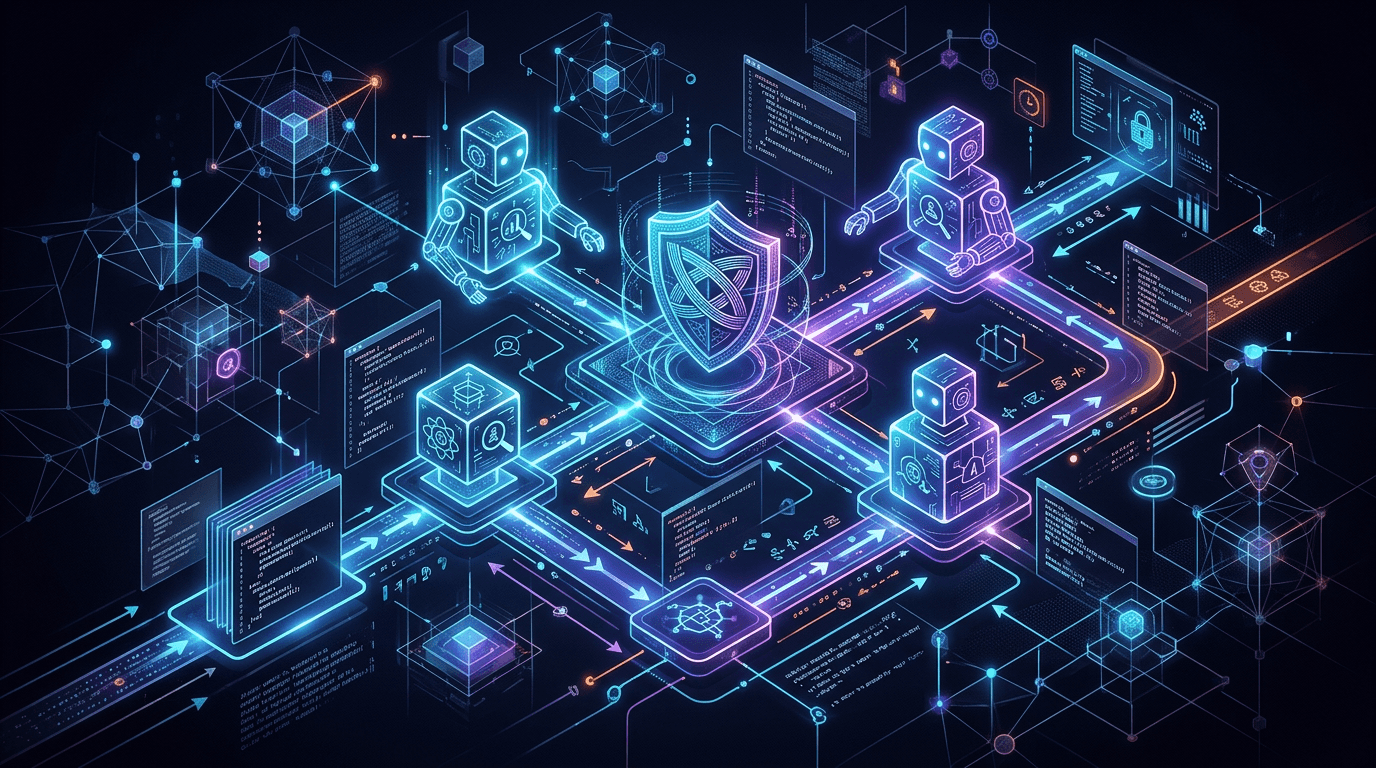
Multi-agent review pipelines are not a single design pattern. They are a family of architectures that share a common principle: different agents, operating with different contexts, different prompting strategies, and different tool access, will surface different classes of issues. The most common implementation pattern is a supervisor-worker hierarchy, where an orchestrating agent decomposes the review task into specialized subtasks and delegates each to a worker agent with a focused mandate. One worker might be tasked exclusively with tracing all external calls and checking for reentrancy conditions. Another might focus on access control, mapping every privileged function to its modifier chain and checking for gaps. A third might simulate economic attack vectors, modeling how a flash loan attacker couldmanipulate price oracles or drain liquidity pools given the current state of the protocol's reserves and fee structure.
This decomposition matters because each of those review tasks requires a different kind of attention. Reentrancy analysis is fundamentally a control flow problem, requiring the agent to trace execution paths across function calls and identify points where external contracts could re-enter before state updates are committed. Access control analysis is a permission mapping problem, requiring the agent to build a complete graph of who can call what under which conditions. Economic attack simulation is closer to adversarial game theory, requiring the agent to reason about incentive structures and capital efficiency in ways that have nothing to do with syntax or even standard vulnerability patterns. No single agent, given a single prompt and a single pass through the codebase, is going to do all three of those things well simultaneously.
The parallel fan-out pattern is a variation on this approach that has gained traction for larger codebases. Rather than a strict hierarchy, a coordinating agent distributes the same contract or set of contracts to multiple independent review agents simultaneously, each operating with a different system prompt and a different analytical lens. The results are then aggregated by a synthesis agent that identifies overlapping findings, resolves conflicts, and produces a unified report with severity rankings. This pattern is particularly effective for DeFi protocols with complex multi-contract architectures, where the interaction surface between contracts is often where the most serious vulnerabilities live.
How Claude Code's Multi-Agent Architecture Changed the Conversation
Claude Code's approach to multi-agent review introduced something that had been missing from most AI-assisted code review discussions: a concrete, documented example of what happens when you separate the agent that writes code from the agent that reviews it. The core insight was straightforward but consequential. A model reviewing its own output is operating with a strong prior toward correctness. It generated the code because it believed the code was right, and that belief persists into the review phase unless something actively disrupts it. A separate agent, instantiated fresh with no memory of the generation process, approaches the same code without that prior.
The implementation that emerged from this thinking used sandboxed, single-turn review calls, where the reviewing agent had no access to the conversation history that produced the code and no ability to modify the codebase directly. It could only read, analyze, and report. This isolation was not just a philosophical choice. It was a practical security measure. An agent that can both review and modify code creates a feedback loop where the agent can rationalize away its own findings by making small adjustments that technically address the flagged issue without actually resolving the underlying vulnerability. Keeping the review agent read-only eliminates that failure mode entirely.
What the Claude Code architecture also demonstrated was the value of tiered decision-making in security contexts. Rather than a binary approve-or-deny output, the reviewing agent could escalate uncertain findings to a human reviewer, creating a three-tier system where clear approvals and clear denials were handled automatically, and ambiguous cases were surfaced for human judgment. For DeFi security specifically, this tiering is critical. The cost of a false negative, missing a real vulnerability, is catastrophic and irreversible. The cost of a false positive, flagging something that turns out to be fine, is a few minutes of a developer's time. Any review system that optimizes for reducing false positives at the expense of false negatives is optimizing for the wrong outcome.
Specialized Agents for DeFi-Specific Vulnerability Classes
General-purpose code review agents, even very capable ones, struggle with DeFi-specific vulnerability classes because those vulnerabilities require domain knowledge that goes beyond standard software security. A reentrancy vulnerability in a Solidity contract looks superficially similar to a callback-based race condition in JavaScript, but the economic consequences and the specific conditions that enable exploitation are entirely different. Flash loan attacks have no analog in traditional software security at all. Price oracle manipulation requires understanding of how automated market makers calculate spot prices and how those calculations can be influenced by large, atomic capital movements. These are not things a general-purpose security agent is going to reason about correctly without explicit, domain-specific context.
This is why the most effective multi-agent pipelines for DeFi security include agents that are purpose-built for specific vulnerability classes rather than relying on a single generalist agent to cover everything. A dedicated oracle manipulation agent, for example, would be prompted with detailed knowledge of how Uniswap V3 TWAP oracles work, how Chainlink price feeds can be stale or manipulated under specific network conditions, and what the common patterns look like when a protocol relies on spot price calculations that can be moved within a single transaction. That agent would approach every external price feed call in the codebase as a potential attack surface and trace the downstream effects of a manipulated price through the protocol's logic.
Similarly, a dedicated access control agent for DeFi protocols needs to understand not just standard role-based access patterns but also the specific risks of proxy upgrade patterns, the implications of initializer functions that can be called by anyone before the contract is properly set up, and the subtle ways that ownership transfer mechanisms can be exploited during the window between deployment and initialization. These are patterns that have appeared repeatedly in real exploits, including the $80 million Rari Capital hack in 2022, which involved a reentrancy vulnerability in a function that had been audited but not analyzed in the context of the specific integration that enabled the attack. Specialization in the review pipeline is what makes it possible to catch that class of issue consistently.
Isolation, Sandboxing, and Trust Boundaries Between Agents
One of the underappreciated design requirements for multi-agent security pipelines is the need for strict isolation between agents. In a naive implementation, agents share context freely, passing findings and intermediate analysis back and forth in a way that seems efficient but creates serious problems. If one agent in the pipeline produces a hallucinated finding, a false positive that it presents with high confidence, that finding can propagate through the pipeline and influence the analysis of other agents. Worse, if an agent is operating on a codebase that contains adversarially crafted comments or documentation designed to mislead AI reviewers, a non-isolated pipeline can be manipulated into missing real vulnerabilities by poisoning the shared context.
The principle of least privilege applies to agents just as it applies to smart contracts. Each agent in the review pipeline should have access only to the information and tools it needs to perform its specific task. A reentrancy analysis agent does not need access to the economic simulation results from another agent. A compliance checking agent does not need to see the raw output of the static analysis tools. Keeping these contexts separate prevents cross-contamination and ensures that each agent's findings are genuinely independent, which is the property that makes multi-agent review more reliable than single-agent review in the first place.
Network controls add another layer of isolation that matters specifically in the context of DeFi security review. An agent that can make arbitrary network calls during a review session could, in theory, exfiltrate code to an external service, query live on-chain state in ways that influence its analysis, or be manipulated through prompt injection embedded in external resources it fetches. Production-grade multi-agent pipelines restrict network access for review agents to a defined allowlist, typically limited to the static analysis tools and knowledge bases the agent needs to do its job. This is not paranoia. It is the same defense-in-depth thinking that makes smart contract security work.
Integrating Deterministic Tools with AI Agents
The most effective multi-agent review pipelines do not treat AI agents as replacements for deterministic static analysis tools. They treat them as interpreters and prioritizers of the output those tools produce. Slither, the Python-based static analysis framework for Solidity, can run over 90 detectors against a contract and produce a list of findings in seconds. The problem is that Slither's output is often noisy, with many findings that are technically correct but contextually irrelevant, and it lacks the ability to reason about the economic implications of what it finds. An AI agent that receives Slither's output and is tasked with triaging, contextualizing, and prioritizing those findings adds genuine value that neither the tool nor the agent could produce alone.
Echidna, the property-based fuzzer for Solidity, is another tool that benefits enormously from AI agent integration. Echidna requires developers to write invariant properties that the fuzzer then tries to violate through random input generation. Writing good invariants is hard, and most teams write too few of them, leaving large portions of the contract's behavior space untested. An AI agent tasked specifically with invariant generation, given the contract's logic and a description of its intended behavior, can produce a substantially more comprehensive set of properties than most developers would write manually. The combination of AI-generated invariants and Echidna's fuzzing engine creates a review layer that catches a class of vulnerabilities, particularly those involving unexpected state transitions under adversarial inputs, that neither approach catches reliably on its own.
Formal verification tools like Certora's Prover and Halmos represent the highest-confidence layer of the review stack, but they require formal specifications written in domain-specific languages that most developers are not fluent in. AI agents can bridge this gap by translating natural language descriptions of intended contract behavior into formal specifications, which the verification tool then checks against the actual implementation. This is not a fully automated process yet, the generated specifications require human review before they can be trusted, but it dramatically reduces the time required to get a contract to the point where formal verification is feasible.
Orchestration Patterns That Work in Production
The gap between a multi-agent review pipeline that works in a demo and one that works reliably in production is mostly an orchestration problem. In a demo, you control the inputs, the contracts are small and well-understood, and you can tolerate occasional failures by re-running the pipeline. In production, contracts are large and complex, the pipeline needs to complete within a time budget that fits into a CI/CD workflow, and failures need to be handled gracefully without silently dropping findings.
The supervisor-worker pattern with explicit failure handling is the most robust orchestration approach for production DeFi security pipelines. The supervisor agent is responsible for decomposing the review task, assigning subtasks to worker agents, monitoring their progress, and handling failures. If a worker agent times out or produces output that fails a basic sanity check, the supervisor can retry with a different prompt, escalate to a human reviewer, or mark the subtask as incomplete in the final report rather than silently omitting it. The key design principle is that incomplete coverage should always be visible in the output. A report that says "reentrancy analysis incomplete due to agent timeout" is far more useful than a report that silently omits reentrancy analysis because the agent failed.
Caching and incremental review are orchestration features that matter a lot for developer experience. Running a full multi-agent review pipeline on every commit is expensive in both time and compute. A well-designed orchestrator tracks which files have changed since the last review and routes only the affected contracts and their dependencies to the relevant agents. For a large DeFi protocol with dozens of contracts, this can reduce review time from 20 minutes to under 3 minutes for a typical commit that touches one or two files. The full pipeline still runs before any deployment to a testnet or mainnet, but the fast incremental review gives developers immediate feedback during active development without creating a bottleneck.
The Audit Trail Problem and Why It Matters
One of the structural advantages of multi-agent review pipelines over traditional human audits is the completeness of the audit trail they produce. A human auditor produces a report. A multi-agent pipeline produces a report plus a complete record of every finding each agent surfaced, every tool call made, every piece of context consulted, and every decision made about how to classify and prioritize findings. This record is not just useful for understanding how the review was conducted. It is a liability artifact that matters enormously in the context of DeFi protocols that manage significant user funds.
When a DeFi protocol is exploited, the post-mortem almost always includes a question about what the pre-deployment review process looked like and whether the vulnerability was present in the code that was reviewed. A complete, timestamped audit trail from a multi-agent pipeline answers that question definitively. It shows exactly what was analyzed, what was found, what was escalated, and what decisions were made about each finding. This is a level of documentation that traditional audits rarely produce and that manual code review almost never produces.
The audit trail also enables continuous improvement of the review pipeline itself. By analyzing which classes of vulnerabilities were caught by which agents, which findings were escalated to human reviewers and how those escalations were resolved, and which vulnerabilities in deployed contracts were not caught by the pre-deployment review, teams can identify gaps in their agent configurations and refine their prompting strategies over time. This feedback loop is one of the most underutilized advantages of AI-assisted review, and it requires a complete audit trail to work.
Economic Attack Simulation as a First-Class Review Stage
Most smart contract security reviews treat economic attack simulation as an afterthought, something that happens informally when a reviewer happens to think about incentive structures, rather than as a structured, mandatory stage of the review process. This is a significant gap, because the most expensive DeFi exploits in recent years have not been simple code bugs. They have been sophisticated economic attacks that exploited the interaction between correct code and adversarial market conditions.
A dedicated economic attack simulation agent approaches the codebase with a specific mandate: find every place where an attacker with access to large amounts of capital, either through flash loans or through their own holdings, could manipulate the protocol's state to extract value. This requires the agent to reason about the protocol's tokenomics, its liquidity assumptions, its oracle dependencies, and the specific mechanics of how flash loans interact with the protocol's accounting logic. It is a fundamentally different kind of analysis from vulnerability scanning, and it requires a different kind of agent with different context and different tools.
Concrete simulation scenarios are more useful than abstract vulnerability descriptions in this context. An agent that says "this protocol is vulnerable to flash loan price manipulation" is less useful than an agent that says "an attacker with access to 10,000 ETH via Aave flash loans could manipulate the WETH/USDC price on the protocol's internal AMM by 40% within a single transaction, enabling them to borrow against inflated collateral and extract approximately $2.3 million before the price reverts." The specificity of the second finding is what makes it actionable, and it is the kind of specificity that a purpose-built economic simulation agent, given access to on-chain liquidity data and a detailed understanding of the protocol's mechanics, can produce.
Building Multi-Agent Review into Your CI/CD Pipeline
The practical question for most DeFi teams is not whether multi-agent review is valuable, it is how to integrate it into an existing development workflow without creating friction that causes developers to route around it. The answer is a tiered integration model that matches the depth of review to the stage of the development process.
At the commit level, a lightweight agent runs a fast pass focused on the highest-severity vulnerability classes: reentrancy, integer overflow, unchecked external calls, and obvious access control gaps. This pass should complete in under 60 seconds and block the commit only for critical findings. The goal is not comprehensive coverage at this stage. It is catching the most obvious issues before they accumulate in the codebase. At the pull request level, a more comprehensive multi-agent pipeline runs, including specialized agents for DeFi-specific vulnerabilities, integration with Slither and Echidna, and a synthesis agent that produces a structured report. This review can take 10 to 20 minutes and should be a required check before any PR is merged to the main branch.
Before deployment to any public network, including testnets, a full pipeline run is mandatory. This includes the economic attack simulation agent, formal specification generation, and a complete audit trail that is stored alongside the deployment artifacts. The deployment pipeline should be configured to require a passing review report before it will proceed, with no manual override available for mainnet deployments. This is not bureaucracy. It is the minimum viable security posture for a protocol that is about to accept real user funds.
Where Cheetah AI Fits in This Architecture
The multi-agent review patterns described in this post are not theoretical. They are being implemented by DeFi teams right now, using combinations of general-purpose AI tools, custom agent frameworks, and purpose-built security tooling. The challenge most teams face is not understanding the architecture. It is having an environment where that architecture can be built, tested, and iterated on without constantly fighting against tooling that was not designed for blockchain development.
Cheetah AI is built specifically for this context. The IDE understands Solidity natively, integrates with the static analysis tools that multi-agent pipelines depend on, and provides the kind of crypto-native development environment where building and running agent-based review workflows feels like a first-class activity rather than a workaround. If your team is thinking about how to move from single-pass AI review to a proper multi-agent security pipeline for your DeFi protocol, Cheetah AI is worth a close look. The tooling problem is already solved. The architecture is ready to build.
For teams building serious DeFi infrastructure, the shift to multi-agent review is not optional in the long run. The protocols that survive the next wave of exploits will be the ones that treated security review as a continuous, automated, multi-perspective process rather than a one-time audit gate before launch. Cheetah AI is designed to make that process feel like a natural part of how you write and ship code, not like a separate compliance exercise bolted onto the side of your workflow. That distinction matters more than it might seem when you are three days from a mainnet deployment and the review pipeline is the last line of defense between your users and an irreversible loss of funds.
Related Posts
Reasoning Agents: Rewriting Smart Contract Development
TL;DR:Codex CLI operates as a multi-surface coding agent with OS-level sandboxing, 1M context windows via GPT-5.4, and the ability to read, patch, and execute against live codebases, making

Web3 Game Economies: AI Dev Tools That Scale
TL;DR:On-chain gaming attracted significant capital throughout 2025, with the Blockchain Game Alliance's State of the Industry Report confirming a decisive shift from speculative token launc
Token Unlock Engineering: Build Safer Vesting Contracts
TL;DR:Vesting contracts control token release schedules for teams, investors, and ecosystems, often managing hundreds of millions in locked supply across multi-year unlock windows Time-lo