Smart Contract TDD: Testing in the AI Age
How TDD practices are evolving for smart contract teams using AI coding tools, and why combining TDD discipline with AI-assisted test generation is becoming a non-negotiable production requirement.
Subscribe to our newsletter to get the latest updates and offers
* Will send you weekly updates on new features, tips, and developer resources.
Why TDD Looks Different When Code Is Irreversible
TL;DR:
- Smart contract deployment is permanent, making test-driven development a security architecture decision rather than a methodology preference
- Tools like Foundry, Hardhat, and Slither form the baseline testing stack, but AI-assisted test generation is rapidly becoming a force multiplier on top of that foundation
- Research published at ICSE 2025 introduced SOL MIGRATOR, a technique that extracts and migrates test cases from real on-chain contract interactions, reducing manual test writing effort significantly
- AI-generated tests and human-written tests catch different vulnerability classes, making hybrid approaches more effective than either in isolation
- Coverage metrics in Solidity are necessary but insufficient; branch coverage and mutation testing reveal gaps that line coverage consistently hides
- The same comprehension gap that makes AI-generated production code risky applies equally to AI-generated test suites, and teams that ignore this are trading one liability for another
The result: TDD for smart contracts is not a methodology choice, it is a security architecture decision, and AI tools are making it faster to implement correctly than at any point in the history of blockchain development.
There is a version of test-driven development that most developers learned in the context of web applications or backend services, where a failing test is a temporary inconvenience and a bug in production is an embarrassing but recoverable event. That version of TDD does not translate cleanly to smart contract development. When a Solidity contract is deployed to Ethereum mainnet, the code is effectively permanent. Upgrade patterns exist, but they introduce their own complexity and require social consensus among stakeholders. The practical reality is that most teams treat deployment as a one-way door, which means the test suite that runs before deployment is the last meaningful opportunity to catch anything.
This changes the stakes of TDD in a fundamental way. Writing tests after the fact, or treating test coverage as a metric to satisfy rather than a discipline to practice, is not just a quality problem in Web3. It is a financial risk management problem. The DeFi ecosystem has lost hundreds of millions of dollars to vulnerabilities that thorough pre-deployment testing would have surfaced. The reentrancy pattern that drained the DAO in 2016 was not a novel cryptographic attack. It was a state management bug that a well-structured test suite, one that explicitly modeled adversarial call sequences, would have caught. The fact that AI tools are now capable of generating those adversarial sequences automatically makes the argument for TDD even stronger, not weaker.
The Baseline Problem: What Traditional Testing Misses
The standard testing toolkit for Solidity development has matured considerably over the past few years. Foundry, which compiles and runs tests written in Solidity itself, has become the dominant framework for serious contract development because it eliminates the context-switching overhead of writing tests in JavaScript or TypeScript. Hardhat remains widely used, particularly in teams with existing JavaScript infrastructure, and its plugin ecosystem covers most common testing scenarios. Both frameworks support unit testing, integration testing against forked mainnet state, and basic fuzz testing. For most teams, this combination represents the floor of acceptable practice, not the ceiling.
The problem is that even a well-maintained Foundry test suite written by experienced developers tends to test the happy path more thoroughly than the adversarial path. Developers naturally write tests that reflect their mental model of how the contract will be used, which means the edge cases they fail to imagine are precisely the ones that attackers will find. Static analysis tools like Slither and Mythril address part of this gap by scanning the abstract syntax tree and control flow graph of a contract for known vulnerability patterns. Slither, maintained by Trail of Bits, can detect reentrancy vulnerabilities, incorrect use of tx.origin for authentication, and a range of integer handling issues without executing any code. Mythril uses symbolic execution to explore execution paths that static analysis cannot reach. Neither tool replaces a test suite, but both surface issues that test suites routinely miss.
What traditional testing approaches share, regardless of the specific tools involved, is a dependence on the developer's ability to anticipate failure modes. A unit test verifies that a function behaves correctly given inputs the developer thought to provide. A static analyzer checks for patterns that security researchers have previously documented. Both are backward-looking in a meaningful sense. They catch what has been seen before, or what the developer was already worried about. The class of vulnerabilities that emerges from novel protocol interactions, from unexpected combinations of state changes across multiple contracts, or from economic attack vectors that only become viable at scale, tends to slip through both layers. This is the gap that AI-assisted testing is beginning to close.
Red, Green, Refactor in Solidity
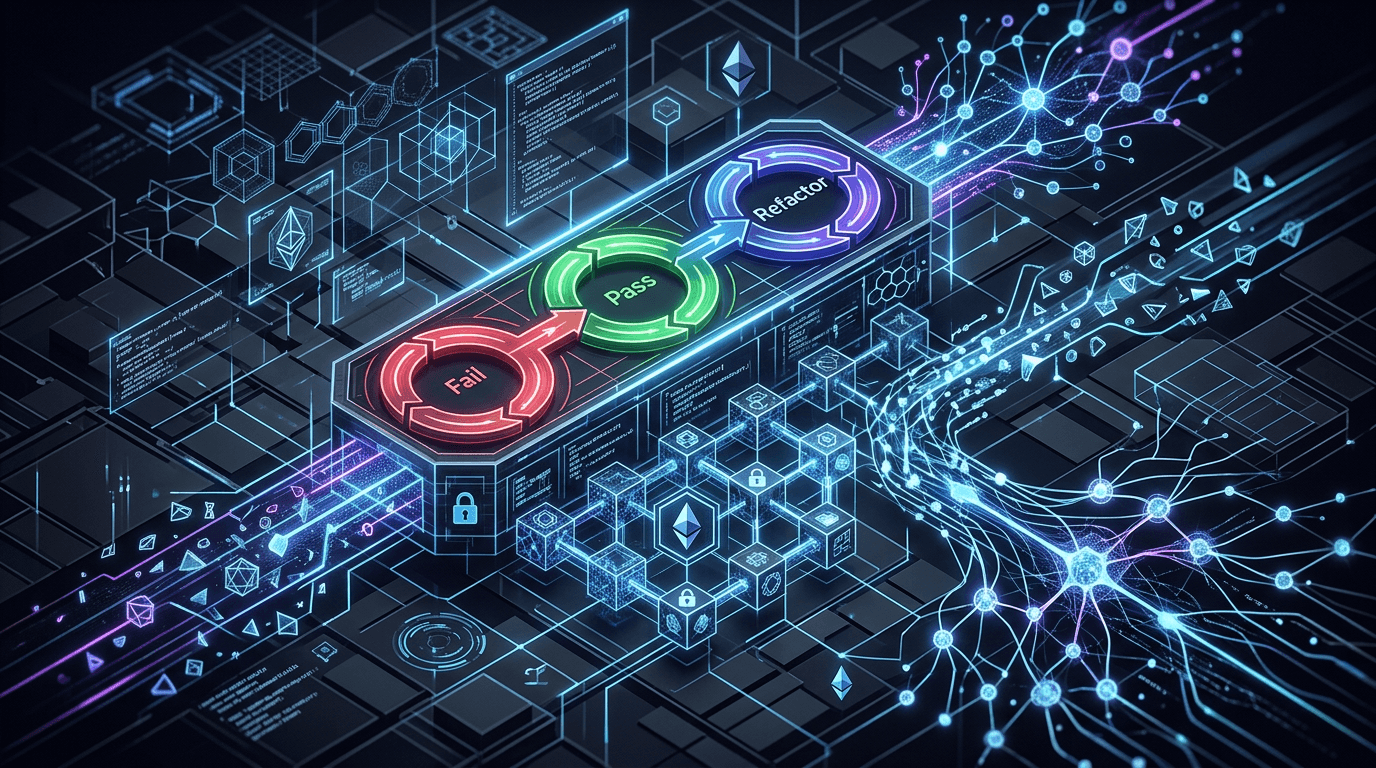
The TDD cycle of writing a failing test, implementing the minimum code to make it pass, and then refactoring for clarity and efficiency translates to Solidity with some important modifications. The refactor step is more constrained in smart contract development because gas optimization and security are often in tension. A refactoring that reduces gas consumption by restructuring storage access patterns can inadvertently introduce a reentrancy surface if the developer is not careful about the order of state updates relative to external calls. This means the test suite needs to cover not just functional correctness but also the security invariants that must hold across any refactoring.
In practice, this means writing tests that explicitly model the checks-effects-interactions pattern as an invariant, not just as a coding convention. A test that verifies a withdrawal function updates the user's balance before making an external call is not testing functionality in the traditional sense. It is testing a security property of the implementation. Foundry's invariant testing feature, which allows developers to define properties that must hold across an arbitrary sequence of function calls, is particularly well-suited to this kind of security-oriented TDD. Writing invariant tests before writing the implementation forces the developer to articulate what the contract must never do, which is often more valuable than specifying what it should do.
The discipline of writing tests first also creates a forcing function for interface clarity. When a developer writes a test for a function that does not yet exist, they are implicitly designing the function's interface from the perspective of a caller. In smart contract development, where the caller might be another contract, a frontend application, or an automated bot, this perspective shift catches interface design problems early. A function that is awkward to test is usually a function that is awkward to use safely, and catching that awkwardness before the implementation exists is significantly cheaper than refactoring after deployment.
Static Analysis as the First Gate
Static analysis occupies a specific and important position in a TDD workflow for smart contracts. It is not a replacement for tests, and it is not a substitute for a formal audit. It is a fast, automated first gate that runs before any test execution and surfaces a class of issues that tests are poorly suited to catch. Slither, for example, can analyze a Solidity file in seconds and produce a prioritized list of potential issues ranging from high-severity reentrancy vulnerabilities to informational notes about code style. Running Slither as a pre-commit hook or as the first step in a CI pipeline means that obvious issues never make it into the test cycle at all.
The integration of AI into static analysis is changing what this first gate can catch. Traditional static analyzers work from a fixed set of rules derived from known vulnerability patterns. They are precise within their rule set but blind to anything outside it. AI-powered analysis tools can learn from the corpus of historical exploits and identify structural patterns that resemble known attack vectors even when they do not match any specific rule. This is particularly valuable for DeFi protocols, where the interaction surface between contracts is complex and the economic incentives for attackers are high. A static analyzer that can flag a price oracle dependency as potentially manipulable, based on its structural similarity to contracts that have been exploited via flash loan attacks, provides a qualitatively different kind of signal than one that only checks for reentrancy.
The practical implication for teams adopting TDD is that static analysis results should feed directly into the test backlog. When Slither flags a potential issue, the correct response is not to dismiss it or to manually inspect the code and decide it is a false positive. The correct response is to write a test that either confirms the vulnerability or demonstrates that the code is safe in the specific context where the flag was raised. This creates a feedback loop between static analysis and the test suite that progressively hardens the codebase against the classes of issues that automated tools can detect.
Fuzzing Is Not Optional Anymore
Fuzz testing, the practice of generating large volumes of random or semi-random inputs and observing whether the contract behaves correctly, has moved from an advanced technique to a baseline expectation in serious smart contract development. Foundry's built-in fuzzer runs property-based tests by generating random inputs for any test function that accepts parameters, and it does this automatically without requiring any additional configuration. Echidna, developed by Trail of Bits, provides a more sophisticated fuzzing environment with support for stateful fuzzing, where the fuzzer maintains a model of the contract's state across multiple transactions and generates sequences of calls designed to reach unusual states.
The value of fuzzing in a TDD context is that it tests the properties the developer specifies rather than the specific inputs the developer imagined. A unit test that checks withdrawal behavior with a specific balance value of 1 ether tells you the contract works for that input. A fuzz test that checks the invariant that a user's balance after withdrawal is always less than or equal to their balance before withdrawal tells you the contract works for any input the fuzzer can generate, which after millions of iterations covers a much larger portion of the input space. The difference between these two approaches is not just quantitative. It reflects a fundamentally different way of thinking about what a test is supposed to prove.
AI is beginning to augment fuzzing in ways that go beyond random input generation. Intelligent fuzzers can analyze the contract's code to identify which input ranges are likely to trigger interesting behavior, focusing their generation effort on boundary conditions and state transitions rather than distributing it uniformly across the input space. Research from academic groups working on smart contract testing has demonstrated that coverage-guided fuzzing, where the fuzzer uses feedback from previous runs to steer toward unexplored code paths, can achieve significantly higher branch coverage than naive random fuzzing in the same number of iterations. When this kind of intelligent fuzzing is integrated into a TDD workflow, the test suite becomes a living document that grows more comprehensive with each CI run.
AI-Generated Test Cases and the Coverage Illusion
The ability of AI coding tools to generate test cases from a contract's source code is genuinely useful, and it is also genuinely dangerous if misunderstood. A language model that reads a Solidity contract and produces a Foundry test file can generate syntactically correct, semantically plausible tests in seconds. For a developer who is new to a codebase or who is working under time pressure, this capability is a significant productivity multiplier. The tests compile, they run, and the coverage report looks healthy. The problem is that coverage is not correctness, and AI-generated tests tend to reflect the same assumptions embedded in the production code they are testing.
This is a subtle but important point. When a developer writes a contract and then asks an AI tool to generate tests for it, the AI is essentially reading the implementation and writing tests that verify the implementation does what it appears to do. This is useful for catching obvious bugs, but it is structurally incapable of catching cases where the implementation does what it appears to do but the specification was wrong. A reentrancy vulnerability, for example, is not a case where the code does something unexpected. It is a case where the code does exactly what it was written to do, but the order of operations creates an exploitable window. An AI that generates tests from the implementation will generate tests that pass against the vulnerable implementation, because the tests are derived from the same mental model that produced the vulnerability.
The solution is not to avoid AI-generated tests. It is to use them as a starting point and then augment them with adversarial tests written from the perspective of an attacker rather than an implementer. This is where the TDD discipline matters most. If the test suite is written before the implementation, the AI is generating tests against a specification rather than against existing code, which produces a qualitatively different and more useful set of tests. Teams that use AI tools to generate tests after the fact should treat those tests as a coverage floor, not a security guarantee, and should explicitly add tests that model adversarial scenarios the AI is unlikely to generate on its own.
Learning from Deployed Contracts: On-Chain Test Migration
One of the more interesting developments in smart contract testing research is the idea of extracting test cases from real on-chain transaction data. The intuition is straightforward: the blockchain is a permanent record of every interaction that has ever occurred with every deployed contract, and that record contains an enormous amount of information about how contracts are actually used in practice. A test suite derived from real transaction patterns will, by definition, cover the usage scenarios that real users and real attackers have actually attempted, rather than the scenarios a developer imagined in advance.
Research published at ICSE 2025 formalized this approach in a tool called SOL MIGRATOR, which extracts transaction traces from deployed contracts and migrates them into executable test cases for new contracts with similar interfaces. The technique addresses one of the most persistent problems in smart contract testing, which is that manually writing test cases to cover all potential usage patterns for a stateful contract with multiple interacting functions requires an enormous amount of effort. SOL MIGRATOR demonstrated that on-chain test case migration can achieve meaningful coverage improvements over manually written test suites, particularly for the kinds of complex multi-step interactions that are most likely to contain exploitable vulnerabilities.
The practical implication for development teams is that the on-chain history of similar contracts is a testing resource that most teams are not currently using. If you are building a lending protocol, the transaction history of Aave, Compound, and every other lending protocol that has ever been deployed contains thousands of edge cases, including the ones that were exploited. Incorporating that history into your test suite, either through automated migration tools or through manual analysis of notable transactions, gives you a test suite that reflects the adversarial reality of the blockchain environment rather than the optimistic assumptions of the development team.
Hybrid Analysis: Combining Static and Dynamic Methods
The most effective testing strategies for smart contracts combine static analysis, dynamic testing, and formal verification in a layered approach where each method compensates for the weaknesses of the others. Static analysis is fast and catches structural issues without requiring execution, but it cannot reason about runtime state. Dynamic testing through unit tests and fuzzing exercises the contract's actual behavior but is limited by the inputs the test suite provides. Formal verification can prove properties about all possible executions, but it requires significant expertise and is computationally expensive for complex contracts. The practical question for most teams is not which method to use but how to sequence and integrate them efficiently.
A hybrid approach that works well in practice starts with static analysis as a pre-commit gate, moves to unit and fuzz testing in CI, and reserves formal verification for the highest-value invariants in the most critical contracts. AI tools are particularly useful at the integration points between these layers. An AI that can read a Slither report and automatically generate fuzz tests targeting the flagged code paths bridges the gap between static analysis and dynamic testing in a way that would otherwise require significant manual effort. Similarly, an AI that can analyze fuzz test failures and suggest formal verification targets helps teams prioritize their formal verification effort on the properties that fuzzing has already demonstrated are difficult to verify empirically.
The research community has been exploring hybrid analysis approaches for several years, and the results consistently show that combining methods catches more vulnerabilities than any single method in isolation. A 2025 study on generative AI-driven smart contract optimization found that contracts analyzed with hybrid static and dynamic methods had significantly lower rates of post-deployment vulnerability discovery than contracts analyzed with either method alone. The specific numbers vary by contract complexity and vulnerability class, but the directional finding is consistent: layered analysis is more effective, and AI tools are making it more accessible to teams that do not have dedicated security researchers on staff.
Mutation Testing and the Limits of Coverage Metrics
Line coverage and branch coverage are the metrics most commonly used to evaluate the quality of a smart contract test suite, and both are deeply misleading if treated as proxies for security. A test suite can achieve 100% line coverage while completely failing to test the security properties that matter most. The reason is that coverage metrics measure whether code was executed during testing, not whether the tests would catch a bug if one were introduced. A test that calls a function and asserts that it does not revert covers the lines in that function, but it does not verify that the function's output is correct, that its state changes are appropriate, or that it behaves correctly under adversarial conditions.
Mutation testing addresses this limitation by systematically introducing small changes to the contract's source code, mutations like flipping a greater-than to a less-than or removing a require statement, and then checking whether the test suite catches the change. A test suite that fails to detect a mutation is a test suite with a gap, regardless of what its coverage metrics say. Mutation testing is computationally expensive because it requires running the full test suite against each mutated version of the contract, but tools like Vertigo-rs have made it practical for Solidity codebases by optimizing the mutation generation and test execution pipeline.
AI tools are beginning to make mutation testing more accessible by automating the analysis of mutation survivors, the mutations that the test suite failed to catch. Rather than requiring a developer to manually inspect each surviving mutation and determine whether it represents a real gap or a semantically equivalent change, an AI can classify survivors by severity and suggest specific test cases that would catch the most dangerous ones. This closes the loop between mutation testing and test suite improvement in a way that makes the practice sustainable for teams without dedicated QA engineers.
Building a TDD Pipeline That Actually Ships
The gap between knowing that TDD is important for smart contracts and actually practicing it consistently is largely an infrastructure problem. When running a full test suite takes ten minutes, developers skip it. When setting up a new test requires understanding three different configuration files, developers write fewer tests. When the feedback loop between writing code and seeing test results is measured in minutes rather than seconds, the TDD discipline breaks down because the cognitive overhead of context-switching between implementation and testing becomes too high.
Building a TDD pipeline that teams actually use requires investing in the tooling layer before investing in the test suite itself. Foundry's test execution speed, which compiles and runs Solidity tests significantly faster than JavaScript-based frameworks, is one reason it has become the dominant choice for teams that take TDD seriously. Configuring Slither to run as a pre-commit hook takes about fifteen minutes and eliminates an entire class of issues from the CI pipeline. Setting up a GitHub Actions workflow that runs the full test suite, including fuzz tests with a reasonable iteration count, on every pull request creates the accountability structure that makes TDD a team practice rather than an individual preference.
AI-powered development environments are changing this infrastructure equation by embedding testing support directly into the coding workflow. When an IDE can suggest test cases as a developer writes a function, run the relevant tests automatically when a file is saved, and surface coverage gaps inline in the editor, the friction of TDD drops to near zero. The developer does not need to context-switch to a terminal to run tests or to a separate tool to check coverage. The feedback loop tightens to the point where writing tests first becomes the path of least resistance rather than an additional burden.
The Comprehension Problem in Test Suites
There is a version of the comprehension gap problem that applies specifically to test suites, and it is one that the Web3 development community has not fully reckoned with. When AI tools generate test cases, those tests can be syntactically correct and even semantically plausible without the developer who owns the codebase understanding what they are testing or why. A test suite full of AI-generated tests that nobody on the team fully understands is not a safety net. It is a false sense of security that may be more dangerous than no test suite at all, because it creates the impression of rigor without the substance.
This problem compounds over time. A test that was generated by an AI six months ago and has been passing ever since is a test that nobody has thought critically about in six months. When the contract is upgraded or when a new developer joins the team, that test is treated as authoritative documentation of the contract's expected behavior, even if the original generation was based on an incomplete understanding of the specification. The test suite becomes a source of truth that nobody wrote and nobody fully owns, which is a fragile foundation for a system that handles real financial value.
The solution is not to avoid AI-generated tests but to treat them as drafts that require human review and annotation before they are merged into the canonical test suite. Every test should have a comment that explains what property it is testing and why that property matters for the contract's security or correctness. This is not bureaucratic overhead. It is the minimum documentation required to make a test suite useful as a communication tool rather than just a CI gate. AI tools that can generate both the test code and a natural language explanation of what the test verifies make this practice significantly easier to maintain.
Where Cheetah AI Fits Into This Picture
The convergence of TDD discipline and AI-assisted test generation is not a future state. It is happening now, and the teams that are building the most secure smart contracts are the ones that have figured out how to use AI tools to accelerate their testing practice without letting those tools replace their judgment. The infrastructure to support this kind of development, where AI suggestions are fast and contextually relevant but the developer remains in the loop on every decision, is exactly what purpose-built crypto-native development environments are designed to provide.
Cheetah AI is built for this specific context. It understands Solidity semantics, knows the common vulnerability patterns in DeFi protocols, and can generate test cases that reflect adversarial scenarios rather than just happy-path coverage. More importantly, it keeps the developer in the loop by explaining what each generated test is checking and why, which addresses the comprehension problem directly rather than papering over it. For teams that are serious about TDD as a security practice rather than a coverage metric, having an IDE that treats testing as a first-class concern rather than an afterthought changes the daily development experience in ways that compound over time.
If you are building smart contracts and you are not yet practicing TDD with the rigor the stakes demand, Cheetah AI is a reasonable place to start. The tooling is there. The AI assistance is there. The gap between knowing TDD matters and actually doing it consistently has never been smaller.
What that looks like in practice is an environment where writing a test for a function you have not yet implemented takes roughly the same amount of time as writing the function itself, where the IDE surfaces relevant vulnerability patterns from similar contracts as you type, and where the feedback loop between a code change and a test result is measured in seconds. That kind of environment does not just make TDD easier. It makes the alternative, writing implementation code without tests, feel like the slower path, which is the only way TDD ever becomes a genuine team habit rather than a policy that gets abandoned under deadline pressure.

The broader point is that the smart contract ecosystem is at an inflection point where the tooling available to individual developers is catching up to the security requirements of the protocols they are building. A solo developer working on a DeFi contract in 2026 has access to static analysis, intelligent fuzzing, on-chain test migration, and AI-assisted test generation that would have required a dedicated security team to replicate three years ago. Cheetah AI is part of that shift, built specifically for the context where the code you write today may be handling significant financial value tomorrow, and where the cost of getting it wrong is not a rollback and a hotfix but a permanent loss. If that context resonates with how you think about your work, it is worth spending some time with an environment designed around the same assumptions.
Related Posts
Reasoning Agents: Rewriting Smart Contract Development
TL;DR:Codex CLI operates as a multi-surface coding agent with OS-level sandboxing, 1M context windows via GPT-5.4, and the ability to read, patch, and execute against live codebases, making


Web3 Game Economies: AI Dev Tools That Scale
TL;DR:On-chain gaming attracted significant capital throughout 2025, with the Blockchain Game Alliance's State of the Industry Report confirming a decisive shift from speculative token launc

Token Unlock Engineering: Build Safer Vesting Contracts
TL;DR:Vesting contracts control token release schedules for teams, investors, and ecosystems, often managing hundreds of millions in locked supply across multi-year unlock windows Time-lo