Generative UI for Web3: Engineering Dynamic dApp Interfaces
Static dApp interfaces are failing users at scale. Here is how generative UI and AI-driven component generation are reshaping the way Web3 applications get built and experienced.
Subscribe to our newsletter to get the latest updates and offers
* Will send you weekly updates on new features, tips, and developer resources.
Why Static Interfaces Are Failing Web3 Users
TL;DR:
- Generative UI uses AI models to produce interface components dynamically at runtime, replacing the static component trees that have defined dApp development since Ethereum's early days
- Natural language interaction layers are reducing the technical barrier to entry for DeFi and NFT platforms, with early implementations showing 30 to 40 percent improvements in task completion rates among non-technical users
- AI-driven data visualization is becoming essential for communicating on-chain complexity, particularly in DeFi protocols where a single transaction can involve five or more contract interactions
- Component generation pipelines using models like GPT-4o and Claude 3.5 Sonnet are cutting frontend scaffolding time by 60 to 70 percent in production Web3 teams
- Predictive testing frameworks powered by AI can simulate thousands of wallet states and user flows before a single line of interface code reaches a testnet
- Wallet abstraction and contextual onboarding, when driven by AI, reduce drop-off rates at the connection step by surfacing the right wallet options and guidance based on user context
- The convergence of AI agents and blockchain interfaces is producing a new class of dApp where the UI itself is a runtime artifact, not a static deliverable
The result: Generative UI is not a design trend for Web3, it is an architectural shift that changes how dApps are built, tested, and experienced at every layer of the stack.
The dApp interface problem has been hiding in plain sight for years. While the Web3 ecosystem has poured enormous engineering effort into protocol design, consensus mechanisms, and smart contract security, the layer that most users actually interact with has remained largely static, fragile, and hostile to anyone who did not already understand how blockchain transactions work. The average DeFi protocol today presents users with raw token addresses, gas estimation dialogs, and transaction confirmation flows that assume a level of technical literacy that the broader market simply does not have. This is not a minor UX inconvenience. It is a structural barrier that limits adoption at scale.
The numbers reflect this clearly. Wallet connection abandonment rates on DeFi platforms routinely exceed 60 percent among first-time users, and the average time-to-first-transaction for a new user on a complex protocol like a multi-hop DEX aggregator or a yield optimizer can stretch to 15 minutes or more. These are not acceptable metrics for any consumer-facing software product, and they represent a compounding problem as the protocols themselves grow more sophisticated. Every new feature added to a DeFi protocol, every additional contract interaction in a transaction path, every new chain supported in a multi-chain deployment, adds another layer of complexity that a static interface has to somehow communicate to a user who may be encountering the concept of gas fees for the first time.
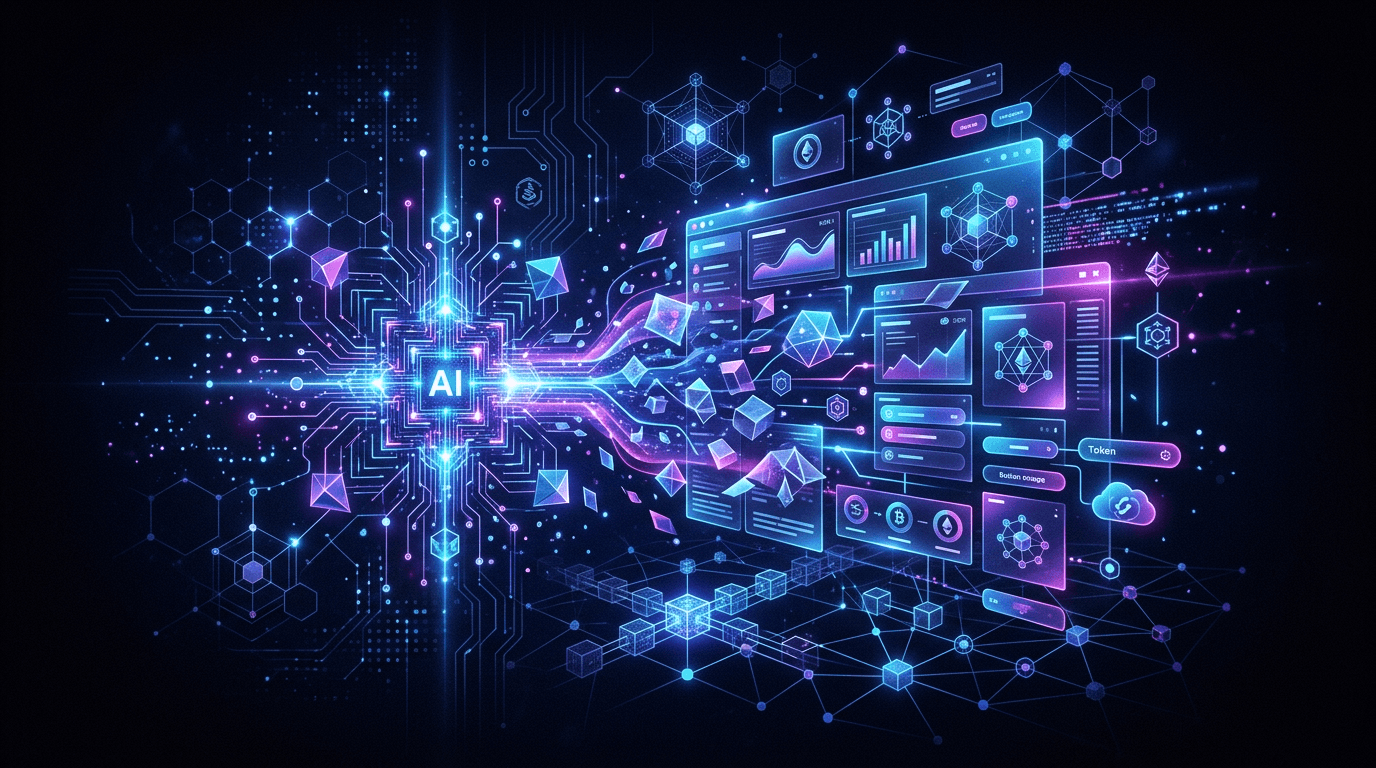
Generative UI is the architectural response to this problem. Rather than building a fixed component tree that attempts to anticipate every possible user state and protocol interaction in advance, generative UI systems use AI models to produce interface components dynamically, in response to the actual context of the user's session, their wallet state, their transaction history, and the specific protocol they are interacting with. This is a fundamentally different approach to frontend development, and it has implications that extend well beyond design aesthetics into the core engineering decisions that Web3 teams make every day.
The UX Debt That Web3 Has Been Accumulating
The Web3 ecosystem has a UX debt problem that predates the current AI moment by several years. The earliest dApps were built by protocol engineers who were primarily focused on getting the on-chainlogic correct before worrying about how it looked. That was a reasonable prioritization in 2017 and 2018, when the primary users of these systems were other developers and crypto-native early adopters who were willing to tolerate rough interfaces in exchange for access to novel financial primitives. The problem is that the industry never fully graduated from that mindset. As protocols matured and capital inflows grew, the interface layer received incremental improvements rather than fundamental rethinking. Teams added better error messages, cleaner modal designs, and mobile-responsive layouts, but the underlying model remained the same: a static React application that reads from a set of known contract ABIs and renders a predetermined set of components.
This approach breaks down in several specific ways that are worth naming precisely. First, it cannot adapt to the user's actual knowledge level. A wallet that has never interacted with a lending protocol gets the same interface as one that has executed 500 supply and borrow transactions. Second, it cannot communicate the full complexity of a transaction before the user signs it. A Uniswap V3 swap routed through three pools with a permit2 signature and a fee-on-transfer token involves a chain of contract calls that a static confirmation dialog reduces to a single "confirm swap" button, hiding the actual execution path entirely. Third, it cannot respond to protocol upgrades without a full frontend deployment cycle. When a protocol adds a new feature or modifies its contract interface, the frontend team has to manually update the component tree, write new UI logic, and ship a new build, a process that can take days or weeks and creates a window where the interface is out of sync with the actual on-chain state.
The cumulative effect of these limitations is a class of software that consistently underperforms its underlying protocol. The smart contracts powering Aave, Compound, or Uniswap are genuinely sophisticated pieces of financial infrastructure. The interfaces sitting on top of them often feel like they were built in a weekend, not because the teams building them lack skill, but because the static interface model is fundamentally mismatched with the dynamic, stateful, and highly contextual nature of on-chain interactions.
What Generative UI Actually Means at the Engineering Level
Generative UI is a term that gets used loosely, so it is worth being precise about what it means in a Web3 engineering context. At its core, generative UI refers to systems where interface components are produced by an AI model at runtime, based on a structured description of the current application state, the user's context, and the available interaction primitives. This is distinct from AI-assisted code generation, where a developer uses a tool like GitHub Copilot or Cheetah AI to write component code faster. In a generative UI system, the AI is not helping a developer write components ahead of time. It is producing the components themselves, on demand, as part of the application's runtime behavior.
The technical architecture for this typically involves three layers working together. The first is a context layer that aggregates the relevant state: the user's wallet address, their on-chain history, the current protocol state read from contract calls, and any session-level preferences or prior interactions. The second is a generation layer, usually a large language model with structured output capabilities, that takes the context as input and produces a component specification, either as a JSON schema describing the UI structure or as actual JSX/TSX code that gets evaluated at runtime. The third is a rendering layer that takes the generated specification and produces the actual DOM elements the user sees, applying design system tokens and accessibility constraints in the process.
In practice, teams building generative UI for Web3 are using a combination of tools to implement this architecture. Vercel's AI SDK, which introduced the concept of streamable UI components through its streamUI and generateObject functions, has become a common foundation for the generation and rendering layers. On the context side, teams are using libraries like Viem and Wagmi to read on-chain state efficiently, feeding that data into the prompt context alongside wallet metadata. The result is a system where the interface can respond to the actual state of the blockchain in real time, not just the state that was anticipated when the frontend was originally built.
Natural Language as a First-Class Interface Primitive
One of the most consequential shifts that generative UI enables in Web3 is the elevation of natural language from a supplementary help feature to a primary interaction primitive. In a traditional dApp, natural language appears at the margins: a tooltip here, a help article link there, maybe a chatbot widget that answers FAQ-style questions. In a generative UI system, natural language becomes the mechanism through which users express intent, and the AI layer translates that intent into the appropriate on-chain actions and interface states.
The practical implications of this are significant. Consider a user who wants to maximize yield on a stablecoin position across multiple protocols. In a traditional DeFi interface, this requires the user to navigate to each protocol separately, understand the current APY figures, calculate the opportunity cost of moving funds, and manually execute the rebalancing transactions. In a generative UI system, the user can express this intent in plain language, and the AI layer can surface a dynamically generated interface that shows the relevant yield comparison, calculates the net benefit after gas costs, and presents a single confirmation flow for the entire rebalancing operation. The interface components for this flow do not need to exist in the codebase ahead of time. They are generated in response to the specific request.
Early implementations of this pattern are showing meaningful results. Teams that have integrated natural language intent layers into DeFi interfaces report task completion rate improvements in the 30 to 40 percent range for non-technical users, with the largest gains coming from complex multi-step operations that previously required users to understand the underlying protocol mechanics. The reduction in support burden is also notable: when users can describe what they want to accomplish rather than having to figure out which sequence of UI interactions achieves that goal, the volume of "how do I" support tickets drops substantially. This is not a soft benefit. For a protocol team running a lean operation, reducing support load by even 20 percent frees up meaningful engineering time.
The engineering challenge here is maintaining accuracy and safety. A natural language interface that misinterprets user intent in a financial context can produce real financial harm. A user who says "move my ETH to earn yield" and gets routed into a high-risk leveraged position because the AI misread the risk tolerance signal has a legitimate grievance. This is why the best implementations of natural language interfaces in Web3 pair the generation layer with explicit confirmation steps that show the user exactly what on-chain actions will be taken before any transaction is signed, and why the prompt engineering for these systems needs to be treated with the same rigor as smart contract security.
AI-Driven Data Visualization for On-Chain Complexity
On-chain data is inherently complex, and the challenge of communicating that complexity to users is one of the most underappreciated problems in dApp development. A single DeFi transaction can involve interactions with five or more contracts, produce a dozen or more on-chain events, and affect the user's position across multiple protocols simultaneously. Communicating what actually happened in a transaction, and what the user's current state looks like as a result, requires a level of data visualization sophistication that static interfaces rarely achieve.
Generative UI opens up a different approach here. Rather than building a fixed set of charts and tables that display a predetermined set of metrics, AI-driven visualization systems can analyze the user's on-chain data and generate the most relevant visual representation for their specific situation. A user with a complex DeFi portfolio spanning lending positions, liquidity pool shares, and staked assets across three chains does not need the same dashboard as a user who holds a single ERC-20 token. Generative visualization can produce a tailored view that surfaces the metrics most relevant to each user's actual holdings and risk profile, using the same underlying data but presenting it in a form that matches the complexity of their specific situation.
The tooling for this is maturing quickly. Libraries like Recharts and Nivo provide the rendering primitives, and when combined with AI models that can analyze on-chain data and produce structured visualization specifications, they enable a level of dashboard personalization that would require months of manual development to achieve through traditional means. Teams building portfolio trackers and analytics tools on top of protocols like The Graph, which indexes on-chain data and makes it queryable via GraphQL, are finding that AI-driven visualization generation can reduce the time to build a meaningful analytics view from weeks to days. The AI handles the translation from raw subgraph data to a visualization specification; the developer handles the integration and the design system constraints.
Component Generation Pipelines in Practice
The practical workflow for building generative UI in a Web3 project looks different from traditional frontend development in several important ways. Rather than starting with a Figma file and translating it into a component library, teams building generative UI systems start by defining the space of possible interface states and the data structures that describe them. This is closer to API design than traditional UI design, and it requires frontend engineers to think more carefully about the semantic structure of their interface rather than its visual appearance.
In a typical implementation, the component generation pipeline starts with a schema definition layer. The team defines the types of components that can be generated, the data they require, and the constraints they must satisfy. This schema serves as the contract between the AI generation layer and the rendering layer, ensuring that generated components are always valid and renderable. Tools like Zod are commonly used for this schema definition in TypeScript-based projects, and the structured output capabilities of models like GPT-4o and Claude 3.5 Sonnet make it straightforward to constrain generation to schema-valid outputs.
The generation step itself typically involves a prompt that includes the current application context, the user's wallet state, the relevant on-chain data, and the component schema. The model produces a structured output that describes the components to render, their props, and their layout relationships. This output is then passed to the rendering layer, which instantiates the actual React components and applies the design system. The entire pipeline, from context aggregation to rendered UI, can execute in under two seconds on modern infrastructure, which is fast enough for most interactive use cases in a dApp context where users are already accustomed to waiting for blockchain confirmations.
Production Web3 teams that have adopted this pipeline report frontend scaffolding time reductions of 60 to 70 percent compared to traditional component-by-component development. The gains are largest for protocol-specific views that need to handle many different states, such as a lending protocol dashboard that needs to display different information depending on whether the user has active borrows, is at risk of liquidation, has unclaimed rewards, or is interacting with the protocol for the first time. In a static interface, each of these states requires a separate component or a complex conditional rendering tree. In a generative UI system, the AI handles the state differentiation and produces the appropriate component structure automatically.
Predictive Testing and Simulated Wallet States
Testing is one of the areas where generative UI creates the most leverage for Web3 development teams, and also one of the areas where the approach diverges most sharply from traditional frontend testing practices. In a static dApp, frontend testing typically involves a combination of unit tests for individual components, integration tests for wallet connection flows, and manual QA against a testnet. This approach works reasonably well when the interface has a fixed structure, but it breaks down when the interface itself is generated dynamically, because the space of possible outputs is too large to enumerate manually.
AI-driven predictive testing addresses this by generating test cases from the same model that generates the interface. Given the component schema and the range of possible wallet states, a testing framework can use an AI model to generate thousands of representative wallet configurations and simulate the interface output for each one, checking for rendering errors, accessibility violations, and logical inconsistencies without requiring a human to manually specify each test case. This is a fundamentally different testing model, closer to property-based testing than traditional example-based testing, and it is particularly well-suited to the combinatorial complexity of DeFi interfaces where a user's state is defined by dozens of variables across multiple protocols and chains.
The tooling for this is still maturing, but teams are already building effective predictive testing pipelines using a combination of Foundry for on-chain state simulation, Playwright for browser-level rendering tests, and custom AI-driven test case generation layers that produce realistic wallet state fixtures. The key insight is that the same AI model that understands the component schema well enough to generate valid interface components also understands it well enough to generate valid test inputs, creating a tight feedback loop between generation and validation. Teams that have implemented this approach report finding interface bugs in edge-case wallet states that would never have been caught by manually written test suites, simply because no human tester would have thought to construct those specific combinations of on-chain positions.
Wallet Abstraction and Contextual Onboarding
Wallet connection is the single highest-friction point in the dApp user journey, and it is the place where generative UI has the most immediate impact on conversion and retention. The traditional wallet connection flow presents users with a modal listing every supported wallet provider, from MetaMask to WalletConnect to Coinbase Wallet to a dozen others, and expects them to know which one they have and how to use it. For users who are new to Web3, this is a disorienting experience that frequently results in abandonment. For users who are experienced but connecting from a new device or browser, it is an unnecessary friction point that adds time to every session.
Generative UI enables a contextual onboarding approach where the wallet connection flow is tailored to the user's detected environment and inferred experience level. By analyzing signals like the browser's injected providers, the device type, the referral source, and any prior session data, an AI layer can generate a connection flow that surfaces the most relevant options first and provides the appropriate level of guidance for the user's apparent experience level. A user arriving from a mobile device with no injected provider gets a flow that guides them through setting up a mobile wallet. A user arriving from a desktop browser with MetaMask already injected gets a single-click connection option. A user who has connected before but is on a new device gets a flow that acknowledges their prior history and offers the most likely reconnection path.
This contextual approach, when implemented well, reduces wallet connection abandonment rates significantly. Teams that have moved from static wallet modals to AI-driven contextual connection flows report drop-off reductions of 25 to 35 percent at the connection step, with the largest improvements among users who are new to the specific protocol but not entirely new to Web3. The combination of wallet abstraction libraries like Privy and Dynamic, which handle the underlying connection mechanics, with AI-driven context layers that determine what to show and when, is becoming a standard pattern for production dApps that are serious about onboarding at scale.
The Agent-Driven Interface: When UI Becomes a Runtime Artifact
The most forward-looking development in generative UI for Web3 is the emergence of agent-driven interfaces, where the UI is not just generated dynamically but is produced and modified by an AI agent that is actively pursuing a goal on behalf of the user. This is a meaningful architectural departure from even the most sophisticated generative UI systems described so far, because it changes the relationship between the user and the interface from one of navigation to one of delegation.
In an agent-driven interface, the user specifies an intent at a high level, and an AI agent takes responsibility for determining the sequence of on-chain actions required to fulfill that intent, generating the interface components needed to communicate each step, and managing the transaction flow from start to finish. The interface components are not just generated in response to user input; they are generated by the agent as part of its execution plan, surfaced to the user for confirmation at appropriate checkpoints, and updated in real time as the agent's understanding of the optimal execution path evolves. This is the model that frameworks like Vercel's AG-UI protocol and Anthropic's tool use API are enabling, and it is already appearing in production Web3 applications in the form of AI-powered trading assistants and automated portfolio management tools.
The engineering challenges here are substantial. Agent-driven interfaces require careful design of the confirmation and override mechanisms that keep the user in control of their funds at all times. They require robust error handling for the case where an agent's planned execution path becomes invalid due to on-chain state changes between planning and execution. And they require a level of transparency about what the agent is doing and why that goes beyond what most current AI interfaces provide. Getting these details right is the difference between an agent-driven interface that users trust and one that they abandon after the first unexpected transaction. The teams that are solving these problems well are treating the agent's decision-making process as a first-class UI concern, not an implementation detail.
Security Considerations in Generative Interface Systems
Introducing AI-driven component generation into a dApp's frontend stack creates a new class of security considerations that Web3 teams need to think through carefully. The most obvious risk is prompt injection, where malicious content in on-chain data or user-provided input is crafted to manipulate the AI generation layer into producing interface components that mislead the user about the nature of a transaction. A token name that contains carefully crafted text designed to influence the AI's output, for example, could potentially cause a generative UI system to display incorrect transaction details or suppress important warnings.
Defending against this requires treating all on-chain data as untrusted input in the prompt construction layer, applying the same sanitization discipline that web developers apply to user input in SQL queries or HTML rendering contexts. It also requires designing the component schema to separate the display of user-controlled data from the display of system-generated guidance, so that even if on-chain data influences the visual presentation of a component, it cannot influence the security-critical information like transaction amounts, recipient addresses, and contract interaction types. These are solvable engineering problems, but they require explicit attention during the design of the generation pipeline, not as an afterthought.
There is also the question of what happens when the AI generation layer produces incorrect output due to model error rather than adversarial input. In a traditional static interface, a rendering bug produces a visual glitch. In a generative UI system, a generation error could produce a component that displays incorrect financial information or omits a critical warning. This is why the best generative UI implementations in Web3 maintain a set of invariant checks that run on every generated component before it is rendered, verifying that the displayed transaction details match the actual on-chain data regardless of what the generation layer produced. The AI handles the presentation logic; the invariant layer handles the correctness guarantees.
Building Generative dApp Interfaces with Cheetah AI
The shift from static to generative interfaces in Web3 is not a distant future state. It is happening now, in production applications, built by teams that have decided the UX debt of the static model is no longer acceptable. The engineering patterns described in this article, from component generation pipelines to predictive testing to agent-driven interfaces, are all implementable today with the tools and models that are currently available. The question for most Web3 development teams is not whether to adopt generative UI, but how to build the capability to do it well without losing the security discipline and correctness guarantees that on-chain applications require.
This is precisely the kind of problem that Cheetah AI was built to help with. As a crypto-native AI IDE, Cheetah AI understands the specific constraints of Web3 frontend development: the need to reason about wallet states and contract ABIs, the importance of keeping transaction details accurate and auditable, and the challenge of building interfaces that are both dynamically responsive and provably correct. When you are scaffolding a generative UI pipeline for a DeFi protocol, or designing the component schema that will govern your AI generation layer, or writing the invariant checks that ensure your generated components never display incorrect transaction data, having an IDE that understands the Web3 context at a deep level makes a meaningful difference in how fast you can move and how confident you can be in what you ship.
If you are building a dApp and the gap between your protocol's capabilities and your interface's ability to communicate them is starting to feel like a liability, generative UI is worth a serious look. And Cheetah AI is worth having open while you build it.
The broader point is that generative UI is not a feature you add to a dApp. It is a different way of thinking about what a dApp interface is. When the interface is a runtime artifact rather than a static deliverable, the relationship between your frontend codebase and your protocol changes fundamentally. Your codebase becomes a set of primitives and constraints, and the AI layer becomes the thing that assembles them into the right experience for each user in each moment. That is a more powerful model, and it is one that the Web3 ecosystem is only beginning to explore seriously. The teams that build fluency with it now will have a meaningful advantage as the protocols they are building on continue to grow in complexity and the user base they are trying to reach continues to grow in diversity.
Related Posts

Cheetah Architecture: Building Intelligent Code Search
Building Intelligent Code Search: A Hybrid Approach to Speed and Relevance TL;DR: We built a hybrid code search system that:Runs initial text search locally for instant response

Reasoning Agents: Rewriting Smart Contract Development
TL;DR:Codex CLI operates as a multi-surface coding agent with OS-level sandboxing, 1M context windows via GPT-5.4, and the ability to read, patch, and execute against live codebases, making
The New Bottleneck: AI Shifts Code Review
TL;DR:AI coding assistants now account for roughly 42% of all committed code, a figure projected to reach 65% by 2027, yet teams using these tools are delivering software slower and less rel