Concurrent Agents: Engineering Parallel Smart Contract Development
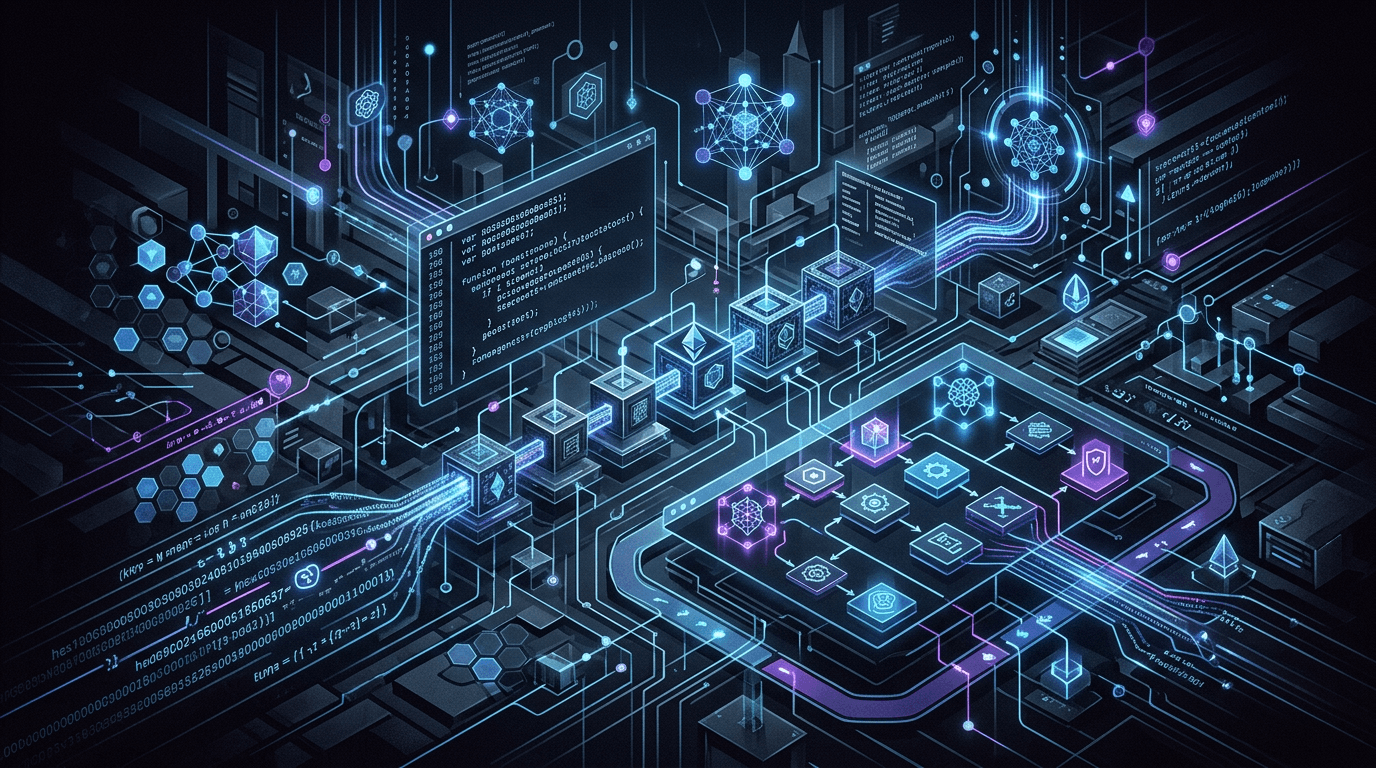
Multi-agent IDEs are enabling parallel smart contract development workflows that eliminate merge conflicts and compress audit cycles. Here is how the architecture works and why it matters for Web3 teams.
Subscribe to our newsletter to get the latest updates and offers
* Will send you weekly updates on new features, tips, and developer resources.
Why Parallel Agents Are Rewriting the Rules of Smart Contract Development
TL;DR:
- Sequential development workflows create compounding bottlenecks in smart contract projects, where a single developer context window cannot hold the full complexity of a modern DeFi protocol
- Multi-agent systems decompose development into specialized roles, with distinct agents handling planning, implementation, security review, and test generation running concurrently rather than in sequence
- Andrew Ng identified parallel agents as a critical new direction for scaling AI performance in August 2025, noting that parallelization improves results without increasing user wait time
- By the end of 2026, up to 75% of companies are expected to invest in agentic systems according to Deloitte's State of AI Report, with autonomous coordination becoming a baseline expectation across the industry
- The merge conflict problem that plagues traditional parallel development is structurally eliminated in multi-agent workflows through isolated execution contexts and orchestrated state management
- Smart contract security benefits disproportionately from parallel agent architectures, where a dedicated audit agent can run static analysis concurrently with a separate implementation agent writing new contract logic
- The IDE is becoming the primary orchestration surface for multi-agent workflows, shifting from a text editor with autocomplete to a coordination layer for concurrent autonomous processes
The result: Parallel AI agents are not a productivity enhancement for smart contract teams, they are a structural rethinking of how complex on-chain software gets built.
The Sequential Development Problem Nobody Has Solved
The way most smart contract teams work today is fundamentally sequential. A developer writes a function, waits for a colleague to review it, incorporates feedback, writes tests, waits for a CI pipeline to run, and then moves to the next function. This linear chain of dependencies made sense when the primary constraint was human attention, but it creates compounding bottlenecks as protocol complexity grows. A modern DeFi protocol, whether a lending market, a perpetuals exchange, or a cross-chain bridge, can involve dozens of interdependent contracts, each with its own storage layout, access control logic, and upgrade path. Holding all of that in a single developer's working memory, or a single AI agent's context window, is not realistic at production scale.
The problem compounds when you factor in the security requirements unique to smart contract development. Unlike traditional software, where a bug can be patched in a hotfix and deployed within hours, a deployed smart contract is immutable by default. The cost of a missed vulnerability is not a degraded user experience or a support ticket, it is a permanent loss of funds. This asymmetry means that the review and audit phases of smart contract development cannot be treated as afterthoughts or compressed into a single pass at the end of a sprint. They need to run continuously, in parallel with implementation, not sequentially after it.
The tooling that most teams use today was not designed for this reality. Traditional IDEs like VS Code with Solidity extensions, or even purpose-built environments like Remix, are fundamentally single-agent tools. They surface one developer's view of one file at a time. They do not have a native concept of concurrent work streams, parallel review processes, or coordinated multi-role workflows. The result is that teams compensate with process overhead: pull request queues, manual audit checklists, and synchronous code review sessions that serialize what could otherwise be parallel work. The bottleneck is not developer skill or protocol complexity, it is the architecture of the tools themselves.
What Multi-Agent Architecture Actually Means for a Codebase
A multi-agent system, in the context of software development, is a network of autonomous AI processes that each maintain their own context, pursue their own objectives, and communicate with other agents through defined interfaces. The key word is autonomous. These are not sequential steps in a pipeline where one process hands off to the next. They are concurrent processes that can observe shared state, make independent decisions, and produce outputs that other agents consume in real time. The distinction matters because it changes the fundamental throughput model of development from serial to parallel, and the performance implications of that shift are not incremental.
In practice, a multi-agent development system for smart contracts might decompose a feature request into several concurrent workstreams. A planning agent analyzes the specification and produces a structured task breakdown, identifying which contracts need to be modified, which interfaces need to change, and which invariants need to be preserved. Simultaneously, a security agent begins scanning the existing codebase for patterns that the proposed changes might interact with, building a risk map before a single line of new code is written. An implementation agent starts drafting the contract logic based on the planning agent's output, while a test generation agent begins writing property-based tests against the specification. None of these processes wait for the others to complete before starting.
The architecture that makes this possible is not fundamentally different from what distributed systems engineers have been building for decades. Each agent operates in an isolated execution context with its own memory and tool access. An orchestrator process manages the coordination layer, routing messages between agents, resolving conflicts when two agents produce incompatible outputs, and maintaining a shared representation of the codebase state that all agents can read from and write to. The hard part, as practitioners in the multi-agent space consistently note, is context management. Deciding what information each agent needs, when it needs it, and how to prevent agents from working on stale or conflicting state is the engineering challenge that separates functional multi-agent systems from ones that produce incoherent output.
Specialization as a First-Class Design Principle
The reason multi-agent systems outperform single-agent systems on complex tasks is not raw compute, it is specialization. A single AI agent asked to simultaneously plan a feature, implement it, review it for security vulnerabilities, and write tests for it is being asked to context-switch constantly between fundamentally different cognitive modes. Planning requires holding a high-level view of the system and reasoning about dependencies. Implementation requires deep focus on a specific function's logic. Security review requires adversarial thinking, actively looking for ways the code could be exploited. Test generation requires reasoning about edge cases and invariants. These are not the same task, and optimizing for all of them simultaneously in a single context window produces mediocre results across the board.
Specialized agents sidestep this problem by giving each role its own dedicated context and its own optimized configuration. A security-focused agent can be built with deep knowledge of known Solidity vulnerabilitypatterns, common reentrancy vectors, integer overflow conditions, and access control antipatterns accumulated across years of on-chain exploits. It does not need to also understand the product requirements or the deployment pipeline. Its entire context budget is allocated to adversarial analysis, which means it catches things that a generalist agent running in a mixed-mode context would miss.
This specialization principle maps directly onto how experienced smart contract teams already organize themselves. Senior teams do not have one person who simultaneously architects, implements, and audits. They have distinct roles with distinct responsibilities, and the quality of the output reflects that separation. Multi-agent systems formalize this structure at the tooling layer, making it available to teams that do not have the headcount to staff every role with a dedicated human expert. A two-person team using a well-configured multi-agent IDE can operate with the effective review coverage of a much larger organization, because the agents handling security review and test generation are running continuously rather than being scheduled around human availability.
The Merge Conflict Problem Is Structurally Different Here
One of the most cited advantages of multi-agent parallel development is the elimination of merge conflicts, and it is worth being precise about why this is true rather than treating it as a marketing claim. In traditional parallel development, merge conflicts arise because two developers modify the same file or the same lines of code without awareness of each other's changes. The version control system detects the divergence and requires a human to reconcile it. This is a coordination failure, and it happens because the two developers are working in isolated contexts without a shared real-time view of what the other is doing.
Multi-agent systems solve this at the architecture level rather than the process level. In a well-designed multi-agent workflow, agents do not write to the same files simultaneously. The orchestrator maintains a task graph that assigns ownership of specific contracts or modules to specific agents, and that ownership is exclusive for the duration of the task. An implementation agent working on a lending pool contract and a separate implementation agent working on an oracle integration are not competing for the same files. They are working in parallel on genuinely independent units of work, and the orchestrator is responsible for integrating their outputs once both are complete. The conflict resolution problem does not disappear entirely, but it moves from an unpredictable, human-resolved event to a deterministic, orchestrator-managed process.
The deeper reason this works in smart contract development specifically is that well-architected Solidity codebases are already modular by necessity. Gas optimization, upgrade patterns, and security best practices all push toward small, focused contracts with clearly defined interfaces. A lending protocol built on a pattern like the one Aave uses, with separate contracts for pool logic, interest rate models, price oracles, and collateral management, has natural seams where parallel work can happen without interference. Multi-agent systems exploit those seams systematically, assigning agents to modules in a way that mirrors the architectural boundaries already present in the codebase.
Security Agents and the Concurrent Audit Model
The traditional smart contract audit model is sequential by design. A team finishes writing code, freezes the codebase, and sends it to an external auditor who spends two to four weeks reviewing it. The auditor produces a report, the team addresses findings, and the process repeats until both parties are satisfied. This model made sense when auditing required deep human expertise that was scarce and expensive, but it creates a structural problem: the audit happens after the code is written, which means that architectural decisions made early in development, decisions that might have been made differently with security input, are already baked in by the time anyone looks for vulnerabilities.
Concurrent security agents change this model fundamentally. Rather than a single audit pass at the end of development, a security agent runs continuously alongside the implementation agent, analyzing each new function as it is written and flagging issues before they propagate into dependent contracts. This is not the same as running a static analysis tool like Slither or Mythril in a CI pipeline, though those tools remain valuable. A security agent operating in a multi-agent IDE has access to the full context of what the implementation agent is building, including the intent behind the code, the specification it is implementing, and the broader system architecture. It can reason about whether a new function introduces a reentrancy risk given the specific call graph of this particular protocol, not just whether it matches a generic reentrancy pattern.
The practical impact of this shift is significant. Research on AI-assisted security analysis has demonstrated that AI agents can identify exploitable vulnerabilities in real-world smart contracts at a rate that would take human auditors considerably longer to match. When that capability runs concurrently with development rather than sequentially after it, the feedback loop compresses from weeks to minutes. A developer writing a new withdrawal function gets a security analysis of that function before they move on to the next task, not three weeks later when the entire codebase has been built on top of a flawed assumption. The cost of fixing a vulnerability found during development is orders of magnitude lower than the cost of fixing one found after deployment, and concurrent security agents make early detection the default rather than the exception.
How Orchestration Works in Practice
The orchestration layer is the part of a multi-agent system that most developers interact with least directly but that determines whether the system produces coherent output or chaotic noise. An orchestrator is responsible for decomposing a high-level task into subtasks, assigning those subtasks to appropriate agents, managing the dependencies between them, and integrating the results into a coherent whole. In a smart contract development context, this means the orchestrator needs to understand the structure of the codebase, the relationships between contracts, and the order in which changes need to be made to avoid breaking existing functionality.
Tools like Claude Code's subagent system, which practitioners have used to run product manager, UX designer, and senior software engineer agents in parallel to produce fully-formed feature specifications in minutes, demonstrate what this looks like at a practical level. The orchestrator in that workflow is not just dispatching tasks, it is managing the information flow between agents so that the output of the planning agents feeds into the implementation agents in a structured way. For smart contract development, the equivalent workflow might involve a specification agent producing a formal description of a new protocol feature, a planning agent decomposing that specification into a set of contract modifications, and implementation and security agents working in parallel on each modification, with the orchestrator ensuring that the security agent's findings are incorporated into the implementation agent's output before the changes are finalized.
The tooling ecosystem for multi-agent orchestration is maturing rapidly. Frameworks like LangGraph, CrewAI, and purpose-built CLI tools provide the scaffolding for defining agent roles, managing inter-agent communication, and handling the state synchronization that makes parallel execution coherent. What has been missing until recently is deep integration between these orchestration frameworks and the development environment itself, the IDE where developers actually spend their time. When orchestration lives in a separate tool that developers have to context-switch into, the friction is high enough that most teams do not adopt it. When it is embedded in the IDE, it becomes part of the natural development workflow.
The Context Management Challenge at Scale
Context management is, as practitioners consistently note, the hardest problem in multi-agent systems. Each agent in a parallel workflow has a finite context window, and the decisions about what information to include in that window directly determine the quality of the agent's output. An implementation agent that does not have access to the security constraints defined in the project's specification might write technically correct code that violates a critical invariant. A security agent that does not have visibility into the full call graph of the protocol might miss a vulnerability that only manifests through a specific sequence of cross-contract interactions.
The challenge is compounded in smart contract development by the fact that the relevant context is not just the code itself. It includes the protocol's economic model, the threat model that the security design is built around, the upgrade path that the proxy pattern enables, and the external dependencies like price oracles and liquidity pools that the protocol interacts with. A multi-agent system that only has access to the Solidity source files is working with an incomplete picture. Production-grade multi-agent IDEs need to ingest and index all of this context, making it available to agents in a structured way that does not exhaust their context budgets on irrelevant information.
The emerging solution to this problem is hierarchical context management, where a shared knowledge base holds the full project context and individual agents query it for the specific information relevant to their current task. Rather than loading an entire protocol's codebase into every agent's context window, the orchestrator retrieves and injects only the contracts, interfaces, and documentation that are directly relevant to the task at hand. This approach mirrors how experienced developers actually work: they do not hold an entire codebase in their head simultaneously, they know where to look for the information they need and retrieve it on demand. Building that same retrieval capability into multi-agent systems is what makes them scale to production-grade protocol complexity.
Parallel Agents and the Test Coverage Problem
Test coverage in smart contract development is notoriously difficult to achieve at meaningful depth. Property-based testing with tools like Foundry's fuzzer or Echidna can surface edge cases that unit tests miss, but writing good invariant tests requires deep understanding of the protocol's intended behavior and the ways it could be violated. This is time-consuming work that often gets deprioritized when development timelines are tight, which is precisely when the risk of shipping undertested code is highest.
Parallel test generation agents address this problem by running concurrently with implementation rather than after it. As an implementation agent writes a new function, a test generation agent analyzes the function's inputs, outputs, and state transitions and begins writing property-based tests that probe its behavior under adversarial conditions. The test agent does not need to wait for the implementation to be complete to start working. It can generate tests against the specification and the partial implementation simultaneously, producing a test suite that is ready to run as soon as the implementation is finalized. In practice, this compresses the time to meaningful test coverage from days to hours on complex DeFi contracts.
The quality of AI-generated tests has improved substantially as models have been trained on larger corpora of smart contract code and vulnerability disclosures. A test generation agent with access to a curated dataset of historical exploits can write tests that specifically probe for the vulnerability patterns that have caused the most damage in production protocols. Reentrancy tests, flash loan attack simulations, and oracle manipulation scenarios can all be generated automatically and run against new code as part of the parallel development workflow. This does not replace the judgment of an experienced security engineer, but it raises the baseline coverage that every function receives before a human reviewer ever looks at it.
What This Means for Deployment Pipelines
The downstream effects of parallel agent development on deployment pipelines are significant. When security review and test generation happen concurrently with implementation, the code that reaches the deployment pipeline is already in a substantially more reviewed state than code produced by sequential workflows. The CI/CD pipeline is no longer the first place that automated security analysis runs, it is the last checkpoint in a process that has been running continuously throughout development. This changes what the pipeline needs to do and how long it takes to do it.
In a traditional smart contract deployment pipeline, the security scanning step is often the longest-running job because it is doing work that should have been done earlier. Running Slither against a large protocol codebase, executing a full Foundry test suite including fuzz tests, and generating a coverage report can take thirty minutes or more. When those same analyses have been running incrementally throughout development, the pipeline can focus on integration-level checks rather than repeating work that has already been done. The result is faster deployment cycles without any reduction in security coverage, which is the combination that production Web3 teams have been trying to achieve for years.
The deployment pipeline also benefits from the structured outputs that multi-agent workflows produce. When a planning agent has generated a formal task breakdown and an implementation agent has produced code that explicitly references that breakdown, the audit trail connecting specification to implementation is machine-readable. Automated compliance checks can verify that every requirement in the specification has a corresponding implementation and a corresponding test, without requiring a human to manually trace those connections. For protocols operating in regulated environments or seeking institutional adoption, this kind of structured traceability is increasingly a requirement rather than a nice-to-have.
The IDE as the New Orchestration Layer
The shift from IDE as text editor to IDE as orchestration layer is the most significant architectural change happening in developer tooling right now. For most of software development history, the IDE's job was to help a single developer write code faster: syntax highlighting, autocomplete, inline error detection, and integrated debugging. These are all single-developer, single-context tools. They optimize for the experience of one person working on one file at a time.
Multi-agent development requires a fundamentally different kind of tool. The IDE needs to display the state of multiple concurrent agents, show which parts of the codebase each agent is currently working on, surface conflicts and dependencies between agent workstreams, and provide the developer with enough visibility to intervene when an agent is heading in the wrong direction. This is closer to a project management interface than a traditional code editor, but it needs to be both simultaneously. The developer still needs to read and write code directly, but they also need to coordinate a team of agents that are doing the same thing in parallel.
The tooling ecosystem is converging on this model from several directions. Orchestration frameworks are adding IDE integrations. AI coding assistants are adding multi-agent capabilities. And purpose-built environments are being designed from the ground up with concurrent agent workflows as the primary use case rather than an afterthought. The teams that figure out how to make this orchestration layer feel natural, how to give developers the right level of visibility and control without overwhelming them with agent state, will define what professional smart contract development looks like for the next several years.
Building the Future of Smart Contract Development with Cheetah AI
The convergence of multi-agent orchestration, specialized AI roles, and concurrent security analysis is not a distant possibility. The architectural patterns are established, the tooling primitives exist, and teams that have adopted parallel agent workflows are already reporting compression in development cycles that would have seemed implausible two years ago. What has been missing is a development environment built specifically for Web3 that integrates these capabilities at the IDE layer rather than requiring developers to assemble them from disparate tools.
Cheetah AI is built around the premise that smart contract development is a fundamentally different discipline from general software engineering, and that the tools supporting it should reflect that difference. The multi-agent workflows that parallel development requires, the concurrent security analysis that irreversible on-chain deployment demands, and the context management that production-grade protocol complexity necessitates are all first-class concerns in how Cheetah AI is designed. If you are building on-chain and you are still working with sequential, single-agent tooling, the gap between what you are using and what is now possible is worth taking seriously.
What Cheetah AI offers is not just faster code generation. It is a rethinking of the development loop itself, where planning, implementation, security review, and test generation happen in parallel rather than in sequence, where the IDE surfaces the state of concurrent agent workstreams rather than a single file view, and where the feedback between security analysis and implementation is measured in seconds rather than weeks. For teams building production protocols where the cost of a missed vulnerability is measured in user funds rather than support tickets, that structural difference is what matters.

If you want to see what parallel agent development looks like in a purpose-built Web3 environment, Cheetah AI is where that work is happening.
Related Posts

Cheetah Architecture: Building Intelligent Code Search
Building Intelligent Code Search: A Hybrid Approach to Speed and Relevance TL;DR: We built a hybrid code search system that:Runs initial text search locally for instant response

Reasoning Agents: Rewriting Smart Contract Development
TL;DR:Codex CLI operates as a multi-surface coding agent with OS-level sandboxing, 1M context windows via GPT-5.4, and the ability to read, patch, and execute against live codebases, making

The New Bottleneck: AI Shifts Code Review
TL;DR:AI coding assistants now account for roughly 42% of all committed code, a figure projected to reach 65% by 2027, yet teams using these tools are delivering software slower and less rel