AI Service Layer: Engineering Autonomous Deployment Pipelines
Autonomous AI agents are reshaping how smart contracts get built, audited, and shipped. Here is what a production-grade AI-powered deployment pipeline actually looks like.
Subscribe to our newsletter to get the latest updates and offers
* Will send you weekly updates on new features, tips, and developer resources.
The Architecture Shift Redefining Smart Contract Deployment
TL;DR:
- AI agents evaluated on the SCONE-bench dataset of 405 real-world exploited contracts identified $4.6M in exploitable vulnerabilities, establishing a concrete economic baseline for what autonomous exploitation capability looks like in practice
- Claude Opus 4.5, Claude Sonnet 4.5, and GPT-5 collectively uncovered two novel zero-day vulnerabilities in 2,849 recently deployed contracts with no prior known vulnerabilities, demonstrating that autonomous offensive capability is already technically feasible
- Autonomous deployment pipelines are shifting from rule-based CI/CD configurations to AI-driven decision trees that can halt, reroute, or escalate deployments based on real-time risk signals
- The irreversibility of smart contract deployment makes pre-deployment AI analysis a structural requirement, not a performance optimization
- Multi-agent architectures are emerging as the dominant pattern for production-grade Web3 deployment, with specialized agents handling security scanning, gas optimization, and state verification in parallel
- AI-powered arbitration and verification frameworks are moving smart contract governance from human-in-the-loop to human-on-the-loop models, where developers set policy and agents execute within defined boundaries
- The tooling layer is where AI and blockchain convergence is most practically expressed, and purpose-built IDEs are becoming the coordination surface for autonomous deployment workflows
The result: Autonomous AI deployment pipelines are not a future state for Web3 teams, they are the present architecture for any team that takes irreversibility seriously.
The way smart contracts get deployed has not kept pace with the complexity of what is being deployed. For most teams, the pipeline still looks roughly the same as it did five years ago: write Solidity or Vyper, run a static analyzer like Slither or MythX, maybe run a Foundry test suite, and then push to mainnet through a deployment script that someone wrote once and has been copy-pasted ever since. The process is manual at its core, even when it is wrapped in automation. A developer makes a judgment call at nearly every stage, and those judgment calls are only as good as the developer's familiarity with the specific vulnerability classes that have emerged since the last time they audited a contract of this type.
What is changing is not just the tooling available to developers, but the fundamental model of how deployment decisions get made. AI is moving from being a passive assistant that surfaces suggestions to being an active service layer that sits between the developer's intent and the chain's immutable state. This is not a subtle shift. It changes the accountability model, the risk surface, and the architecture of the pipeline itself. Understanding what that shift actually looks like in practice, and what it demands from the teams building on top of it, is the central question this piece is trying to answer.
Why Traditional CI/CD Breaks in a Blockchain Context
The CI/CD patterns that work well for web services and microservices were designed around a core assumption: deployment is reversible. If a bad build ships to production, you roll it back. If a configuration error causes an outage, you patch it and redeploy. The entire philosophy of continuous delivery is built on the idea that fast feedback loops and low-cost rollbacks make it safe to ship frequently. That assumption does not hold in a blockchain context, and the failure to internalize that difference is responsible for a significant portion of the production incidents that have defined Web3's security track record.
When a smart contract is deployed to Ethereum mainnet, or to any EVM-compatible chain, the bytecode is permanent. The logic encoded in that deployment is the logic that will govern every transaction that contract ever processes, unless an upgrade mechanism was explicitly built in, and upgrade mechanisms introduce their own attack surface. A reentrancy vulnerability that would be a two-hour incident in a traditional web application becomes a permanent financial liability on-chain. The Moonwell DeFi protocol's $1.78M exploit, traced to AI-generated vulnerable code, is a concrete example of what happens when the comprehension gap between code that exists and code that developers actually understand gets exploited in an environment where there is no rollback button.
Traditional CI/CD tooling also was not designed to reason about the semantic properties of smart contracts. Tools like GitHub Actions, CircleCI, and Jenkins are excellent at running test suites, checking code style, and managing deployment artifacts. They are not equipped to evaluate whether a given contract's access control logic is sound, whether a flash loan attack vector exists in a DeFi integration, or whether the gas optimization choices made during development create exploitable edge cases under specific network conditions. Adapting these tools to a blockchain context requires purpose-built integrations, and even with those integrations, the fundamental limitation remains: rule-based pipelines can only catch the vulnerability classes they were explicitly programmed to look for.
The Anatomy of an Autonomous Deployment Pipeline
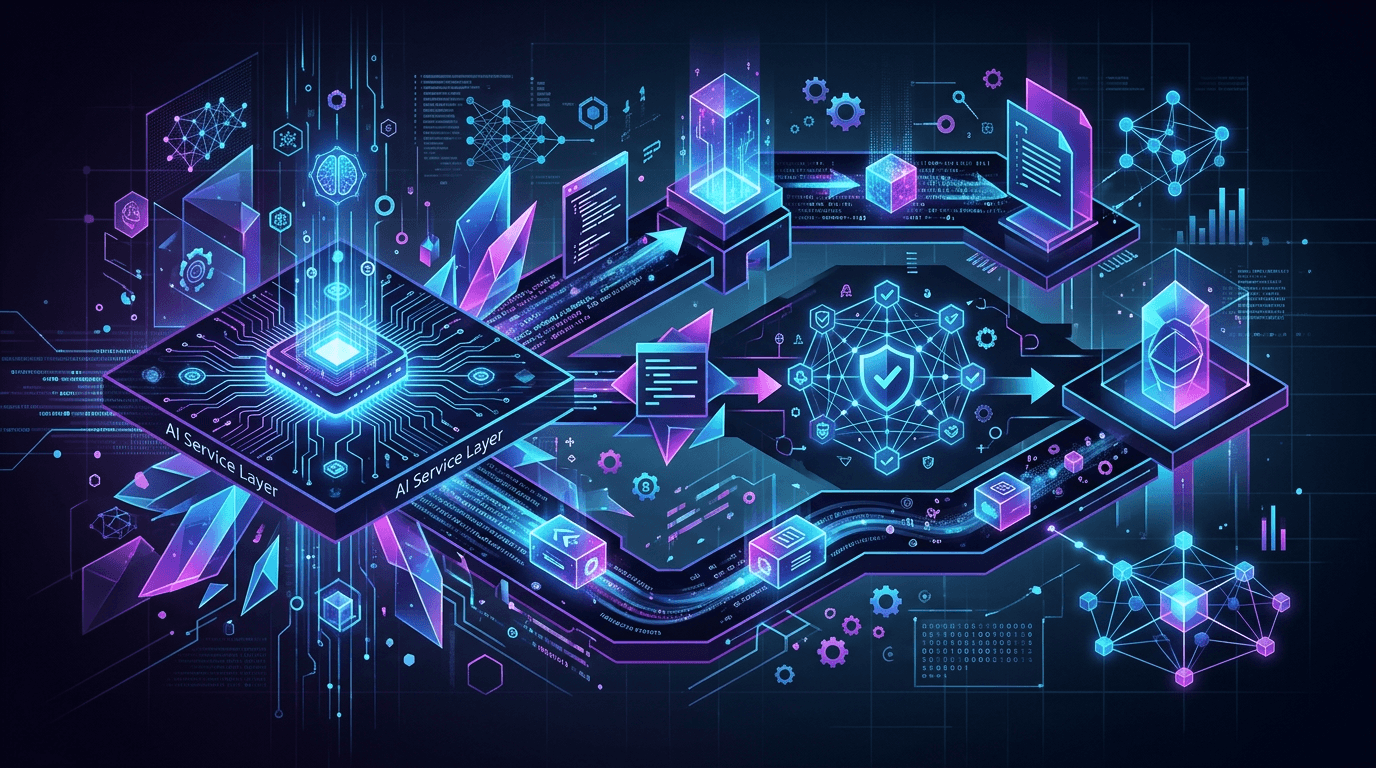
An autonomous smart contract deployment pipeline looks structurally different from a traditional CI/CD workflow in several important ways. The most significant difference is that the decision-making layer is no longer a static configuration file. Instead of a YAML file that says "run tests, then deploy if tests pass," an autonomous pipeline uses an AI service layer that evaluates the deployment against a dynamic risk model, considers the current state of the chain, checks the contract's behavior against a simulation environment, and makes a recommendation or takes an action based on the aggregate signal.
In practice, this means the pipeline has several distinct stages that operate with different levels of autonomy. The first stage is static analysis, where an AI agent reviews the contract source code for known vulnerability patterns, using a combination of rule-based checks and learned representations of vulnerability classes from historical exploit data. This is where tools like Slither and Semgrep provide the rule-based foundation, and where AI models trained on exploit datasets add the pattern-recognition layer that catches novel variants of known vulnerability classes. The second stage is simulation, where the contract is deployed to a forked mainnet environment and subjected to a battery of adversarial transactions designed to probe the attack surface. This is where Foundry's forking capabilities and Hardhat's simulation environment become the execution substrate for AI-generated test cases.
The third stage is the decision layer itself, where the AI service aggregates the signals from static analysis and simulation, weights them against the deployment context (is this a new protocol or an upgrade to an existing one, what is the total value locked at risk, what is the upgrade path if a vulnerability is discovered post-deployment), and produces a deployment recommendation with an associated confidence score and a structured explanation of the risk factors that informed it. The fourth stage is post-deployment monitoring, where on-chain event indexing and anomaly detection agents watch for transaction patterns that deviate from expected behavior. This is not a passive logging layer; it is an active surveillance system that can trigger alerts or, in more advanced implementations, initiate circuit-breaker mechanisms when anomalous activity is detected.
AI as the Security Layer, Not an Afterthought
The traditional model of smart contract security treats auditing as a gate that happens before deployment. You write the code, you send it to an audit firm, you wait several weeks, you receive a report, you fix the critical findings, and then you deploy. This model has two fundamental problems. The first is that it is slow, and in a market where protocol launches are time-sensitive, the audit gate creates pressure to compress the review timeline or to ship with open findings that are classified as low severity. The second problem is that it treats security as a binary state: audited or not audited. In reality, security is a continuous property that degrades over time as the protocol integrates with new contracts, as the DeFi ecosystem around it evolves, and as new vulnerability classes are discovered.
AI as a service layer changes this model by making security analysis continuous rather than episodic. Instead of a single audit gate before deployment, the pipeline runs security analysis at every commit, every pull request, and every deployment candidate. The AI agent does not replace the human auditor for complex protocol-level security review, but it handles the high-volume, pattern-matching work that currently consumes a significant portion of audit time. Research on AI-powered vulnerability detection has shown that models trained on historical exploit data can surface reentrancy vulnerabilities, integer overflow risks, and access control gaps with meaningful accuracy, and can do so in seconds rather than days.
The more important shift is that AI security analysis can be tuned to the specific risk profile of the protocol being deployed. A lending protocol has a different attack surface than a bridge, which has a different attack surface than an NFT marketplace. A static rule set treats all contracts the same. An AI service layer that understands the semantic context of the contract being analyzed can weight its findings accordingly, flagging oracle manipulation risks more aggressively for a DeFi protocol that relies on price feeds, and flagging cross-chain message validation issues more aggressively for a bridge contract. This context-sensitivity is what makes AI a genuine improvement over rule-based static analysis, rather than just a faster version of the same thing.
The $4.6M Proof Point: What AI Agents Found in the Wild
The most concrete evidence that autonomous AI agents are capable of meaningful security work in a smart contract context comes from research published by Anthropic's red team in December 2025. The team evaluated AI agents against SCONE-bench, a benchmark comprising 405 smart contracts that were actually exploited between 2020 and 2025. On contracts exploited after the models' knowledge cutoffs, Claude Opus 4.5, Claude Sonnet 4.5, and GPT-5 collectively developed exploits worth $4.6 million, establishing what the researchers described as a concrete lower bound for the economic harm these capabilities could enable.
The more operationally significant finding was what happened when the same agents were evaluated against 2,849 recently deployed contracts with no known vulnerabilities. Both Sonnet 4.5 and GPT-5 uncovered two novel zero-day vulnerabilities and produced exploits worth $3,694. GPT-5 accomplished this at an API cost of $3,476, which means the cost of autonomous vulnerability discovery is already approaching the point where it is economically viable as a continuous monitoring service rather than a one-time audit. The researchers were careful to note that all testing was conducted in blockchain simulators, with no impact on real-world assets, but the proof-of-concept is clear: profitable, real-world autonomous exploitation is technically feasible today.
The implication for deployment pipeline design is direct. If AI agents can find exploitable vulnerabilities in deployed contracts at a cost that is approaching economic viability for attackers, then the same class of tools needs to be running on the defender's side before deployment, not after. The asymmetry between offense and defense in smart contract security has historically favored attackers, because attackers only need to find one vulnerability while defenders need to find all of them. AI-powered defensive pipelines do not eliminate that asymmetry, but they compress it significantly by running the same class of adversarial analysis that an attacker would run, before the contract is live.
Simulation Environments and the Isolated Execution Problem
One of the architectural requirements for an autonomous deployment pipeline that is often underspecified is the simulation environment. Running AI-generated adversarial tests against a contract requires an execution environment that is isolated from the live chain but faithful enough to the live chain's state that the test results are meaningful. This is a harder problem than it sounds. A forked mainnet environment captures the state of the chain at a specific block, but DeFi protocols are deeply interdependent, and a contract's behavior under adversarial conditions often depends on the state of the protocols it integrates with.
Foundry's forking capabilities provide a reasonable starting point for this. The ability to fork mainnet at a specific block and run a full test suite against that fork is a significant improvement over testing against a local development chain that does not reflect real-world state. But for an autonomous pipeline that is running continuous security analysis, the forking approach has limitations. The fork is a snapshot, not a live environment, and the adversarial test cases generated by an AI agent need to be evaluated against the range of states the contract might encounter in production, not just the state at the time of the fork.
The more sophisticated approach, which is emerging in production-grade autonomous pipelines, is to use a combination of forked state and simulation-based state generation. The AI agent generates a set of adversarial scenarios based on its analysis of the contract's logic, and the simulation environment generates the chain state that each scenario requires. This allows the pipeline to test the contract against conditions that do not currently exist on the live chain but could plausibly exist in the future, including flash loan attacks that require specific liquidity conditions, oracle manipulation attacks that require specific price feed states, and governance attacks that require specific token distribution states. The goal is not to enumerate every possible attack, but to cover the attack surface that the AI agent's analysis identifies as highest risk.
Self-Optimizing Pipelines: From Static Rules to Dynamic Risk Assessment
The term "self-optimizing" gets used loosely in discussions of AI-powered tooling, but in the context of deployment pipelines it has a specific meaning. A self-optimizing pipeline is one that updates its risk model based on the outcomes of previous deployments, the evolution of the threat landscape, and the feedback from post-deployment monitoring. This is distinct from a pipeline that simply runs a fixed set of checks faster than a human could.
In practice, self-optimization in a deployment pipeline looks like this: the AI service layer maintains a risk model that is updated continuously based on new exploit data, new vulnerability disclosures, and the results of post-deployment monitoring for contracts that have already been deployed through the pipeline. When a new vulnerability class is discovered in the wild, the risk model is updated to weight that class more heavily in future analyses. When a contract deployed through the pipeline is exploited, the pipeline's analysis of that contract is reviewed to understand why the vulnerability was not caught, and the model is updated accordingly. This is a feedback loop that does not exist in a static rule-based pipeline, and it is what makes the AI service layer genuinely adaptive rather than just automated.
The gas optimization dimension of self-optimization is also worth noting. Gas costs on EVM chains are not static; they vary with network congestion, with the specific opcodes used in a contract, and with the interaction patterns of the contracts a given protocol integrates with. An AI service layer that has visibility into historical gas usage patterns for similar contracts can make deployment timing recommendations, flag contracts whose gas profiles suggest they will be prohibitively expensive to interact with under normal network conditions, and suggest specific optimization patterns that have been validated against the protocol's specific use case. This is the kind of context-sensitive optimization that a static linter cannot provide.
Multi-Agent Coordination in Production Deployment
The most architecturally interesting development in autonomous deployment pipelines is the emergence of multi-agent coordination patterns. Rather than a single AI agent that handles all aspects of the deployment analysis, production-grade pipelines are increasingly using specialized agents that operate in parallel and coordinate through a shared state representation of the deployment candidate.
The coordination pattern typically looks like this: a security agent handles vulnerability analysis and adversarial testing, a gas optimization agent handles cost analysis and opcode-level optimization recommendations, a state verification agent handles the analysis of the contract's interaction with existing on-chain state, and an orchestration agent coordinates the outputs of the specialized agents and produces the final deployment recommendation. Each specialized agent has a narrower scope and can be trained or fine-tuned on data that is specific to its domain. The security agent benefits from training on exploit datasets; the gas optimization agent benefits from training on historical gas usage data; the state verification agent benefits from training on the interaction patterns of the specific protocol ecosystem the contract is being deployed into.
The coordination challenge in this architecture is non-trivial. The specialized agents may produce conflicting recommendations, and the orchestration agent needs a principled way to resolve those conflicts. A contract that passes security analysis but fails gas optimization analysis presents a different risk profile than a contract that fails security analysis but passes everything else. The orchestration agent needs to understand the relative weights of these signals in the context of the specific deployment, and those weights are not fixed. A contract managing $100M in user funds has a different risk tolerance than a contract managing $10K in a testnet environment. Building the orchestration layer to be context-sensitive rather than applying a fixed weighting scheme is one of the harder engineering problems in autonomous pipeline design.
On-Chain Verification and Post-Deployment Monitoring
Deployment is not the end of the pipeline; it is the beginning of the monitoring phase. For autonomous pipelines, post-deployment monitoring is not a separate system bolted on after the fact. It is an integral part of the pipeline architecture, and the monitoring agents share state with the deployment agents so that anomalies detected post-deployment can inform the risk model for future deployments.
On-chain event indexing is the foundation of post-deployment monitoring. Tools like The Graph and custom indexing infrastructure built on top of Ethereum's event log provide the raw data stream that monitoring agents consume. But raw event data is not sufficient for meaningful anomaly detection. The monitoring agent needs a model of what normal behavior looks like for the specific contract being monitored, and that model needs to account for the full range of legitimate interaction patterns, including high-volume periods, unusual but legitimate transaction sequences, and the interaction patterns of other protocols that integrate with the monitored contract.
AI-driven anomaly detection in this context is meaningfully different from threshold-based alerting. A threshold-based system fires an alert when a specific metric exceeds a predefined value, for example, when a single address withdraws more than a certain amount in a single transaction. An AI-driven system models the joint distribution of multiple signals and fires an alert when the observed pattern is anomalous relative to the learned distribution, even if no individual metric exceeds its threshold. This is the difference between catching a known attack pattern and catching a novel attack pattern that does not match any previously observed exploit. Given that the most damaging exploits in DeFi history have tended to be novel rather than repetitions of known patterns, the distinction matters.
The Developer Experience at the Center of All of This
It is easy to describe autonomous deployment pipelines in terms of their technical architecture and lose sight of the fact that they are ultimately tools that developers use. The sophistication of the underlying AI service layer is irrelevant if the developer experience is poor, if the pipeline produces so many false positives that developers learn to ignore its recommendations, or if the interface between the developer's workflow and the pipeline's analysis is so friction-heavy that teams route around it.
The developer experience challenge in autonomous pipeline design has several dimensions. The first is signal quality. An AI security agent that flags every potential vulnerability with equal urgency trains developers to treat all findings as noise. The pipeline needs to produce findings that are ranked by severity, contextualized by the specific deployment scenario, and accompanied by enough explanation that a developer can make an informed decision about whether to act on the finding or accept the risk. This requires the AI service layer to produce structured, human-readable output, not just a list of vulnerability identifiers.
The second dimension is integration with the developer's existing workflow. A pipeline that requires developers to leave their IDE, navigate to a separate dashboard, and manually trigger analysis is a pipeline that will be used inconsistently. The most effective autonomous pipelines are the ones that surface their analysis directly in the developer's editing environment, at the point in the workflow where the developer is making decisions about the code. This is where the IDE becomes the coordination surface for the entire pipeline, and where the choice of development environment has a direct impact on the quality of the deployment process. When the AI service layer is embedded in the IDE rather than bolted on as an external tool, the feedback loop between writing code and understanding its deployment risk becomes tight enough to actually change how developers write code, not just how they review it before shipping.
Building on the Right Foundation
The teams that are getting autonomous deployment pipelines right are not the ones with the most sophisticated AI models. They are the ones that have thought carefully about the architecture of the pipeline as a whole, the quality of the data that feeds the AI service layer, and the integration between the pipeline and the developer's daily workflow. The AI models matter, but they are not the differentiating factor. The differentiating factor is the system design.
For Web3 teams building on this architecture today, the practical starting point is not to try to build a fully autonomous pipeline from scratch. It is to identify the highest-risk stages of the existing deployment process and introduce AI-assisted analysis at those stages first. For most teams, that means starting with pre-deployment security analysis, because the cost of a missed vulnerability is highest there and the feedback loop is most direct. From there, the pipeline can be extended to include simulation-based adversarial testing, gas optimization analysis, and post-deployment monitoring as the team builds confidence in the AI service layer's recommendations and develops the operational practices needed to act on them effectively.
The research from Anthropic's red team makes the stakes concrete. If AI agents can find $4.6M in exploitable vulnerabilities in historical contracts and uncover zero-day vulnerabilities in recently deployed contracts at an API cost of a few thousand dollars, then the question is not whether to invest in AI-powered defensive pipelines. The question is how quickly those pipelines can be made robust enough to stay ahead of the offensive capability that the same class of tools enables. That is a race that the Web3 industry is currently running, and the teams that are building the right tooling infrastructure are the ones that will be positioned to win it.
The IDE as the Deployment Pipeline's Front Door
Cheetah AI was built on the premise that the IDE is not just where code gets written; it is where deployment decisions get made. Every line of Solidity that a developer writes in Cheetah AI is written in an environment that understands the deployment context, the security implications of the code being written, and the pipeline that will carry that code from the editor to the chain. The AI service layer is not a separate tool that developers consult before deployment. It is embedded in the editing experience, surfacing analysis at the point where it can actually influence the code rather than just review it after the fact.
If you are building smart contracts and your current deployment pipeline still relies on manual judgment calls at the stages where the cost of error is highest, Cheetah AI is worth a closer look. The autonomous pipeline architecture described in this piece is not a theoretical future state. It is the architecture that Cheetah AI is built to support, and the teams using it are shipping with a level of pre-deployment confidence that the traditional audit-and-deploy model cannot match.
The broader point is that the IDE is the most natural coordination surface for an autonomous deployment pipeline because it is where the developer's intent is first expressed in code. Every other stage of the pipeline is downstream of that moment. If the AI service layer can influence the code at the point of authorship, it can prevent entire categories of vulnerability from entering the pipeline at all, rather than catching them at a later stage where the cost of remediation is higher and the pressure to ship is greater. That is the architectural insight that separates purpose-built Web3 IDEs from general-purpose editors with blockchain plugins, and it is the insight that Cheetah AI is built around.

If your team is at the stage where autonomous deployment pipelines feel like a future investment rather than a present need, the $4.6M figure from Anthropic's research is a useful calibration point. The offensive capability is already here. The defensive tooling is available. The gap between teams that have closed that loop and teams that have not is widening, and it is widening faster than the traditional audit cycle can accommodate. Cheetah AI is where that loop gets closed.
Related Posts

Cheetah Architecture: Building Intelligent Code Search
Building Intelligent Code Search: A Hybrid Approach to Speed and Relevance TL;DR: We built a hybrid code search system that:Runs initial text search locally for instant response

Reasoning Agents: Rewriting Smart Contract Development
TL;DR:Codex CLI operates as a multi-surface coding agent with OS-level sandboxing, 1M context windows via GPT-5.4, and the ability to read, patch, and execute against live codebases, making
The New Bottleneck: AI Shifts Code Review
TL;DR:AI coding assistants now account for roughly 42% of all committed code, a figure projected to reach 65% by 2027, yet teams using these tools are delivering software slower and less rel