Smart Contract Auditing: Data Science Meets Web3 Security
How data science engineering practices like reproducible pipelines, RAG models, and multi-modal deep learning are transforming AI-assisted smart contract auditing at scale.
Subscribe to our newsletter to get the latest updates and offers
* Will send you weekly updates on new features, tips, and developer resources.
Overview
TL;DR:
- Smart contract auditing is a high-stakes discipline where a single missed vulnerability can result in losses exceeding hundreds of millions of dollars, as seen in the $611M Ronin bridge hack and the original $60M DAO exploit.
- Data science software engineering practices, including reproducible pipelines, feature extraction from bytecode and abstract syntax trees, and model versioning, are being applied directly to AI-assisted auditing workflows.
- Retrieval-augmented generation models allow audit tools to match new contract code against curated knowledge bases of known vulnerability patterns, improving detection accuracy without retraining from scratch.
- Multi-modal deep learning frameworks combine static analysis outputs, control flow graphs, and natural language processing to surface vulnerabilities that single-method tools consistently miss.
- Integrating AI audit tooling into CI/CD pipelines transforms security review from a one-time pre-deployment gate into a continuous monitoring practice embedded in the development lifecycle.
- The result: audit workflows that are faster, more reproducible, and more thorough than traditional manual review alone, without eliminating the expert judgment required to catch the most complex attack vectors.
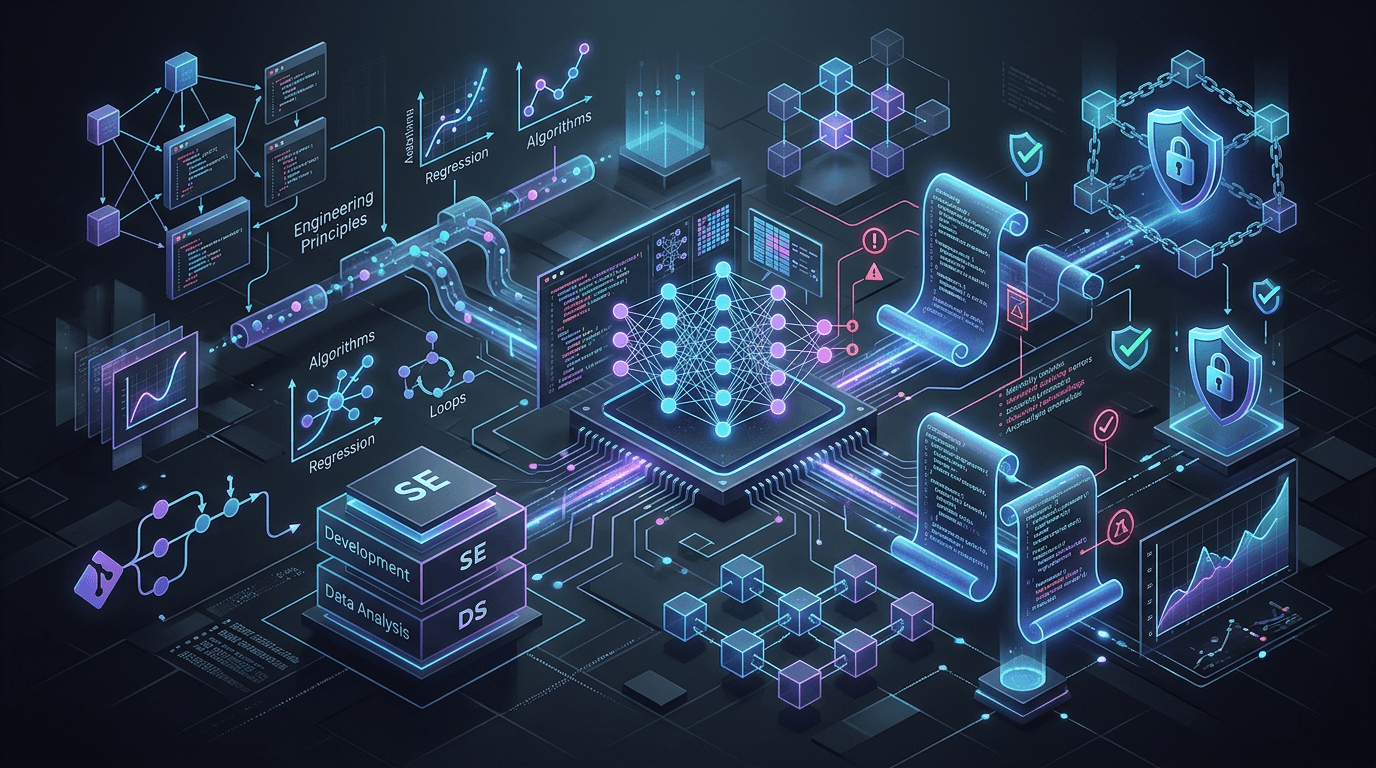
The result: AI-assisted auditing, built on data science engineering principles, is becoming the baseline expectation for serious Web3 security teams.
The Scale Problem in Smart Contract Security
The numbers are not abstract. According to data tracked by blockchain security firms, over $3.8 billion was lost to smart contract exploits in 2022 alone, and the attack surface has only grown since then. The DeFi ecosystem now hosts thousands of protocols, each deploying contracts that interact with one another in ways that create emergent vulnerabilities no single contract review would catch in isolation. The traditional model of hiring a boutique audit firm, waiting four to six weeks for a report, and shipping a patched version before launch was already straining under this volume before AI entered the picture.
The core tension is that smart contracts are immutable once deployed. Unlike a web application where you can push a hotfix at 2am, a Solidity contract on mainnet is permanent. That immutability is a feature from a trust perspective, but it means the cost of a missed vulnerability is not a bad user experience or a degraded service level agreement. It is a direct, irreversible financial loss. The Ronin bridge hack in 2021 resulted in $611 million being drained because attackers compromised validator keys and exploited a logic flaw that had not been caught during review. The DAO hack in 2016, which triggered the Ethereum hard fork, stemmed from a reentrancy vulnerability that a more systematic review process would have flagged. These are not edge cases. They are the baseline risk profile of the industry.
What makes this problem tractable for data science approaches is that vulnerabilities in smart contracts are not random. They cluster around well-understood patterns: reentrancy, integer overflow and underflow, access control failures, oracle manipulation, flash loan attack surfaces, and improper use of delegatecall. These patterns can be encoded, learned, and retrieved. The challenge is building the engineering infrastructure to do that reliably at scale, across thousands of contracts, with low false positive rates and high recall on the vulnerability classes that actually matter.
What Data Science Engineering Brings to the Table
When people talk about applying data science to smart contract auditing, they often mean the models themselves, the neural networks, the classifiers, the embedding spaces. But the more important contribution from data science software engineering is the discipline around how those models are built, versioned, evaluated, and deployed. A model that achieves 94% accuracy on a held-out test set is not useful if you cannot reproduce that result, if the training data is contaminated with contracts from the same protocols as the test set, or if the model degrades silently when it encounters contract patterns from a new DeFi primitive that did not exist when the training data was collected.
Data science engineering practices address these problems directly. Reproducible pipelines, built with tools like DVC or MLflow, ensure that every model artifact can be traced back to a specific dataset version, a specific set of hyperparameters, and a specific training run. This matters enormously in a security context, where you need to be able to explain why a tool flagged a particular function and what evidence supports that classification. Experiment tracking is not just a convenience for researchers. In an audit context, it is the foundation of defensible, auditable tooling.
The other major contribution is the discipline of proper train-test separation and evaluation methodology. Smart contract vulnerability datasets have a temporal structure that naive random splits destroy. If you train on contracts deployed before a certain date and test on contracts deployed after, you get a much more honest picture of how your model will perform on new code. This is the same principle that governs time-series forecasting in quantitative finance, and it is just as critical here. Teams that apply these practices to their audit tooling end up with models that generalize better and fail more gracefully when they encounter novel attack patterns.
Static Analysis as the Feature Extraction Layer
Before any machine learning model can reason about a smart contract, the contract needs to be represented in a form the model can process. This is the feature extraction problem, and it is where static analysis tools play a foundational role. Tools like Slither, developed by Trail of Bits, parse Solidity source code into an intermediate representation that exposes the contract's control flow, data flow, and call graph in a structured format. Mythril uses symbolic execution to explore the state space of a contract's bytecode, identifying paths that lead to dangerous states. These tools are not just standalone scanners. They are feature generators.
In a data science pipeline, the outputs of Slither and Mythril become inputs to downstream models. A control flow graph extracted by Slither can be fed into a graph neural network that has been trained to recognize subgraph patterns associated with reentrancy vulnerabilities. The symbolic execution traces from Mythril can be embedded and compared against a retrieval index of known exploit patterns. The abstract syntax tree of a contract can be tokenized and passed through a transformer model fine-tuned on a corpus of audited contracts. Each of these representations captures different aspects of the contract's behavior, and combining them is where multi-modal approaches start to show real gains over single-method tools.
The engineering challenge here is pipeline orchestration. You need to run Slither, Mythril, and potentially several other analysis tools against every contract version, store the outputs in a consistent schema, and feed them into your model serving infrastructure in a way that is fast enough to be useful in a development workflow. This is a classic data engineering problem, and the solutions look familiar: Apache Airflow or Prefect for orchestration, Parquet or Arrow for efficient storage of structured analysis outputs, and a feature store to avoid recomputing expensive static analysis results for contracts that have not changed. The crypto-native development context adds some wrinkles, particularly around handling proxy patterns and upgradeable contracts, but the underlying engineering patterns are well-established.
Retrieval-Augmented Generation for Vulnerability Pattern Matching
Retrieval-augmented generation, or RAG, has become one of the more practically useful architectures in applied AI over the past two years, and its application to smart contract auditing is a natural fit. The core idea is straightforward: instead of asking a language model to recall vulnerability patterns from its training weights, you give it a retrieval mechanism that can pull relevant examples from a curated knowledge base at inference time. For smart contract auditing, that knowledge base is a corpus of known vulnerabilities, past audit reports, exploit post-mortems, and annotated contract code.
The practical advantage of RAG over a purely parametric model is that the knowledge base can be updated without retraining. When a new vulnerability class emerges, such as the price oracle manipulation patterns that became prevalent in 2020 and 2021, you add the relevant examples to the retrieval index and the system immediately benefits from that knowledge. This is critical in a domain where the attack surface evolves as fast as the protocols themselves. A model trained six months ago may have no representation of a vulnerability pattern that was first exploited three months ago, but a RAG system with a well-maintained index will surface it.
Building a good retrieval index for smart contract auditing requires careful curation. The quality of the retrieved context directly determines the quality of the model's output, so the index needs to be dense with high-signal examples and sparse on noise. This means annotating retrieved snippets with metadata about the vulnerability class, the severity, the affected protocol, and the conditions under which the vulnerability is exploitable. It also means building evaluation harnesses that measure retrieval precision and recall separately from generation quality, so you can diagnose failures at the right layer of the system. These are standard practices in production RAG systems, and they apply here without modification.
Multi-Modal Deep Learning Frameworks for Contract Analysis
The most capable AI audit systems currently in research and early production use multi-modal architectures that combine several different representations of a contract simultaneously. A contract can be represented as source code text, as a bytecode sequence, as a control flow graph, as a call graph showing interactions with external contracts, and as a sequence of EVM opcodes. Each representation captures information that the others miss. Source code text carries developer intent and naming conventions that can signal risky patterns. The control flow graph captures the structural logic of the contract independent of surface syntax. The opcode sequence reveals low-level behaviors that are invisible at the Solidity level.
Multi-modal frameworks fuse these representations using techniques borrowed from computer vision and natural language processing research. A common architecture uses separate encoder networks for each modality, a graph neural network for the control flow graph, a transformer for the source code and opcode sequences, and then a cross-attention mechanism or a simple concatenation layer to combine the encoded representations before the final classification head. Training these models requires large labeled datasets of contracts with known vulnerabilities, and the quality of the labels matters enormously. Contracts labeled as vulnerable based on automated tool output alone introduce noise. Contracts labeled by experienced auditors who have traced the actual exploit path are far more valuable.
The research literature on this topic has been growing rapidly. Papers published in 2023 and 2024 have demonstrated that multi-modal approaches consistently outperform single-modality baselines on standard vulnerability detection benchmarks, with some architectures achieving F1 scores above 0.90 on reentrancy and integer overflow detection tasks. The gap is most pronounced on complex, multi-contract vulnerabilities where the vulnerability only manifests through the interaction of two or more contracts, a scenario that purely source-level analysis handles poorly. For teams building production audit tooling, the practical implication is that investing in the infrastructure to extract and store multiple contract representations pays off in detection quality.
Integrating Audit Tooling into CI/CD Pipelines
The shift from treating auditing as a pre-deployment gate to treating it as a continuous practice embedded in the development lifecycle is one of the most significant changes that AI-assisted tooling enables. In a traditional workflow, a team writes code, reaches a milestone, engages an audit firm, waits weeks for results, and then scrambles to fix findings before a deadline. In a CI/CD-integrated workflow, every pull request triggers an automated analysis run that surfaces potential vulnerabilities within minutes, giving developers feedback while the context is still fresh.
Implementing this in practice requires a few key components. First, you need a fast analysis tier that can run on every commit without blocking the development workflow. This typically means running lightweight static analysis tools like Slither in the CI pipeline and reserving heavier symbolic execution or model inference for scheduled runs or pre-merge checks. Second, you need a results management system that tracks findings across runs, deduplicates known issues, and surfaces new findings clearly. A CI pipeline that floods developers with the same 40 false positives on every run will be ignored within a week. Third, you need severity triage logic that distinguishes between informational findings, low-severity issues that should be tracked but not block merges, and high-severity findings that require immediate attention.
GitHub Actions and GitLab CI both support the webhook and artifact storage patterns needed to build this infrastructure. The audit tooling runs as a containerized job, outputs findings in a structured format like SARIF, which is the standard format for static analysis results, and the results are posted as pull request comments or uploaded to a security dashboard. Teams that have implemented this pattern report that it catches a significant fraction of common vulnerability classes before they ever reach a formal audit, which reduces the cost and duration of the formal audit and improves the overall security posture of the codebase.
Reproducibility and Version Control for Audit Workflows
One of the underappreciated problems in smart contract security is the reproducibility of audit findings. When an audit firm delivers a report, the findings are tied to a specific commit hash of the contract code. But contracts evolve, and the relationship between a finding in an audit report and the current state of the codebase can become unclear over time. If a developer fixes one finding and inadvertently reintroduces a related vulnerability in a different function, a purely manual process may not catch it until the next formal audit cycle.
Applying version control discipline to audit workflows means treating audit findings as first-class artifacts that are tracked alongside the code. Each finding gets a unique identifier, a status, a linked commit range, and a resolution record. When a finding is marked as resolved, the resolution is verified by re-running the relevant analysis and confirming that the tool no longer flags the issue. This is the same pattern used in software vulnerability management systems like GitHub's Dependabot or Snyk, and it works for the same reasons: it creates a clear audit trail, it prevents regressions, and it gives teams a quantitative measure of their security posture over time.
Model versioning is equally important for the AI components of the audit pipeline. When you update the vulnerability detection model, you need to be able to compare its findings against the previous version on the same set of contracts to understand what changed. A new model version that catches more reentrancy vulnerabilities but misses a class of access control issues it previously flagged is not straightforwardly better. Maintaining a regression test suite of contracts with known vulnerabilities, and running every model version against that suite before deploying it to production, is the same practice that software teams use for unit and integration testing. It is not glamorous, but it is what separates reliable tooling from tooling that surprises you in production.
The False Positive Problem and Precision-Recall Tradeoffs
Any team that has run Slither or Mythril against a non-trivial codebase has encountered the false positive problem. These tools are designed to be conservative, flagging anything that could potentially be a vulnerability, which means they surface a lot of findings that turn out to be benign after manual review. In a research context, high recall at the cost of precision is acceptable. In a production development workflow, a tool that generates 200 findings per run, 180 of which are false positives, creates alert fatigue and gets disabled.
Managing this tradeoff requires treating it as an explicit engineering problem rather than a property of the underlying tools. The first lever is threshold tuning: most AI-based vulnerability detectors produce a confidence score alongside their findings, and the threshold at which you surface a finding to a developer can be tuned based on the severity class. For high-severity vulnerability classes like reentrancy or unchecked external calls, you want high recall even at the cost of some false positives, because the cost of a miss is catastrophic. For informational findings about code style or gas optimization, you can afford to set a higher confidence threshold. The second lever is suppression and allowlisting: findings that have been reviewed and confirmed as false positives for a specific code pattern should be suppressed in future runs, with the suppression recorded and reviewable so it does not become a way to silently ignore real issues.
Measuring the precision and recall of your audit tooling requires a labeled evaluation dataset, which is the same requirement that applies to any classification system. Building and maintaining this dataset is ongoing work, because new vulnerability patterns emerge and the distribution of contract code in your codebase shifts over time. Teams that invest in this evaluation infrastructure end up with a much clearer picture of what their tooling actually catches and what it misses, which is the foundation for making informed decisions about where to invest in additional manual review.
Formal Verification as Ground Truth
Formal verification occupies a different position in the audit tooling stack than AI-based detection. Where machine learning models produce probabilistic outputs, formal verification tools like Certora Prover, Halmos, or the SMTChecker built into the Solidity compiler produce mathematical proofs. If a property is verified, it holds for all possible inputs and all possible execution paths. If it is not verified, the tool produces a counterexample that demonstrates a violation. This is a qualitatively different kind of assurance, and it is the closest thing to ground truth available in smart contract security.
The practical limitation of formal verification is that it requires writing formal specifications, which is skilled, time-consuming work. You need to express the intended behavior of the contract as a set of invariants and postconditions in a specification language, and the quality of the verification is only as good as the completeness of those specifications. A contract can be formally verified against an incomplete specification and still contain a critical vulnerability that the specification did not cover. This is not a failure of formal verification as a technique. It is a reflection of the fact that specifying what a complex financial system should do is genuinely hard.
The emerging practice is to use AI-assisted tooling to generate candidate specifications from contract source code and documentation, which a human auditor then reviews and refines before running the formal verifier. This hybrid approach reduces the specification burden while preserving the mathematical rigor of the verification step. It is an example of the broader pattern where AI handles the high-volume, pattern-matching work and human experts focus on the judgment-intensive tasks that require deep domain knowledge.
Human-in-the-Loop Design Patterns
The most effective AI-assisted audit workflows are not fully automated. They are designed around the principle that AI handles the work that scales poorly for humans, and humans handle the work that AI handles poorly. AI is good at scanning thousands of lines of code for known vulnerability patterns, maintaining consistency across a large codebase, and surfacing findings quickly. Humans are good at understanding the economic incentives of a protocol, reasoning about multi-contract interactions in the context of a specific DeFi primitive, and evaluating whether a theoretical vulnerability is actually exploitable given the constraints of the system.
Designing a human-in-the-loop audit workflow means being explicit about the handoff points between automated and manual review. A common pattern is to use automated tooling to triage the full contract surface and produce a prioritized list of areas that warrant deeper manual review. The auditor then focuses their time on the high-priority areas, using the AI-generated context as a starting point rather than starting from a blank page. This is analogous to how radiologists use AI-assisted screening tools: the AI flags regions of interest, and the radiologist applies expert judgment to the flagged regions. The AI does not replace the radiologist. It changes how the radiologist allocates their attention.
Another important design consideration is the feedback loop between human reviewers and the AI system. When an auditor identifies a vulnerability that the automated tools missed, that finding should feed back into the training data and the retrieval index. When an auditor confirms that a flagged finding is a false positive, that confirmation should update the suppression rules and, over time, the model's calibration. Building these feedback loops requires treating the audit workflow as a system that learns and improves over time, not a static tool that produces fixed outputs. This is standard practice in production machine learning systems, and it applies here with the same force.
Building Audit-Ready Contracts with Cheetah AI
The practices described in this post represent a significant shift in how serious Web3 teams approach security. The shift is from security as a final checkpoint to security as a continuous property of the development process, enforced by tooling that is embedded in the workflow from the first line of code. Getting there requires investment in pipeline infrastructure, evaluation datasets, model versioning, and the organizational discipline to treat audit findings as first-class engineering artifacts rather than a compliance checklist.
Cheetah AI is built for exactly this context. As the first crypto-native AI IDE, it is designed around the reality that Web3 development has a different risk profile than traditional software development, and that the tooling needs to reflect that. The ability to surface vulnerability patterns inline as you write Solidity, to integrate with static analysis tools as part of the development loop rather than as a separate post-hoc step, and to reason about contract interactions in the context of the broader protocol architecture is what separates a general-purpose AI coding assistant from one that is actually useful for smart contract development.
If you are building on-chain and you want your security practices to keep pace with the sophistication of the attackers targeting your protocol, the combination of data science engineering discipline and AI-assisted tooling described here is the direction the industry is moving. Cheetah AI is where that work happens.
The broader point is that the gap between teams that treat security as a continuous engineering discipline and teams that treat it as a periodic compliance exercise is widening. As DeFi protocols grow more complex, as cross-chain interactions multiply the attack surface, and as the value locked in smart contracts continues to increase, the cost of that gap becomes harder to absorb. The tools to close it exist today. The engineering practices to deploy them effectively are well-understood. What remains is the organizational commitment to treat smart contract security with the same rigor that the financial stakes demand, and to build that rigor into the development environment where the code is actually written.

If you are at that point, whether you are a solo developer building your first protocol or a team shipping production DeFi infrastructure, Cheetah AI is worth a look. It is built by people who understand the Web3 development context from the inside, and it is designed to make the practices described in this post feel like a natural part of how you write code, not an additional burden layered on top of it.
Related Posts
Reasoning Agents: Rewriting Smart Contract Development
TL;DR:Codex CLI operates as a multi-surface coding agent with OS-level sandboxing, 1M context windows via GPT-5.4, and the ability to read, patch, and execute against live codebases, making


Web3 Game Economies: AI Dev Tools That Scale
TL;DR:On-chain gaming attracted significant capital throughout 2025, with the Blockchain Game Alliance's State of the Industry Report confirming a decisive shift from speculative token launc

Token Unlock Engineering: Build Safer Vesting Contracts
TL;DR:Vesting contracts control token release schedules for teams, investors, and ecosystems, often managing hundreds of millions in locked supply across multi-year unlock windows Time-lo