Benchmarking GPT-5 Pro: Smart Contract Development Reality
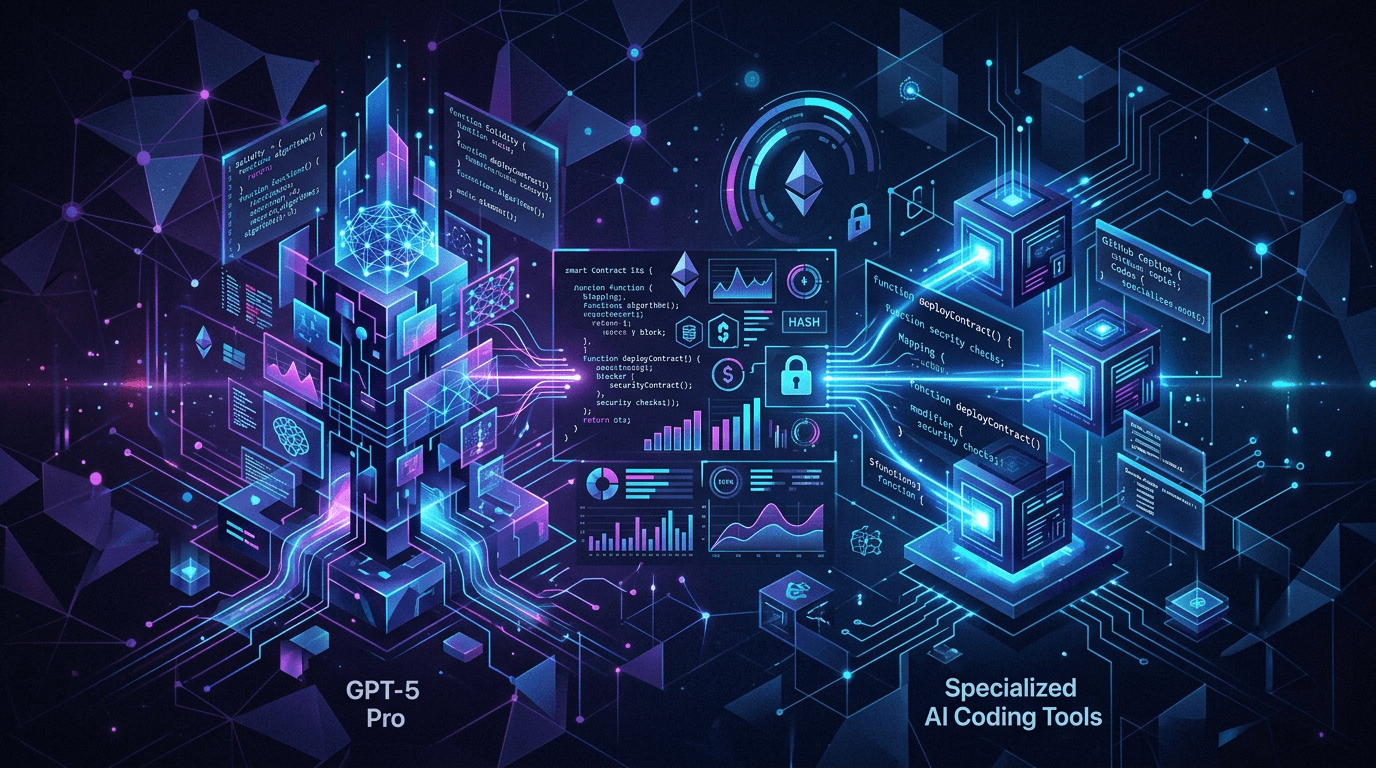
GPT-5 Pro scores well on general coding benchmarks, but domain-specific AI agents outperform it by 56 percentage points on real-world DeFi exploit detection. Here is what that gap means for smart contract developers.
Subscribe to our newsletter to get the latest updates and offers
* Will send you weekly updates on new features, tips, and developer resources.
TL;DR:
- GPT-5 Pro achieves a perfect 100% on AIME 2025 mathematical reasoning and 80.0% on SWE-bench Verified, making it one of the strongest general-purpose coding models available
- Domain-specific AI security agents outperformed general-purpose GPT-5.1 by 56 percentage points on real-world DeFi exploit detection in EVMbench testing
- EVMbench, launched by OpenAI and Paradigm, is the first benchmark designed specifically to evaluate AI agents on smart contract vulnerability detection, patching, and exploitation
- Specialized AI security agents achieved 92% detection rates on real-world DeFi exploits, compared to roughly 36% for general-purpose models
- Smart contract code is irreversible once deployed, meaning the performance gap between general and specialized tools translates directly into financial risk, not just developer inconvenience
- General coding benchmarks like SWE-bench measure software engineering tasks that share almost no structural overlap with Solidity security analysis or EVM execution model reasoning
- The right tooling choice for Web3 teams is not about which model scores highest overall, it is about which tool was built for the specific failure modes of on-chain code
The result: GPT-5 Pro is a genuinely capable coding model, but for smart contract security and development, the 56-point performance gap in favor of specialized tools is not a benchmark footnote, it is a production risk.
The Benchmark Conversation Nobody Is Having Correctly
The conversation around AI coding tools in 2026 has become almost entirely benchmark-driven. A new model drops, the SWE-bench scores get posted, the leaderboard updates, and developers start forming opinions based on numbers that were designed to measure something quite different from what most of them actually need. GPT-5 Pro is a genuinely impressive model. It achieves a perfect 100% on AIME 2025 mathematical reasoning, scores 80.0% on SWE-bench Verified, and demonstrates strong performance across a wide range of complex coding tasks. Those numbers are real, and they matter for a large class of software development work. The problem is that smart contract development is not that class of work, and treating it as though it is leads teams to make tooling decisions that carry real financial consequences.
The benchmark problem is not unique to AI. Developers have been navigating the gap between synthetic test performance and production reality for as long as benchmarks have existed. What makes the AI coding tool conversation particularly tricky is that the benchmarks being used are genuinely rigorous for the domains they were designed to measure. SWE-bench Verified, for instance, tests models against real GitHub issues from popular open-source repositories. That is a meaningful signal for teams building web applications, data pipelines, or backend services. It is a much weaker signal for teams writing Solidity, Vyper, or Rust-based smart contracts where the failure modes, the security surface, and the deployment constraints are categorically different from anything in the SWE-bench dataset.
What the industry needed was a benchmark that actually reflected the problem space of on-chain development. That benchmark now exists, and the results it has produced are forcing a more honest conversation about where general-purpose models like GPT-5 Pro genuinely excel and where they fall short in ways that matter to teams shipping production contracts.
What GPT-5 Pro Actually Brings to the Table
To be fair to GPT-5 Pro, it is worth being specific about what it does well before getting into where it struggles. The model's mathematical reasoning capabilities are exceptional. A perfect score on AIME 2025 is not a trivial achievement, and for smart contract developers working on complex protocol mathematics, including AMM curve calculations, liquidation thresholds, and interest rate models, that reasoning depth is genuinely useful. When you are trying to verify that a bonding curve formula behaves correctly across edge cases, or that a collateralization ratio calculation handles rounding correctly, a model that can reason through the mathematics with precision is a meaningful asset.
GPT-5 Pro also performs well on the kind of code generation tasks that make up a significant portion of a smart contract developer's day. Writing boilerplate ERC-20 or ERC-721 implementations, scaffolding test files, generating NatSpec documentation, and drafting deployment scripts are all tasks where a capable general-purpose model can save meaningful time. The 80.0% SWE-bench Verified score reflects genuine software engineering competence, and that competence does translate to productivity gains in the parts of Web3 development that look like conventional software engineering. Claude Opus 4.5 leads that same benchmark at 80.9%, making it the first model to exceed 80% on the test, but both models are operating at a level of general coding capability that would have seemed remarkable just two years ago.
The issue is not that GPT-5 Pro is a bad tool. The issue is that smart contract development has a specific category of high-stakes work, security analysis and vulnerability detection, where general-purpose capability is not sufficient. And the gap between sufficient and not sufficient in this context is not a matter of convenience or developer preference. It is a matter of whether exploitable vulnerabilities make it to mainnet.
SWE-bench and Why It Does Not Tell the Whole Story
SWE-bench Verified has become the de facto standard for evaluating AI coding models, and for good reason. It tests models against 500 verified real-world software engineering tasks drawn from popular Python repositories, requiring models to understand existing codebases, identify bugs, and produce working patches. The benchmark is rigorous, the tasks are real, and the scoring methodology is transparent. For the majority of software development work, it is a reasonable proxy for production capability.
But the benchmark's design reveals its limitations for Web3 use cases. The tasks in SWE-bench are drawn frompopular Python repositories, which means the failure modes being tested are the failure modes of conventional software: incorrect logic, broken APIs, mishandled exceptions, and regression bugs. These are recoverable failures. A web application that ships a bug can be patched in the next deployment. A smart contract that ships a reentrancy vulnerability, an integer overflow, or a broken access control check cannot be patched at all once it is live on mainnet. The structural difference between those two categories of failure is not a matter of degree, it is a matter of kind, and no amount of SWE-bench performance translates across that boundary.
There is also the question of training data distribution. The most widely deployed smart contract patterns, including OpenZeppelin's access control libraries, Uniswap's AMM implementations, Compound's interest rate models, and the various proxy upgrade patterns in common use, represent a relatively small slice of the code that general-purpose models were trained on. A model that has seen billions of lines of Python, JavaScript, and TypeScript will have deeply internalized the idioms, failure modes, and best practices of those languages. Its internalization of Solidity's specific quirks, including storage layout collisions in upgradeable contracts, the subtleties of delegatecall, and the gas optimization patterns that interact with security properties, is necessarily shallower. That shallowness does not show up in SWE-bench scores. It shows up in production.
EVMbench: The Benchmark That Actually Matters for Web3
The launch of EVMbench by OpenAI and Paradigm represents the first serious attempt to evaluate AI agents specifically against the problem space of smart contract security. The benchmark is designed around three core tasks: detecting vulnerabilities in real-world DeFi contracts, generating patches for identified issues, and, critically, actually exploiting vulnerabilities to verify that they are genuine rather than false positives. That last component is what makes EVMbench particularly valuable. A benchmark that only tests detection creates incentives for models to flag everything as potentially vulnerable. A benchmark that requires successful exploitation to score a detection as valid forces models to demonstrate genuine understanding of how the EVM executes code and how attackers actually construct exploits.
The dataset underlying EVMbench is drawn from real-world DeFi exploits, which means the vulnerabilities being tested are not synthetic edge cases constructed by researchers. They are the actual bugs that have cost the industry billions of dollars over the past several years. Reentrancy attacks, flash loan manipulation, oracle price manipulation, and access control failures are all represented. The benchmark also covers the more subtle categories of vulnerability that tend to escape automated tools, including logic errors in complex multi-step transaction sequences and economic exploits that require understanding protocol incentive structures rather than just code syntax.
The $10 million in API credits that OpenAI committed to the EVMbench initiative signals that this is not a one-time research exercise. The goal is to create a standardized evaluation substrate for AI-driven smart contract security that can evolve alongside the DeFi ecosystem. With over $100 billion in open-source crypto assets potentially exposed to smart contract vulnerabilities, the economic justification for that investment is straightforward. What the benchmark has already revealed, however, is the performance gap that should be driving tooling decisions for every serious Web3 development team.
The 56-Point Gap and What It Actually Means
The headline number from EVMbench testing is stark. Domain-specific AI security agents achieved 92% detection rates on real-world DeFi exploits. General-purpose GPT-5.1-based agents achieved roughly 36%. That is a 56-percentage-point gap on a benchmark specifically designed to reflect the security challenges that smart contract developers face in production. To put that in concrete terms: if a team is relying on a general-purpose model to catch vulnerabilities before deployment, and that model is missing roughly 64% of real-world exploits, the security review process is providing a false sense of coverage rather than actual protection.
It is worth being precise about what the 92% figure represents as well. No tool catches everything, and a 92% detection rate on a benchmark of real-world exploits is a genuinely strong result. But the gap between 92% and 36% is not a marginal performance difference that might wash out in practice. It reflects a fundamental difference in how the two categories of tools approach the problem. General-purpose models approach smart contract security the same way they approach any code review task: pattern matching against known bad practices, reasoning about control flow, and applying general software engineering intuition. Specialized agents approach it with structured knowledge of EVM execution semantics, known exploit patterns from historical DeFi attacks, and the ability to reason about economic incentives alongside code logic.
The practical implication for development teams is that using GPT-5 Pro or any general-purpose model as a primary security analysis tool for smart contracts is not a cost-saving measure. It is a risk transfer. The cost of the missed vulnerabilities does not disappear from the budget, it moves from the tooling line to the incident response line, and in Web3, incident response often means watching funds drain from a protocol in real time with no ability to intervene.
Why General Models Struggle with EVM-Specific Reasoning
Understanding why the performance gap exists requires getting into the specifics of what makes smart contract security analysis different from conventional code review. The Ethereum Virtual Machine has a set of execution semantics that do not map cleanly onto any other computing environment. Storage is persistent across calls but accessed through a slot-based system that creates collision risks in proxy patterns. The call stack has a depth limit of 1024 frames, which creates specific attack surfaces. Gas costs are not just a performance concern, they are a security property, because certain operations can be made to fail by manipulating gas availability. External calls can trigger arbitrary code execution in the calling contract's context if not handled correctly, which is the root cause of reentrancy vulnerabilities.
A general-purpose model can describe all of these properties accurately when asked about them directly. The challenge is applying that knowledge during code review in a way that catches subtle interactions between multiple contract components. A reentrancy vulnerability in a complex DeFi protocol is rarely as simple as a missing reentrancy guard on a single function. It often involves a specific sequence of calls across multiple contracts, a particular ordering of state updates relative to external calls, and an economic incentive structure that makes the exploit profitable. Reasoning about all of those layers simultaneously, while also tracking the full state of a complex protocol, requires a kind of structured domain knowledge that general-purpose models have not been trained to apply systematically.
Specialized tools address this by encoding the known taxonomy of smart contract vulnerabilities as structured analysis frameworks rather than relying on the model to reconstruct that taxonomy from general training data. When a specialized agent analyzes a DeFi contract, it is not just asking whether the code looks correct in a general sense. It is systematically checking for the specific patterns that have produced real exploits: the checks-effects-interactions pattern violations, the price oracle manipulation vectors, the flash loan attack surfaces, and the governance manipulation risks. That systematic approach is what produces the 92% detection rate, and it is not something that can be replicated by prompting a general-purpose model more carefully.
The Irreversibility Problem Changes the Risk Calculus
The reason the performance gap between general and specialized tools matters so much more in Web3 than in conventional software development comes down to a single property of smart contracts: they cannot be changed after deployment. In traditional software, a security vulnerability that makes it to production is a serious problem, but it is a recoverable one. The team patches the code, deploys the fix, and the vulnerability window closes. The damage is bounded by the time between discovery and remediation, and that window can often be measured in hours or days.
Smart contracts do not work that way. A vulnerability that makes it to mainnet is permanent unless the contract was designed with an upgrade mechanism, and upgrade mechanisms introduce their own security surface. The Ethereum blockchain has no mechanism for retroactively modifying deployed bytecode. If a reentrancy vulnerability exists in a live DeFi protocol, it exists until either the protocol is abandoned or a governance process executes a migration to a new contract, assuming the governance mechanism itself has not been compromised. In the meantime, the vulnerability is visible to anyone who can read the blockchain, which means every day between deployment and remediation is a day during which sophisticated attackers can study the exploit and decide whether to execute it.
This irreversibility is why the 56-point performance gap in EVMbench is not a benchmark curiosity. It is a direct measure of the probability that a vulnerability survives the pre-deployment review process and becomes a permanent feature of a live contract. Teams that treat smart contract security review as equivalent to conventional code review, and choose their AI tooling accordingly, are making a decision that the irreversibility of on-chain deployment does not change their risk tolerance. That is rarely a decision those teams have made consciously.
How Specialized Tools Approach the Problem Differently
The architecture of specialized smart contract security tools reflects a fundamentally different set of design priorities than general-purpose coding assistants. Tools like Slither, which performs static analysis on Solidity source code, and Mythril, which analyzes EVM bytecode using symbolic execution, were built from the ground up around the specific vulnerability taxonomy of smart contracts. They do not attempt to be useful for general software development tasks. They are optimized entirely for finding the specific categories of bugs that have historically caused the most damage in production DeFi protocols.
The AI agents that achieved 92% detection rates on EVMbench are building on this foundation rather than replacing it. They combine the structured analysis frameworks of purpose-built static analysis tools with the reasoning capabilities of large language models, using the LLM layer to handle the cases that rule-based tools miss: complex multi-contract interactions, economic exploit logic, and novel vulnerability patterns that do not match any existing rule. The result is a system that is more capable than either component alone, but only because the domain-specific structure is doing the heavy lifting of constraining the problem space to something the model can reason about effectively.
This architectural approach also explains why simply prompting GPT-5 Pro with detailed smart contract security instructions does not close the gap. The model's underlying knowledge of EVM semantics and historical exploit patterns is real but shallow compared to what a purpose-built system encodes. Prompting can surface that knowledge, but it cannot substitute for the systematic analysis frameworks that specialized tools apply by default. The difference between a checklist that a developer reads and a tool that enforces the checklist automatically is the difference between a process that depends on human attention and one that does not.
Building a Practical Tooling Stack for Smart Contract Teams
Given the performance data, the practical question for Web3 development teams is not whether to use GPT-5 Pro or a specialized tool, but how to combine them in a way that captures the genuine strengths of each. GPT-5 Pro and models at its capability level are genuinely useful for the parts of smart contract development that look like conventional software engineering. Writing and refactoring Solidity code, generating test scaffolding, documenting contract interfaces, reasoning through protocol mathematics, and debugging failing tests are all tasks where a capable general-purpose model provides real productivity value. The mathematical reasoning capabilities that produce a perfect AIME score are directly applicable to verifying the correctness of complex DeFi formulas.
The security analysis layer, however, needs to be handled by tools that were built for it. That means integrating static analysis with Slither as a mandatory step in the CI pipeline, using symbolic execution tools like Mythril or Halmos for critical contract logic, and incorporating AI-assisted security agents that have been specifically trained or fine-tuned on smart contract vulnerability patterns. The EVMbench results suggest that the AI-assisted security layer is now capable enough to catch a meaningful percentage of vulnerabilities that static analysis tools miss, particularly in the category of complex multi-contract interactions and economic exploit logic.
The workflow that emerges from this approach is one where general-purpose AI handles the productivity layer and specialized tools handle the security layer, with clear handoffs between the two. A developer uses a capable coding assistant to write and iterate on contract logic, then passes the output through a security-focused analysis pipeline before anything approaches a testnet deployment. That pipeline is not a final audit step, it is a continuous process that runs on every meaningful code change. The goal is to catch vulnerabilities as close to their introduction as possible, when the context is fresh and the fix is straightforward, rather than discovering them in a pre-launch audit when the cost of remediation is much higher.
The Convergence of AI and Blockchain Tooling
The EVMbench launch and the performance data it has produced are part of a broader convergence between AI capabilities and blockchain development infrastructure. The $16.5 billion in crypto deal volume recorded in H1 2025 included significant capital flowing into developer tooling categories, reflecting investor recognition that the infrastructure layer of Web3 is where the next phase of growth will be built. AI-powered development tools are a central part of that infrastructure story, and the benchmarking work being done by organizations like OpenAI and Paradigm is helping to define what "AI-powered" actually means in a Web3 context.
The distinction between general-purpose AI coding tools and domain-specific Web3 development tools is becoming a meaningful axis of differentiation in the market. Teams that understand this distinction are building workflows that use each category of tool for what it is actually good at. Teams that do not understand it are either over-relying on general-purpose models for security-critical tasks, or under-utilizing AI assistance for the productivity tasks where it genuinely helps. Neither failure mode is good, but the first one carries consequences that extend well beyond developer productivity.
The trajectory of the specialized tooling category is also worth noting. The 92% detection rate achieved by domain-specific agents on EVMbench represents the current state of the art, but the benchmark itself is designed to evolve alongside the DeFi ecosystem. As new exploit patterns emerge and new protocol architectures create new attack surfaces, the benchmark will incorporate them. That creates a continuous improvement loop for specialized tools that general-purpose models, trained on broad datasets with long update cycles, are structurally less able to participate in.
Where Cheetah AI Fits in This Picture
The tooling decisions that smart contract development teams make in 2026 will have consequences that extend well beyond the current development cycle. The protocols being built today will manage real economic value for years, and the security properties of those protocols are largely determined by the quality of the tooling and processes used during development. Getting those decisions right requires understanding the actual performance characteristics of available tools, not just their benchmark scores on tests designed for different problem domains.
Cheetah AI was built specifically for this environment. As the first crypto-native AI IDE, it is designed around the specific workflows, security requirements, and development patterns of Web3 teams rather than adapted from tools built for conventional software development. That means integrating the security analysis layer directly into the development environment, so that vulnerability detection is not a separate step that happens after code is written but a continuous process that runs alongside it. It means understanding the EVM execution model, the Solidity type system, and the historical taxonomy of smart contract vulnerabilities at a level that informs every code suggestion and review.
If your team is currently navigating the question of how to incorporate AI assistance into a smart contract development workflow without introducing the security risks that come with general-purpose tools, Cheetah AI is worth a close look. The performance gap that EVMbench has quantified is real, and the right response to it is tooling that was designed with that gap in mind from the start.
The benchmarks will keep improving, the models will keep getting more capable, and the gap between general and specialized tools will continue to be a live question worth revisiting. But the data available right now points clearly in one direction: for smart contract development, domain-specific tooling is not a premium option for teams with extra budget. It is the baseline requirement for teams that understand what is actually at stake.
Related Posts

Cheetah Architecture: Building Intelligent Code Search
Building Intelligent Code Search: A Hybrid Approach to Speed and Relevance TL;DR: We built a hybrid code search system that:Runs initial text search locally for instant response


Reasoning Agents: Rewriting Smart Contract Development
TL;DR:Codex CLI operates as a multi-surface coding agent with OS-level sandboxing, 1M context windows via GPT-5.4, and the ability to read, patch, and execute against live codebases, making

The New Bottleneck: AI Shifts Code Review
TL;DR:AI coding assistants now account for roughly 42% of all committed code, a figure projected to reach 65% by 2027, yet teams using these tools are delivering software slower and less rel