Claude Code: Smart Contract CI/CD Reviews
A practical guide to embedding Claude Code into smart contract CI/CD pipelines across GitLab, GitHub Actions, and Azure DevOps, covering security reviews, CLAUDE.md configuration, and what automated analysis can and cannot replace.
Subscribe to our newsletter to get the latest updates and offers
* Will send you weekly updates on new features, tips, and developer resources.
TL;DR:
- Claude Code now integrates natively with GitLab CI/CD, GitHub Actions, and Azure DevOps, enabling automated code review and security scanning directly inside pull request and merge request workflows
- Anthropic's automated security review feature scans codebases for vulnerability classes including reentrancy, integer overflow, and access control misconfigurations, surfacing findings before code reaches a testnet
- The CLAUDE.md configuration file allows teams to teach Claude the specific conventions, architecture patterns, and security constraints of their smart contract codebase, dramatically improving review relevance
- Claude Code operates inside secure containers within CI/CD pipelines, meaning it can read, analyze, and propose fixes without requiring direct access to production infrastructure or private keys
- Automated fix suggestions from Claude Code are proposals, not deployments, and every change still flows through branch protection rules and human review gates, preserving the audit trail that on-chain deployments require
- The shift toward AI-assisted review does not replace static analysis tools like Slither and MythX. It adds a reasoning layer that can interpret findings in context and explain their implications to developers
- Smart contract teams adopting Claude Code in CI/CD are reporting meaningful reductions in the time between code submission and actionable security feedback, compressing review cycles from days to hours
The result: Integrating Claude Code into smart contract CI/CD pipelines is not about replacing security engineers. It is about giving every pull request the benefit of a security-aware reviewer that never sleeps and never skips a function.
The Pipeline Problem Nobody Talks About
There is a persistent gap in how the Web3 industry approaches smart contract development. The conversation tends to center on protocol design, tokenomics, and on-chain logic, while the infrastructure that carries code from a developer's editor to a live blockchain receives comparatively little attention. That gap is where most production incidents originate. A reentrancy vulnerability that slips through a manual review, an integer overflow that a static analysis tool flagged but nobody had time to investigate, an access control misconfiguration that looked fine in isolation but created a critical exposure when combined with a new function added three pull requests later. These are not exotic failure modes. They are the predictable result of pipelines that were not designed with smart contract security as a first-class concern.
The traditional CI/CD stack, built around tools like Jenkins, CircleCI, and GitHub Actions with conventional linting and test runners, was designed for software that can be patched after deployment. Smart contracts cannot. Once a contract is deployed to mainnet, the code is immutable. A bug is not a support ticket. It is a permanent feature of the blockchain, and any funds or state it controls are exposed until the contract is deprecated or a proxy upgrade is executed, assuming the architecture even supports that. This fundamental difference in deployment semantics means that the review process for smart contracts needs to be qualitatively different from the review process for a web application or a microservice. The pipeline needs to catch more, earlier, with higher confidence.
What has changed in the past year is that AI-assisted code review has matured to the point where it can be embedded directly into that pipeline, not as a post-hoc audit tool but as an active participant in the merge request workflow. Anthropic's Claude Code is the most prominent example of this shift, and its integration with GitLab CI/CD, GitHub Actions, and Azure DevOps represents a meaningful change in what is possible for teams shipping smart contracts at production scale.
What Claude Code Actually Does in a Pipeline
Claude Code is not a chatbot that happens to know some Solidity. It is an agentic AI system designed to operate autonomously within a development environment, reading code, understanding context, proposing changes, and executing tasks without requiring a developer to be present at every step. When integrated into a CI/CD pipeline, it runs inside secure containers, which means it has access to the repository contents and the ability to analyze code, but it operates within the same permission boundaries as any otherCI/CD job. It cannot push directly to protected branches, cannot trigger deployments, and cannot interact with external infrastructure unless explicitly granted those permissions. Every change it proposes flows through the same branch protection rules and review gates that govern human-authored code.
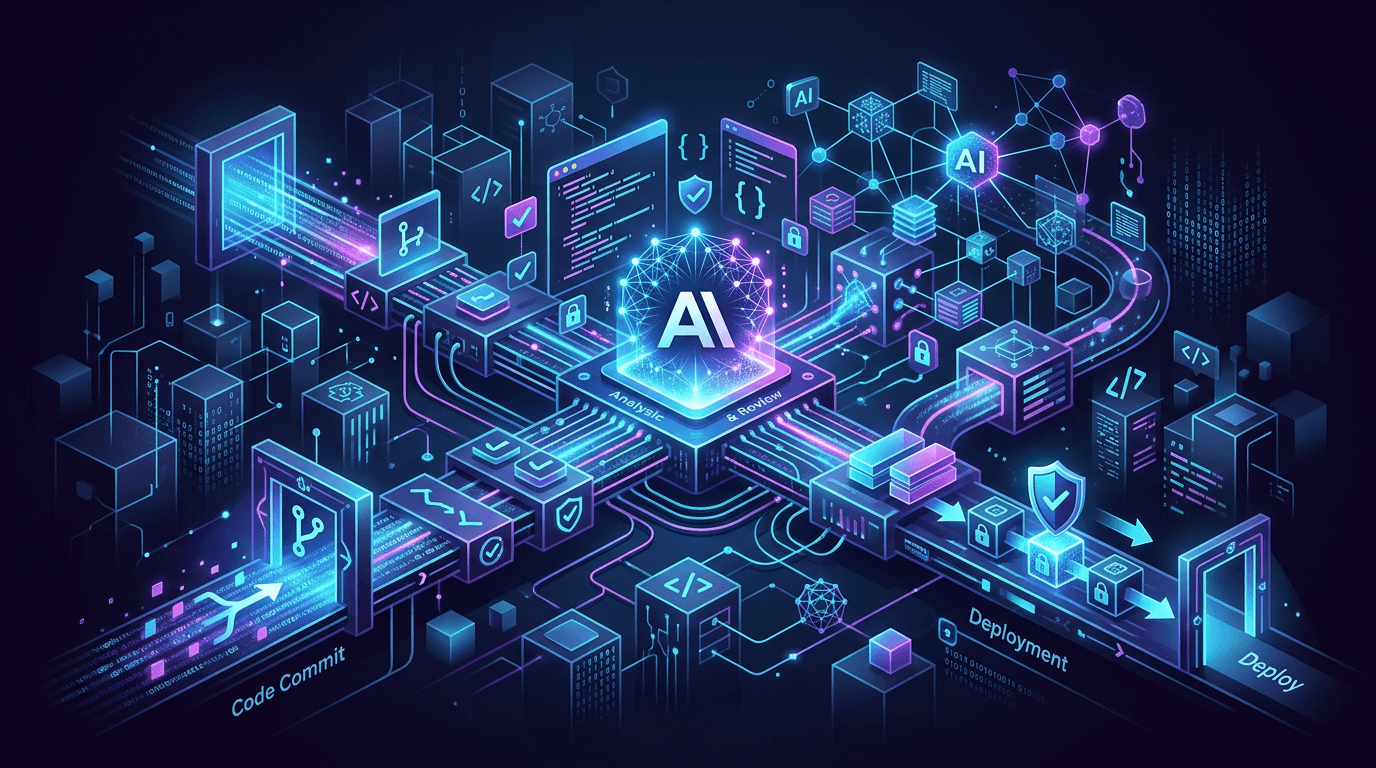
The practical workflow looks like this: a developer opens a pull request or merge request containing new or modified Solidity code. Claude Code is triggered automatically as part of the pipeline, reads the diff and the surrounding codebase context, and produces a structured review that surfaces potential vulnerabilities, logic errors, gas inefficiencies, and deviations from the project's established patterns. That review appears as a comment on the merge request, formatted in a way that developers can act on directly. If Claude identifies a specific fix, it can propose that fix as a code suggestion or, depending on how the pipeline is configured, open a follow-up branch with the proposed change applied. The developer reviews the suggestion, accepts or rejects it, and the normal review process continues.
What makes this different from a conventional static analysis run is the reasoning layer. Tools like Slither and MythX are excellent at pattern matching. They will reliably flag known vulnerability signatures, and any serious smart contract pipeline should include them. But they produce output that requires interpretation. A Slither report listing a reentrancy warning in a function that calls an external contract is useful, but it does not tell you whether that specific call path is actually exploitable given the contract's state machine, or whether the existing checks-effects-interactions pattern in the surrounding code already mitigates the risk. Claude Code can reason about that context. It reads the function, understands the call graph, and produces an explanation that a developer can evaluate without needing to be a security specialist.
The CLAUDE.md File: Teaching Claude Your Codebase
One of the more underappreciated aspects of the Claude Code integration is the CLAUDE.md configuration file. Placed in the root of a repository, this file gives teams a direct channel to communicate codebase-specific context to Claude before it begins any analysis. For smart contract projects, this is not a minor convenience. It is the difference between generic AI feedback and feedback that is actually calibrated to the architecture, conventions, and security constraints of a specific protocol.
A well-constructed CLAUDE.md for a DeFi protocol might include the access control model the project uses, specifying which roles exist, what permissions they carry, and which functions are expected to be restricted. It might describe the upgrade pattern in use, whether that is a transparent proxy, a UUPS proxy, or a diamond pattern, so that Claude understands the deployment architecture and does not flag intentional delegatecall patterns as suspicious. It might list the external protocols the contracts integrate with, such as Uniswap V3, Aave, or Chainlink, along with notes on how those integrations are expected to behave and what assumptions the codebase makes about their return values. It might also include explicit instructions about what Claude should prioritize in its reviews, whether that is gas optimization, reentrancy analysis, or compliance with a specific internal security checklist.
The investment in writing a thorough CLAUDE.md pays compounding returns. Every pull request that Claude reviews benefits from that context, and the quality of the feedback improves as the file is refined over time. Teams that treat CLAUDE.md as a living document, updating it as the architecture evolves and as new patterns are adopted, end up with a review process that gets more accurate and more relevant with each iteration. This is a fundamentally different model from traditional static analysis configuration, which tends to be a one-time setup that teams rarely revisit.
Security Reviews: What Claude Catches and What It Misses
Anthropic's automated security review capability within Claude Code is designed to surface a meaningful range of vulnerability classes in Solidity code. Reentrancy is the obvious one, and Claude handles it well, particularly in cases where the vulnerable pattern is not a textbook single-function reentrancy but a cross-function or cross-contract variant that requires understanding the full call graph to identify. Integer overflow and underflow are less of a concern in Solidity 0.8 and above, where the compiler handles checked arithmetic by default, but they remain relevant in contracts that use unchecked blocks for gas optimization, and Claude can reason about whether a specific unchecked block is safe given the surrounding constraints.
Access control misconfigurations are where Claude's contextual reasoning adds the most value over pattern-matching tools. A function that is missing an onlyOwner modifier is trivial to catch with any static analyzer. A function that has the correct modifier but is callable by an address that can be set by an insufficiently protected setter function is a much harder problem, and it requires understanding the relationship between multiple functions across potentially multiple contracts. Claude can trace those relationships and surface the exposure in a way that a developer can immediately understand and act on. Similarly, oracle manipulation risks, front-running vulnerabilities in functions that depend on block-level state, and signature replay attacks in permit-style functions are all vulnerability classes where reasoning about intent and context matters as much as pattern recognition.
What Claude Code does not replace is a formal security audit. The distinction is important. An automated review in a CI/CD pipeline is a continuous, low-latency signal that catches a broad class of issues early in the development cycle. A formal audit is a deep, adversarial examination of a complete protocol by specialists who are actively trying to find ways to break it. Both are necessary for production-grade smart contracts, and they serve different purposes. The CI/CD integration catches the issues that should never reach an audit in the first place, reducing the cost and scope of the audit itself, and ensuring that the auditors are spending their time on the genuinely hard problems rather than on issues that automated tooling could have caught weeks earlier.
GitHub Actions Integration: A Practical Walkthrough
For teams already using GitHub Actions, integrating Claude Code into the smart contract review workflow is a matter of adding a workflow file and configuring the necessary API credentials. The integration works through the Anthropic API, and it can also be routed through Amazon Bedrock or Google Vertex AI for teams that have existing cloud commitments or data residency requirements. The workflow is triggered on pull request events, specifically on the opened and synchronize events so that every new commit to an open pull request receives a fresh review.
The workflow file itself is straightforward. It checks out the repository, sets up the Claude Code action with the appropriate API key stored as a GitHub Actions secret, and passes the pull request diff along with the repository context to Claude for analysis. The output is posted as a pull request review comment, and the workflow can be configured to fail the CI check if Claude identifies issues above a specified severity threshold. This last point is worth thinking through carefully. Failing the CI check on every medium-severity finding will create friction and noise, particularly in early-stage development where the codebase is changing rapidly. A more practical approach is to use the severity threshold as a soft gate, surfacing all findings as informational comments but only blocking the merge on critical or high-severity issues.
One pattern that works well in practice is combining the Claude Code review with a separate Slither run in the same workflow. Slither produces its output in a structured JSON format that can be parsed and summarized, and Claude can be given that summary as additional context when performing its own analysis. This creates a layered review where the static analyzer handles the deterministic pattern matching and Claude handles the contextual reasoning, with the results presented together in a single pull request comment. Developers get a unified view of the security posture of their changes without needing to cross-reference multiple tool outputs.
GitLab CI/CD: The Native Integration Story
GitLab's integration with Claude Code is notable because it goes beyond a simple API call in a pipeline job. Claude Code is available as a native capability within GitLab CI/CD, which means it can be invoked by tagging it directly in merge request comments or issue descriptions. A developer can open a merge request, leave a comment tagging Claude and asking it to review a specific function for reentrancy risks, and Claude will respond within the merge request thread with its analysis. This conversational model is a meaningful improvement over the traditional static analysis workflow, where findings are produced in bulk at the end of a pipeline run and developers have to work through them without any ability to ask follow-up questions.
The GitLab integration also supports delegating implementation tasks to Claude, not just review tasks. A developer can tag Claude in an issue describing a bug or a feature request, and Claude will analyze the codebase, propose an implementation plan, and in some configurations execute that plan by opening a merge request with the proposed changes. For smart contract development, this capability needs to be used with appropriate caution. Delegating the implementation of a new ERC-20 transfer function to an AI agent and merging the result without careful human review is not a workflow that any serious protocol team should adopt. But using Claude to generate a first draft of a test suite for a new function, or to propose a refactoring of a gas-inefficient loop, and then reviewing that draft carefully before merging, is a reasonable and productive use of the capability.
The secure container model that GitLab uses for Claude Code execution is worth understanding in detail. Claude runs in an isolated environment that has read access to the repository but no access to deployment keys, private keys, or external infrastructure. This is a deliberate architectural choice, and it matters for smart contract teams who are rightly cautious about any automated system that could interact with their deployment infrastructure. The separation between the review and analysis layer, where Claude operates, and the deployment layer, where human approval is required, is a hard boundary that the integration preserves.
Azure DevOps and Enterprise Considerations
For teams operating in enterprise environments with Azure DevOps, the Claude Code integration follows a similar pattern to the GitHub Actions approach, with the additional consideration that many enterprise deployments route API traffic through Azure's own AI services infrastructure. Running Claude Code through Azure OpenAI Service or, more specifically, through Anthropic's models on Azure, allows teams to keep their code analysis traffic within their existing Azure tenant, which matters for organizations with strict data governance requirements or compliance obligations around code confidentiality.
Enterprise smart contract teams, particularly those building infrastructure for institutional DeFi or tokenized asset platforms, often have additional requirements around audit trails and review documentation. Every Claude Code review comment in an Azure DevOps pull request is timestamped, attributed, and stored as part of the pull request history, which means it contributes to the audit trail that compliance teams require. This is not a trivial point. When a protocol undergoes a formal security audit or a regulatory review, the ability to demonstrate that every merge request received automated security analysis, and that the findings were reviewed and addressed before merging, is a meaningful part of the compliance story.
The customization capabilities available through CLAUDE.md are equally important in enterprise contexts. Large organizations building multiple smart contract products on a shared infrastructure often have internal security standards that go beyond what any generic AI reviewer would know to check. Encoding those standards in CLAUDE.md, specifying that all external calls must follow a particular pattern, that all state-changing functions must emit specific events, that all proxy implementations must include a particular storage gap, gives Claude the context it needs to enforce those standards consistently across every pull request, regardless of which developer authored the code.
The Verification Problem: Why Human Review Still Matters
There is a temptation, when integrating a capable AI reviewer into a CI/CD pipeline, to treat its output as authoritative. This is a mistake, and it is a particularly costly mistake in the context of smart contracts. Claude Code is a reasoning system, not a formal verification tool. It can identify likely vulnerabilities and explain its reasoning, but it can also miss things, produce false positives, and occasionally misunderstand the intent of a complex piece of code. The appropriate mental model is that Claude Code is a very capable junior security reviewer who has read a lot of audit reports and understands common vulnerability patterns, but who still needs to have their findings reviewed by someone with deeper context before those findings are acted on.
The verification problem cuts in both directions. A false positive from Claude, flagging a safe pattern as vulnerable, wastes developer time and erodes trust in the tool if it happens frequently. A false negative, missing a genuine vulnerability, creates a false sense of security that can be more dangerous than no automated review at all. Both failure modes are real, and both need to be accounted for in how teams structure their review process. The right approach is to treat Claude's output as a starting point for human review, not a replacement for it. The human reviewer's job is not to re-examine every line of code from scratch, but to evaluate Claude's findings, apply their own judgment about context and exploitability, and make the final call on whether a finding represents a real risk.
This is actually where the combination of AI-assisted review and experienced human reviewers becomes most powerful. Claude handles the breadth, scanning every function in every file for a wide range of vulnerability classes without fatigue or time pressure. The human reviewer handles the depth, focusing their attention on the findings that Claude has surfaced and applying the kind of adversarial thinking that comes from experience with real exploits. The result is a review process that is both more comprehensive and more efficient than either approach alone.
Combining Claude Code with Slither, MythX, and Foundry
A mature smart contract CI/CD pipeline does not choose between Claude Code and existing security tools. It uses all of them, with each tool contributing what it does best. Slither, developed by Trail of Bits, is a static analysis framework that runs a large library of detectors against Solidity code and produces structured output covering everything from reentrancy to incorrect ERC standard implementations. It is fast, deterministic, and well-understood by the security community. MythX is a cloud-based analysis platform that combines multiple analysis techniques including symbolic execution and fuzzing to find vulnerabilities that static analysis alone would miss. Foundry provides a testing framework with built-in fuzzing capabilities that can generate thousands of random inputs to a function and check whether any of them produce unexpected behavior.
Each of these tools has a different profile of what it catches and what it misses. Slither is excellent at known patterns but cannot reason about novel vulnerability classes. MythX's symbolic execution can find deep logical errors but is computationally expensive and not suitable for running on every commit. Foundry's fuzzing is powerful for finding edge cases in individual functions but requires developers to write property-based tests that define what correct behavior looks like. Claude Code sits across all of these, able to interpret their output, explain their findings in plain language, and reason about whether a finding from one tool is mitigated by a pattern that another tool verified.
A practical pipeline architecture for a production DeFi protocol might run Slither on every pull request, run MythX on a nightly schedule against the main branch, run Foundry's test suite including fuzz tests on every pull request, and run Claude Code on every pull request with the Slither output included as context. Claude's review comment would then synthesize the Slither findings, add its own contextual analysis, and flag anything that the combination of tools suggests warrants deeper investigation. This layered approach gives teams the best coverage available with current tooling, without requiring every developer to be a security specialist.
The Iterative Improvement Loop
One of the less obvious benefits of integrating Claude Code into a CI/CD pipeline is the feedback loop it creates over time. Every review Claude produces is an opportunity to refine the CLAUDE.md configuration, update the project's internal security checklist, and improve the quality of the automated analysis for future pull requests. Teams that treat this as an active process, rather than a one-time setup, end up with a review system that becomes progressively more accurate and more relevant to their specific codebase.
The iterative loop works in both directions. When Claude flags a false positive, the right response is not just to dismiss the finding but to understand why Claude flagged it and whether the CLAUDE.md file can be updated to provide the context that would prevent the same false positive in future reviews. When Claude misses a vulnerability that a human reviewer catches, that is an opportunity to add a specific instruction to CLAUDE.md asking Claude to check for that pattern in future reviews. Over time, this process builds a body of codebase-specific knowledge that makes the automated review increasingly effective.
There is also a broader organizational benefit to this loop. The process of writing and refining CLAUDE.md forces teams to articulate their security assumptions, architectural decisions, and coding conventions in a way that is explicit and documented. Many teams operate with a large amount of implicit knowledge about how their codebase works and what patterns are considered safe or unsafe. That knowledge lives in the heads of senior developers and is transmitted informally through code review comments and Slack conversations. Encoding it in CLAUDE.md makes it explicit, searchable, and available to every developer on the team, including new hires who are still learning the codebase.
Measuring the Impact: What Teams Are Actually Seeing
The practical impact of integrating Claude Code into smart contract CI/CD pipelines is becoming clearer as more teams adopt the workflow. The most consistent reported benefit is a reduction in the time between code submission and actionable security feedback. In a traditional workflow, a developer submits a pull request, waits for a human reviewer to find time to look at it, receives feedback, makes changes, and waits again. For security-sensitive changes, this cycle can take days, particularly in teams where security expertise is concentrated in a small number of people. With Claude Code in the pipeline, the developer receives an initial security review within minutes of opening the pull request, and can begin addressing findings immediately while waiting for human review.
The reduction in review burden on senior developers is the other consistently reported benefit. When Claude handles the first pass of a security review, surfacing the obvious issues and explaining the context around them, the human reviewer can focus their attention on the findings that require genuine expertise rather than spending time on issues that automated tooling could have caught. This is not a small efficiency gain. Senior security engineers are expensive and scarce, and any workflow that allows them to focus their time on the genuinely hard problems rather than on routine pattern checking is a meaningful improvement in how a team allocates its most valuable resources.
What teams are also discovering is that the quality of their code improves over time, not just because Claude catches issues before they merge, but because developers internalize the patterns that Claude consistently flags and start avoiding them proactively. This is the same dynamic that happens with any good code review process, where developers learn from feedback and apply those lessons in future code. The difference is that Claude provides that feedback on every pull request, consistently, without the variability that comes from different human reviewers having different areas of focus.
Where Cheetah AI Fits in This Stack
The integration of Claude Code into smart contract CI/CD pipelines represents a meaningful step forward for Web3 development workflows, but it is one piece of a larger picture. The pipeline is where code gets reviewed before it merges. The IDE is where code gets written in the first place, and that is where the most significant opportunity for AI-assisted improvement exists. A developer who receives a reentrancy warning in a pull request review has to context-switch back to the code, understand the finding, and figure out how to fix it. A developer who is warned about a potential reentrancy issue while they are writing the function, in the environment where they are actively working, can address it immediately with full context.
Cheetah AI is built around this insight. As the first crypto-native AI IDE, it is designed specifically for the workflows that smart contract developers actually use, with deep understanding of Solidity, Vyper, and the broader Web3 tooling ecosystem built into the development environment itself. The security analysis that Claude Code brings to the CI/CD layer, Cheetah AI brings to the editing layer, catching issues earlier in the development cycle and providing the kind of contextual, codebase-aware feedback that makes the difference between a tool that developers tolerate and one they actually rely on.
If your team is building out a smart contract CI/CD pipeline and looking for a development environment that complements that investment, Cheetah AI is worth a close look. The goal is the same as the one that motivates the Claude Code integration: fewer vulnerabilities reaching production, faster feedback cycles, and a development process that treats security as a continuous concern rather than a final checkpoint.
Cheetah AI is designed to make that earlier detection practical for Web3 teams. The platform understands the specific patterns that matter in smart contract development, from the subtleties of Solidity's storage layout to the interaction patterns between contracts in a complex DeFi protocol, and it surfaces relevant guidance at the moment a developer is making a decision rather than after the decision has already been committed to a branch. Combined with a Claude Code integration in the CI/CD layer, this creates a defense-in-depth approach to smart contract security that catches issues at two distinct points in the development lifecycle, with each layer reinforcing the other.

The teams that will ship the most secure smart contracts over the next few years are not necessarily the ones with the largest security budgets or the most experienced auditors on retainer. They are the ones that build security into every layer of their development process, from the editor to the pipeline to the formal audit, and that use AI tooling intelligently to extend the reach of their security expertise across every line of code they write. If that is the kind of development environment you are trying to build, Cheetah AI is a good place to start.
Related Posts

Cheetah Architecture: Building Intelligent Code Search
Building Intelligent Code Search: A Hybrid Approach to Speed and Relevance TL;DR: We built a hybrid code search system that:Runs initial text search locally for instant response

Reasoning Agents: Rewriting Smart Contract Development
TL;DR:Codex CLI operates as a multi-surface coding agent with OS-level sandboxing, 1M context windows via GPT-5.4, and the ability to read, patch, and execute against live codebases, making
The New Bottleneck: AI Shifts Code Review
TL;DR:AI coding assistants now account for roughly 42% of all committed code, a figure projected to reach 65% by 2027, yet teams using these tools are delivering software slower and less rel