Grounded Agents: Real Productivity for Web3 Teams
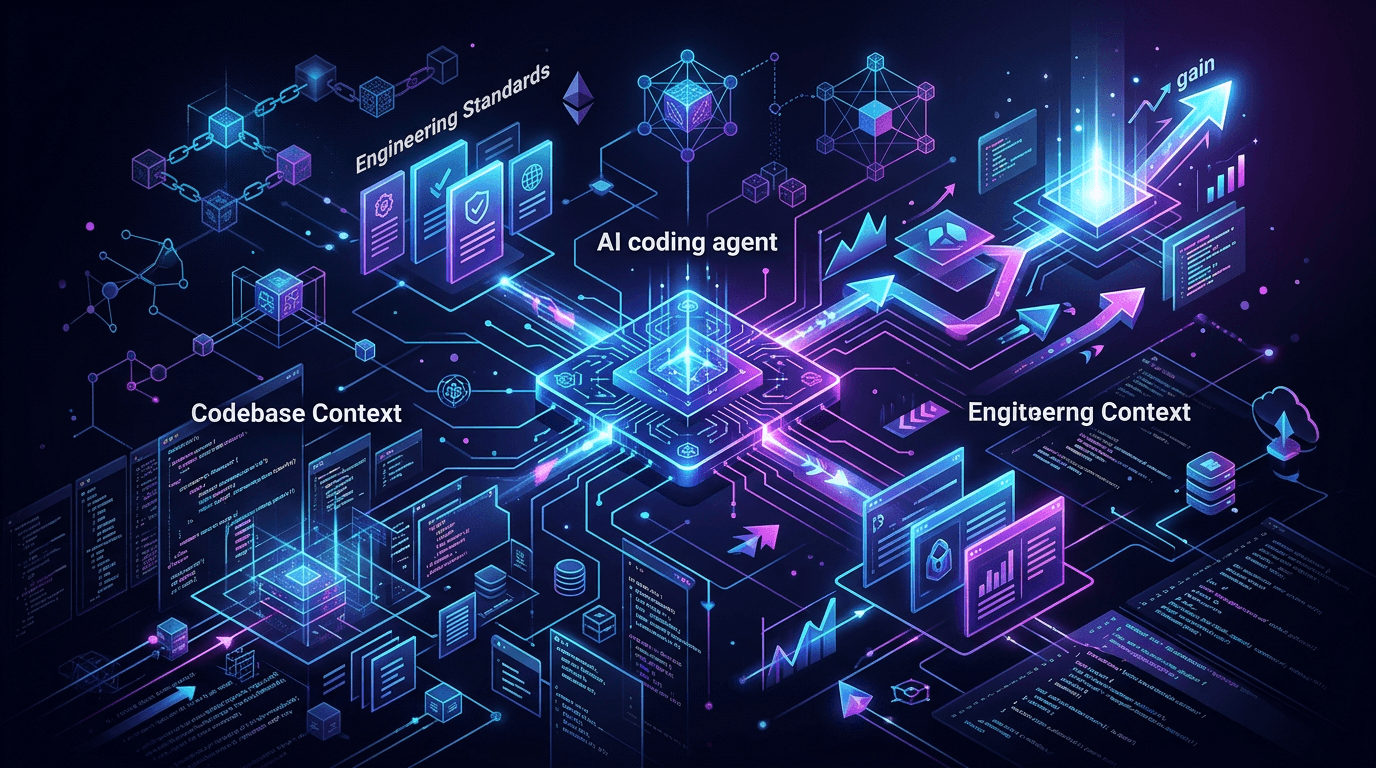
Generic AI coding agents generate generic code. Connecting them to your internal engineering standards and codebase context is what actually moves the needle for Web3 teams.
Subscribe to our newsletter to get the latest updates and offers
* Will send you weekly updates on new features, tips, and developer resources.
TL;DR:
- 42% of code written today is AI-assisted, a figure expected to climb to 65% within two years, yet 96% of developers say they do not fully trust AI-generated code
- The trust gap exists because most AI coding agents operate without knowledge of the codebase they are contributing to, producing syntactically valid but contextually wrong output
- Web3 codebases carry a complexity tax that generic agents cannot absorb: ABIs spanning thousands of lines, multi-contract inheritance chains, protocol-specific patterns, and irreversible deployment constraints
- Connecting AI agents to internal engineering standards reduces the rework cycle by eliminating the gap between what the agent generates and what the team actually ships
- The most significant productivity gains from AI-assisted development come from volume of completed work, not raw generation speed, and volume requires context to be sustainable
- Purpose-built tooling that indexes codebase architecture, remembers team conventions, and applies them at generation time is the difference between an AI assistant and an AI engineering partner
- Agents that understand your codebase can modify code across multiple files simultaneously, write tests that match existing coverage patterns, and generate documentation that reflects actual system behavior
The result: Connecting AI coding agents to codebase context and engineering standards is not a configuration detail, it is the foundational requirement for turning AI assistance into real, compounding productivity.
The Context Problem That Kills Productivity
There is a version of AI-assisted development that most Web3 teams have already experienced, and it goes roughly like this. A developer opens a chat interface, pastes a function signature or a partial contract, asks the model to complete it, and receives something that looks plausible. The code compiles. The logic seems reasonable. Then the developer spends the next forty minutes fixing naming conventions, removing patterns the team deprecated six months ago, adding the access control modifiers that every contract in the codebase uses, and rewriting the error handling to match the custom revert library the team built last year. The AI saved maybe ten minutes of typing and cost thirty minutes of cleanup.
This is not a failure of the underlying model. The model did exactly what it was designed to do: generate statistically likely code given the prompt. The failure is architectural. The agent had no knowledge of the codebase it was contributing to, no awareness of the team's conventions, and no access to the engineering standards that govern how code gets written and reviewed in that specific environment. It was generating in a vacuum, and vacuum-generated code requires human translation before it can be used.
The problem compounds as codebases grow. A team that has been building a DeFi protocol for eighteen months has accumulated hundreds of decisions: which OpenZeppelin contracts to extend and which to avoid, how reentrancy guards are applied, what the internal naming convention for storage variables looks like, how events are structured for the indexing layer, which Solidity version is pinned and why. None of that lives in a prompt. All of it lives in the codebase, and an agent that cannot read the codebase cannot respect it.
Why Generic AI Agents Fall Short in Web3
The gap between generic AI coding assistance and context-aware AI assistance is visible in any software domain, but it is particularly acute in Web3 development. The reason comes down to the specific constraints that blockchain environments impose on code. In traditional software, a bad suggestion from an AI agent is annoying. You revert it, you move on. In Web3, a bad suggestion that makes it past review and into a deployed contract can be permanent. The irreversibility of on-chain deployment means that every piece of generated code carries a higher burden of correctness than its equivalent in a web application or a backend service.
Beyond irreversibility, Web3 codebases have structural characteristics that generic agents struggle to navigate. A single DeFi protocol might involve a dozen interdependent contracts, each with its own inheritance chain, each interacting with the others through carefully defined interfaces. The ABI for a complex protocol can run to thousands of lines. The indexing layer, often built with tools like Ponder or The Graph, has its own schema and query patterns that need to stay synchronized with on-chain events. A developer working in this environment has internalized a mental model of how all these pieces fit together. A generic AI agent has none of that model, and without it, the suggestions it makes are often locally correct but globally wrong.
There is also the question of protocol-specific patterns. Teams building on top of Uniswap V4 hooks have developed conventions around how hook callbacks are structured, how fee logic is isolated, and how state is managed across the hook lifecycle. Teams building cross-chain applications with LayerZero or Wormhole have their own patterns for message encoding, fee estimation, and failure handling. These patterns are not in any training dataset. They exist in the codebase, in the internal documentation, and in the heads of the engineers who built them. An agent that cannot access those sources will consistently generate code that misses the mark, regardless of how capable the underlying model is.
What Codebase Context Actually Means for an AI Agent
When people talk about giving an AI agent codebase context, the phrase can mean several different things, and the distinction matters. At the most basic level, it means providing the agent with the contents of relevant files before asking it to generate code. This is better than nothing, but it is not what serious teams mean when they talk about context-aware AI assistance. Dumping files into a context window is not the same as the agent understanding the architecture of the system.
Real codebase context means the agent has indexed the repository in a way that lets it understand relationships between components, not just the contents of individual files. It means the agent knows that a particular storage contract is the canonical source of truth for a given data structure, and that any new contract touching that data should import from it rather than redeclare it. It means the agent knows that the team uses a specific pattern for upgradeable proxies, and that any new upgradeable contract should follow that pattern rather than inventing a new one. This kind of structural understanding requires more than file contents. It requires semantic indexing of the codebase, the kind of analysis that maps symbols to their definitions, tracks inheritance chains, and understands which patterns recur across the repository.
Thepractical implication of this is significant. An agent with genuine structural understanding of a codebase can answer questions like "where is fee calculation handled across this protocol" or "which contracts inherit from the base access control module" without being told explicitly. It can generate a new contract that slots into the existing architecture rather than sitting beside it awkwardly. It can identify that a proposed change to a shared interface will require updates in four other contracts and surface that dependency before the developer discovers it manually during testing.
This level of context awareness is what separates tools that feel like productivity multipliers from tools that feel like sophisticated autocomplete. The difference is not primarily about model capability. It is about how much of the relevant environment the agent can see and reason over when it is generating code. A smaller model with deep codebase context will consistently outperform a larger model operating blind, because the quality of output is bounded by the quality of the information the agent is working from.
Engineering Standards as Agent Instructions
Every engineering team that has been operating for more than a few months has accumulated a body of standards, whether or not those standards are written down anywhere. Some teams have formal style guides, contribution guidelines, and architecture decision records. Others have informal conventions that live in code review comments and Slack threads. In both cases, those standards represent a significant investment of collective judgment, and they exist because the team has learned, often through painful experience, what works and what does not in their specific context.
When an AI coding agent operates without access to those standards, it effectively ignores that investment. It generates code according to the patterns it learned during training, which are drawn from the broad distribution of public code rather than the specific conventions of the team. The result is code that requires a translation step before it can be merged, and that translation step is where a significant portion of the productivity gain from AI assistance gets lost. A developer who spends twenty minutes reviewing and correcting an AI-generated function to bring it into alignment with team standards has not saved much time compared to writing the function from scratch.
The more productive model is one where engineering standards are treated as first-class inputs to the agent, not as post-generation corrections. This means encoding standards in a form the agent can consume: explicit rules about naming conventions, documented patterns for common operations, examples of correctly structured contracts drawn from the existing codebase. When an agent has access to this material, it can apply the standards at generation time rather than requiring a human to apply them afterward. The review cycle becomes about logic and correctness rather than style and convention, which is a much better use of a senior engineer's attention.
There is also a compounding benefit here that is easy to underestimate. When an agent consistently generates code that matches team standards, junior developers on the team get a better signal about what good code looks like in that specific context. The agent becomes a passive teacher, reinforcing conventions through example rather than requiring explicit instruction. Over time, this can meaningfully reduce the variance in code quality across a team, particularly in fast-growing teams where onboarding is a constant challenge.
The Volume Argument: Why Speed Is the Wrong Metric
The conversation around AI coding productivity tends to default to speed as the primary metric. How much faster can a developer write a function with AI assistance? How many lines of code per hour does the tool enable? These are measurable numbers, and they make for compelling marketing, but they are not the right frame for understanding where AI assistance actually creates value at the team level.
The more meaningful metric is volume of completed work, and the distinction matters because volume is a function of sustained throughput, not peak generation speed. A developer who can generate code quickly but spends significant time correcting, reworking, and debugging that code is not necessarily completing more work than a developer who generates more slowly but produces output that is closer to shippable on the first pass. The productivity gain from AI assistance is real and substantial, but it accrues primarily through the ability to take on more tasks, handle more complexity, and maintain momentum across a larger surface area of work, not through raw typing speed.
This reframing has direct implications for how teams should think about context and standards. An agent that generates contextually correct code, code that fits the architecture, follows the conventions, and handles the edge cases the team has already thought through, enables a developer to move from one task to the next without the friction of a correction cycle. That frictionless handoff is where the volume gains come from. A developer who can complete eight well-formed tasks in a day rather than five partially-formed ones that each require rework is operating at a meaningfully higher level of output, and the difference is not the speed of generation but the quality of what gets generated.
The research supports this framing. Studies on AI-assisted development consistently find that the largest gains come not from individual task completion time but from the developer's ability to maintain flow across a longer working session. Context switching, rework, and debugging are the primary enemies of sustained productivity, and an agent that reduces those friction points by generating contextually appropriate code is addressing the right problem.
Multi-File Coherence and the Cross-Contract Problem
One of the most practically challenging aspects of Web3 development is that meaningful changes almost never touch a single file. Adding a new feature to a DeFi protocol might require changes to the core contract, updates to the interface it implements, modifications to the factory that deploys it, adjustments to the event definitions that the indexing layer depends on, and corresponding updates to the test suite. A developer who understands the full system can navigate these dependencies intuitively. An AI agent that can only see one file at a time will consistently miss them.
This is the cross-contract problem, and it is one of the clearest illustrations of why codebase context is not optional for Web3 teams. When an agent modifies a function signature in a core contract without understanding that three other contracts call that function through a shared interface, it creates a build failure that the developer has to diagnose and fix manually. When it adds a new event without knowing that the indexing schema needs a corresponding handler, it creates a silent gap in the data layer that might not surface until the application is running against a live network. These are not edge cases. They are the normal consequence of operating in a tightly coupled multi-contract system without a complete picture of the dependencies.
Agents that have indexed the full codebase can approach these changes differently. They can identify the call graph before making a change, surface the downstream dependencies, and either make the corresponding updates automatically or flag them explicitly for the developer to review. This kind of multi-file coherence is one of the capabilities that most clearly separates purpose-built development tools from general-purpose chat interfaces. The ability to modify code across multiple files simultaneously, while maintaining consistency with the existing architecture, is not a convenience feature. In a Web3 context, it is a correctness requirement.
The practical workflow implication is that teams should be skeptical of AI tooling that presents itself as a single-file assistant. The unit of work in Web3 development is rarely a single file. It is a feature, a fix, or a refactor that touches multiple components, and the agent needs to be able to reason about all of them together to be genuinely useful.
The Context Window Trap: More Is Not Always Better
There is a tempting but ultimately counterproductive approach to the context problem, which is to simply feed the agent as much of the codebase as possible and let the model sort it out. As context windows have grown, from 8,000 tokens to 128,000 tokens to 1 million tokens and beyond, this approach has become technically feasible for many codebases. But feasibility is not the same as effectiveness, and practitioners who have tried this approach in Web3 environments have found that it creates its own set of problems.
The core issue is that large context windows do not guarantee that the model will attend to the right parts of the context. A model given a million tokens of codebase content will not necessarily weight the most relevant files more heavily than the least relevant ones. In practice, models tend to perform better on tasks where the relevant context is focused and well-organized rather than exhaustive and undifferentiated. A Web3 developer working with a complex protocol noted this directly: ABIs that run to thousands of lines and database schemas that would consume half a context window are not useful context for most coding tasks. They are noise that competes with the signal.
The better approach is selective, structured context retrieval. Rather than dumping the entire codebase into the context window, a well-designed agent retrieves the specific files, symbols, and patterns that are relevant to the current task. This requires the agent to have a semantic index of the codebase that it can query intelligently, pulling in the inheritance chain for the contract being modified, the interface definitions it implements, the test patterns used for similar contracts, and the relevant sections of the engineering standards. The result is a focused context that gives the model what it needs without overwhelming it with what it does not.
This distinction between exhaustive context and relevant context is one of the more nuanced aspects of building effective AI coding workflows, and it is an area where purpose-built tooling has a significant advantage over general-purpose approaches. Getting the context retrieval right requires understanding the structure of the codebase, the nature of the task, and the specific information needs of the model, which is exactly the kind of domain-specific intelligence that a tool built for Web3 development can provide.
How Agents Learn Team Conventions Over Time
One of the more underappreciated aspects of context-aware AI assistance is the potential for the agent's understanding of team conventions to improve over time. In the simplest implementation, an agent is given a static set of standards and applies them consistently. This is already valuable. But a more sophisticated approach treats the codebase itself as a living record of team decisions, one that the agent can learn from continuously as new code is written and merged.
Every pull request that gets approved represents a judgment by the team that the code meets their standards. Every review comment that requests a change represents a signal that something in the generated or written code did not match expectations. An agent that can observe these signals and update its model of team conventions accordingly becomes progressively more aligned with the team's actual practices, not just the practices that were documented at a point in time. This is particularly valuable in fast-moving Web3 teams where conventions evolve as the protocol matures and new patterns emerge.
The practical mechanism for this kind of learning varies by tool, but the general principle is that the agent's context should include recent, approved code from the repository, not just the formal documentation of standards. Recent code is the most accurate representation of what the team currently considers correct, because it reflects decisions made in the context of the current architecture, the current tooling, and the current understanding of the problem domain. An agent that weights recent, approved code heavily in its context retrieval will naturally drift toward the team's current conventions rather than anchoring on older patterns that may have been superseded.
Security Implications of Context-Aware Generation
The security dimension of context-aware AI assistance deserves specific attention in a Web3 context, because the stakes of getting it wrong are higher than in most other software domains. Research has found that developers using AI code generation are measurably more likely to introduce security vulnerabilities, with some studies finding that AI models chose insecure coding patterns in nearly half of tested cases. The root cause in most of these cases is not that the model is incapable of generating secure code. It is that the model does not know what secure code looks like in the specific context of the codebase it is contributing to.
A generic AI agent generating Solidity code will apply generic security patterns: it might add a reentrancy guard, check for integer overflow, validate input lengths. These are correct in the abstract. But a team that has built a custom access control system, a specific pattern for handling cross-contract calls, or a particular approach to managing privileged roles has security requirements that go beyond the generic patterns. An agent that does not know about the custom access control system might generate a function that bypasses it entirely, not because it is trying to introduce a vulnerability, but because it does not know the system exists.
Context-aware generation addresses this by ensuring that the agent's security knowledge is grounded in the specific security architecture of the codebase. When the agent knows that every external function in the protocol requires a specific modifier, it will apply that modifier consistently. When it knows that the team has a convention for validating oracle inputs before using them in calculations, it will follow that convention. The security benefit of this consistency is not just about catching individual vulnerabilities. It is about maintaining the integrity of the security model across the entire codebase, which is what actually protects a protocol in production.
Measuring Real Productivity Gains in Practice
Teams that have moved from generic AI assistance to context-aware AI assistance consistently report that the most significant change is not in how fast they write code but in how much of what they write actually ships without rework. The correction cycle, the time spent bringing AI-generated code into alignment with team standards and architecture, is where most of the productivity loss from generic AI assistance occurs, and eliminating it has a compounding effect on team throughput.
Concrete measurements vary by team and context, but the pattern is consistent. Teams report that context-aware agents reduce the number of review cycles required before code is mergeable, reduce the frequency of architecture-level feedback in code review, and reduce the time junior developers spend figuring out how to apply team conventions to new code. These are not dramatic single-task speedups. They are incremental improvements across every task the team undertakes, and they add up to a meaningful increase in the volume of work the team can complete in a given period.
There is also a less quantifiable but equally real benefit in developer experience. Working with an agent that understands your codebase and respects your conventions feels qualitatively different from working with one that does not. The cognitive load of translating between what the agent generates and what the codebase needs is a real source of friction, and removing it allows developers to stay in flow for longer periods. In a domain as demanding as Web3 development, where the complexity of the systems being built is high and the cost of mistakes is significant, sustained focus is not a luxury. It is a prerequisite for doing the work well.
Building the Right Foundation with Cheetah AI
The shift from generic AI assistance to context-aware AI assistance is not a product decision that teams can defer indefinitely. As AI-assisted development becomes the norm rather than the exception, the teams that invest in grounding their agents in codebase context and engineering standards will compound their productivity advantage over time, while teams relying on generic tools will continue to absorb the correction overhead that erodes the gains.
Cheetah AI is built around this premise. As the first crypto-native AI IDE, it is designed specifically for the constraints and conventions of Web3 development, with context retrieval that understands multi-contract architectures, indexing that tracks cross-contract dependencies, and standards integration that lets teams encode their conventions as first-class inputs to the agent. The goal is not to replace the developer's judgment but to give the agent enough of the right context that its suggestions are worth acting on rather than correcting.
If your team is spending meaningful time translating AI-generated code into code that actually fits your codebase, that is a solvable problem. The solution is not a better model. It is a better-informed agent. Cheetah AI is where that work happens.
Getting started with that connection does not require a complete overhaul of how your team works. It starts with treating your codebase as a knowledge asset that your tooling should be able to read and reason over, not just a directory of files that a developer navigates manually. It means writing down the conventions that currently live only in code review comments and making them available to the agent in a structured form. It means choosing tooling that was designed for the environment you are actually working in, rather than adapting general-purpose tools to a domain they were not built for.

Web3 development is hard enough without fighting your tools. The protocols are complex, the security requirements are unforgiving, and the pace of change in the ecosystem means that teams are constantly navigating new patterns and new constraints. An AI coding agent that understands your codebase, respects your standards, and generates code that fits your architecture is not a nice-to-have in that environment. It is the foundation that makes everything else sustainable. Cheetah AI is built to be that foundation.
Related Posts

Cheetah Architecture: Building Intelligent Code Search
Building Intelligent Code Search: A Hybrid Approach to Speed and Relevance TL;DR: We built a hybrid code search system that:Runs initial text search locally for instant response

Reasoning Agents: Rewriting Smart Contract Development
TL;DR:Codex CLI operates as a multi-surface coding agent with OS-level sandboxing, 1M context windows via GPT-5.4, and the ability to read, patch, and execute against live codebases, making

The New Bottleneck: AI Shifts Code Review
TL;DR:AI coding assistants now account for roughly 42% of all committed code, a figure projected to reach 65% by 2027, yet teams using these tools are delivering software slower and less rel